Whole Life Policy Reinstatement: What It Usually Takes, What Can Change, and When Another Option Fits Better
If your premium was missed, the carrier says the policy has lapsed, and you are now hearing the word reinstatement, it is easy to feel like there must be one obvious next move: send the money, restore the contract, and get back to normal.
Sometimes that is the right answer.
Sometimes it is not.
That is why whole life policy reinstatement deserves a calmer review than it usually gets. The key questions are not only "Can I reinstate?" They are also "Has the policy truly lapsed yet?", "What exactly will the carrier require?", and "Is reinstatement really better than reduced paid-up, extended term, or a fresh policy quote for what I need now?"
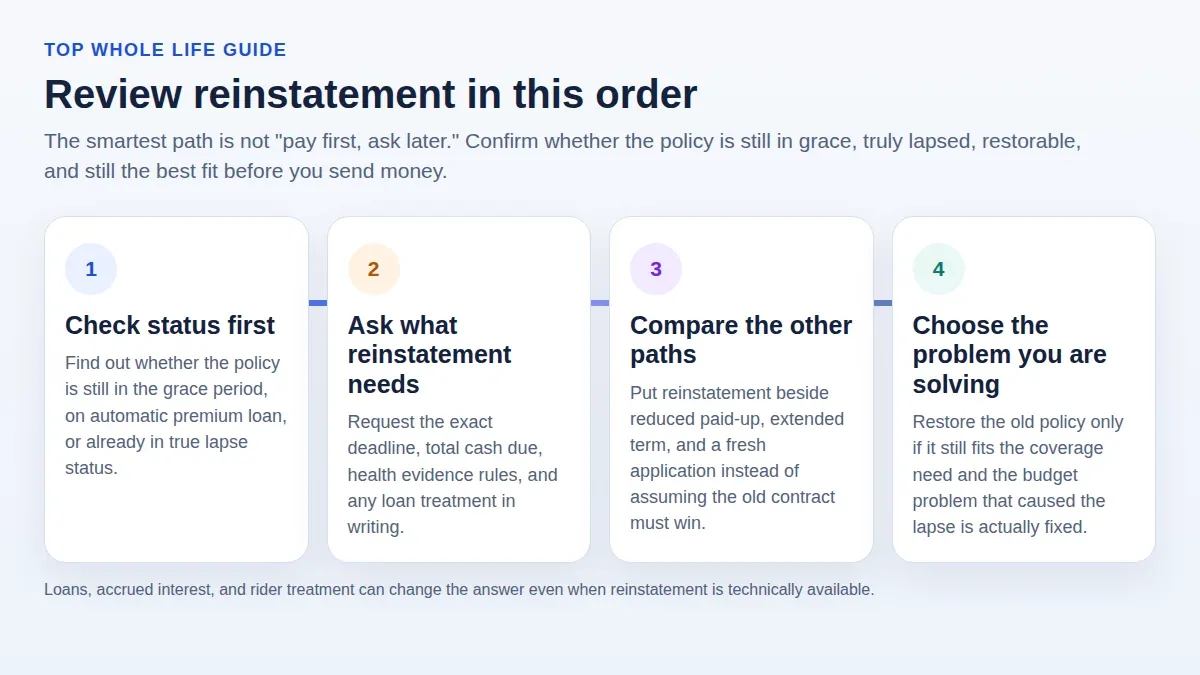
The North Carolina Department of Insurance, the New York Department of Financial Services life insurance FAQ, and the Virginia life insurance guide together give a useful framework: confirm whether the policy is still inside the grace period or already in lapse status, learn the exact reinstatement requirements, and compare that path against the nonforfeiture options or a brand-new application before you send money blindly.
This article is general education only. Policy terms, reinstatement windows, underwriting requirements, and loan handling vary by contract. Confirm the exact terms with your insurer before you act.
Why reinstatement matters after a whole life lapse
Many policyowners assume a missed premium means the policy dies immediately. That is usually not how whole life works.
The North Carolina Department of Insurance says life insurance policies provide a minimum 31-day grace period after the due date, and the policy remains in force during that period. If the premium is still not paid before the grace period expires, the policy lapses.
That distinction matters because the best answer can look very different depending on where you actually are in the timeline:
- still inside the grace period
- being carried by an automatic premium loan
- formally lapsed but still inside a reinstatement window
- already pushed into a nonforfeiture option
Those are not interchangeable situations, even if they all started with the same missed payment.
The Virginia guide is especially helpful here because it reminds readers that a cash value policy does not always fall into a simple "active or dead" bucket. It says cash value policies can carry nonforfeiture benefits that are not lost if the policy lapses or is surrendered, including reduced paid-up insurance, extended term insurance, loan value, and cash surrender value.
That means the real post-lapse question is often broader than "Can I bring the old policy back?" It can also be:
- Should I restore the original contract?
- Should I preserve some coverage without restoring the full premium obligation?
- Has my coverage need changed enough that a different path makes more sense?
The smartest reinstatement decision starts with status. A policy in grace, on automatic premium loan, or already in a nonforfeiture option may require very different next steps.
Reinstatement matters because it can protect a contract you may still want. But it only helps if you first verify what condition the policy is actually in.
What whole life reinstatement usually requires
The single biggest mistake policyowners make here is assuming reinstatement means "pay what I missed and everything goes back exactly as before."
Sometimes the process is close to that. Often it is not.
The Virginia guide says most policies provide for reinstatement within three years from lapse, and that reinstatement usually requires paying missed premiums with interest and furnishing evidence of insurability.
The New York Department of Financial Services adds another layer. It says reinstating a scheduled-premium policy after default generally requires:
- a reinstatement application
- evidence of good health
- payment of overdue premiums with interest
- repayment or reinstatement of outstanding policy loans at the applicable policy-loan interest rate
That list is why the right way to think about reinstatement is not "late payment." It is closer to "carrier review to restore a contract after default."
In practical terms, readers usually need straight answers to these questions before they do anything else:
-
What is the policy's exact current status?
Grace period, automatic premium loan, reduced paid-up, extended term, or true lapse are not the same thing. -
What is the exact reinstatement deadline?
"Within three years" is broad guidance, not your contract language. -
What cash amount is due now?
Ask for overdue premiums, interest, and any loan-related requirement in writing. -
Will underwriting or health evidence be required?
If yes, do not assume approval just because the policy once existed. -
If reinstated, does the policy return with the same riders and settings?
Ask, do not infer.
A reinstatement request becomes much less intimidating when the carrier gives those answers in a documentable form instead of a vague phone promise.
When reinstatement can beat reduced paid-up, extended term, or starting fresh
Reinstatement usually has its strongest case when you still want the original policy design and restoring it is still practical.
That can mean:
- your health has changed and a fresh new application may be weaker
- you still want permanent coverage, not just temporary protection
- the original contract still fits your long-term goal
- the catch-up amount is painful but manageable
In that kind of case, restoring the policy may be cleaner than replacing it.
But whole life lapse recovery is not a one-answer conversation, because the alternatives solve different problems.
The Virginia guide says reduced paid-up insurance uses the policy's cash value to buy paid-up life insurance of the same plan as the original policy, but for less than the original face amount and with the same duration. It also says participating policies may still allow future cash value and dividends.
That can make reduced paid-up attractive when the real problem is ongoing affordability, not lack of interest in permanent coverage.
The same Virginia guidance says extended term uses available cash value to purchase term insurance for the same face amount as the original policy, but only for a shorter time than the original policy, and that most arrangements stop policy loans, dividends, and riders.
That can make extended term more attractive when the remaining need is still real, but it is mostly temporary rather than permanent.
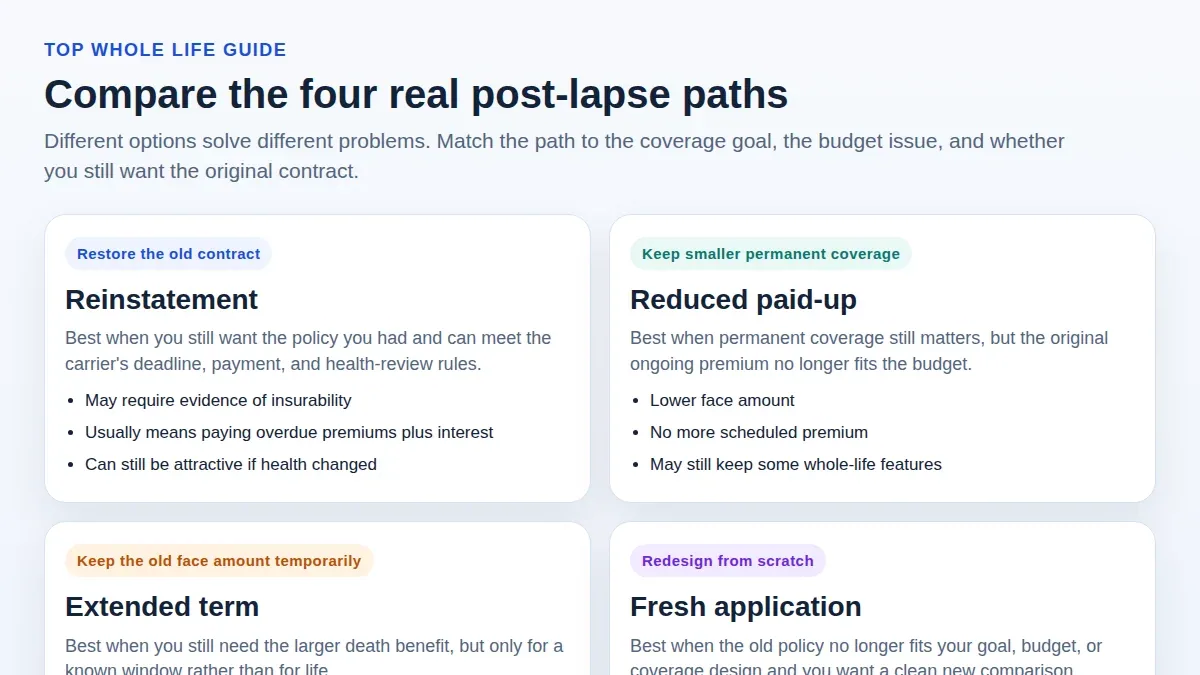 Reinstatement is only one path after trouble. The right answer depends on whether you want the old contract back, lower permanent coverage, temporary protection, or a completely new design.
A fresh application can also be the cleaner answer when the old contract no longer matches what you are trying to solve. If your budget, face amount, policy purpose, or carrier preference changed materially, the best solution may not be restoring an older design at all.
That does not mean a new policy is automatically better. It means you should compare it honestly. If you want to see what a new permanent design looks like before committing either way, start with a single whole life quote and compare that result against the reinstatement path instead of assuming the old policy must win by default.
How loans, automatic premium loans, and policy value change the decision
This is where many reinstatement calls get messier than expected.
First, verify whether the policy really lapsed or whether an automatic premium loan stepped in first. The New York DFS optional-riders page says that at the end of the grace period, if the premium due has not been paid, an automatic premium loan can be made from policy cash value to pay the premium, but only if the cash surrender value at least equals the loan amount plus a year of interest.
That means a missed premium does not always create an immediate reinstatement problem. Sometimes it creates a loan-growth problem instead.
If that happened, your first move is not guessing. It is reviewing the current loan balance, the current available value, and whether the policy is still being supported safely. Top Whole Life's automatic premium loan guide and whole life policy loan repayment guide are useful follow-ups when that is the real issue.
Second, outstanding policy debt can change what reinstatement requires. The New York DFS life insurance FAQ says reinstating a scheduled-premium policy after default may require repayment or reinstatement of outstanding policy loans at the applicable interest rate. So if the policy already had meaningful debt, reinstatement is not just about catching up missed premiums.
Third, loan-heavy policies can move toward lapse in their own way. The same New York DFS FAQ says that if outstanding loans plus interest exceed the policy loan value, the insurer must provide at least 30 days notice before terminating the policy, giving the owner time to cure the problem.
That makes one practical rule especially important: if loans or automatic premium loans are part of the story, do not make a reinstatement decision from memory or from an old annual statement. Ask for current numbers. If the situation is complicated, ask for a current in-force illustration before you assume the policy can simply be restored to a healthy long-term path.
Questions to ask before you send money
When people feel urgency, they often rush to the payment question first. A better sequence is to force the carrier or advisor to answer the structural questions first.
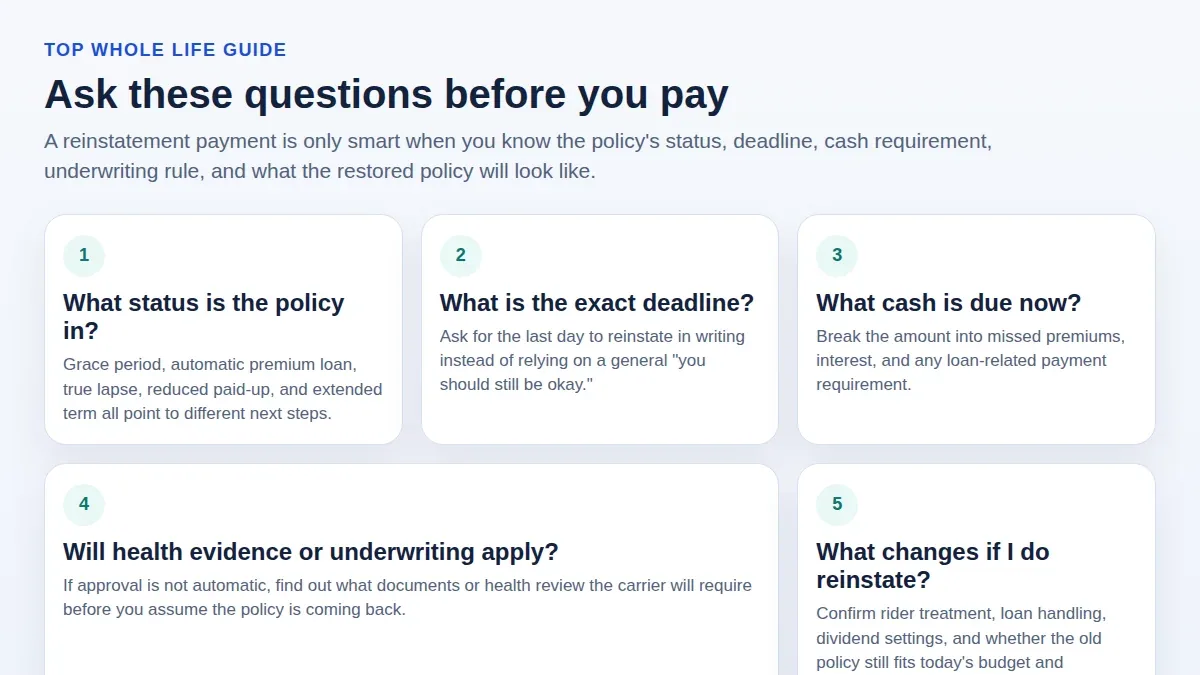 A reinstatement payment is only as smart as the answers that come before it. Status, deadline, loan treatment, and underwriting matter more than speed alone.
Use a checklist like this:
-
Is the policy still in grace, being carried by automatic premium loan, already reduced paid-up, on extended term, or fully lapsed?
You need the exact status before anything else. -
What is the exact deadline to reinstate under this contract?
Ask for the date in writing. -
What total amount is due right now?
Break it into missed premiums, interest, and any loan-related amount. -
Will I need evidence of insurability or any underwriting review?
If yes, ask what happens if the request is not approved. -
If reinstated, what happens to riders, dividend elections, and existing policy debt?
Get the post-reinstatement mechanics explained, not just the payment instructions. -
If I do not reinstate, what nonforfeiture options or other paths are available now?
This is where the reduced paid-up vs extended term guide becomes useful. -
Do my current needs still justify restoring the old contract?
The right answer depends on today's budget and coverage goal, not only yesterday's policy.
Those questions do not slow progress. They keep you from paying for a result you did not actually compare.
When another option may be cleaner than reinstatement
Reinstatement is often a strong solution. It is not a mandatory one.
Another option may be cleaner when:
- you no longer need the original face amount
- the premium pressure that caused the lapse still is not solved
- the policy has enough value to support a reduced paid-up outcome that better fits your budget
- the need has become temporary enough that extended term deserves a look
- the old policy design no longer matches your long-term goal and a fresh policy quote would be easier to live with
The real win is not "reinstated at all costs." The real win is solving the reason the policy got into trouble without walking blindly into the next problem.
If the only reason to reinstate is emotional attachment to the old contract, slow down. If the policy still fits and you can support it, reinstatement may be the cleanest recovery path. If the deeper problem is affordability, temporary coverage need, or a design mismatch, another option may produce a better long-term result with less strain.
Start by confirming policy status, current values, loan treatment, and reinstatement requirements with the insurer. Then compare those numbers against what you actually need the coverage to do now. If you still want permanent coverage but need a fresh benchmark, a single whole life quote is the simplest way to compare the old contract with a new one before you commit.
This article is general education only. Confirm contract language, reinstatement deadlines, loan treatment, and any tax or underwriting implications with your insurer and your own advisors before acting.