Reduced Paid-Up vs Extended Term Whole Life: Which Nonforfeiture Option Fits Your Goal?
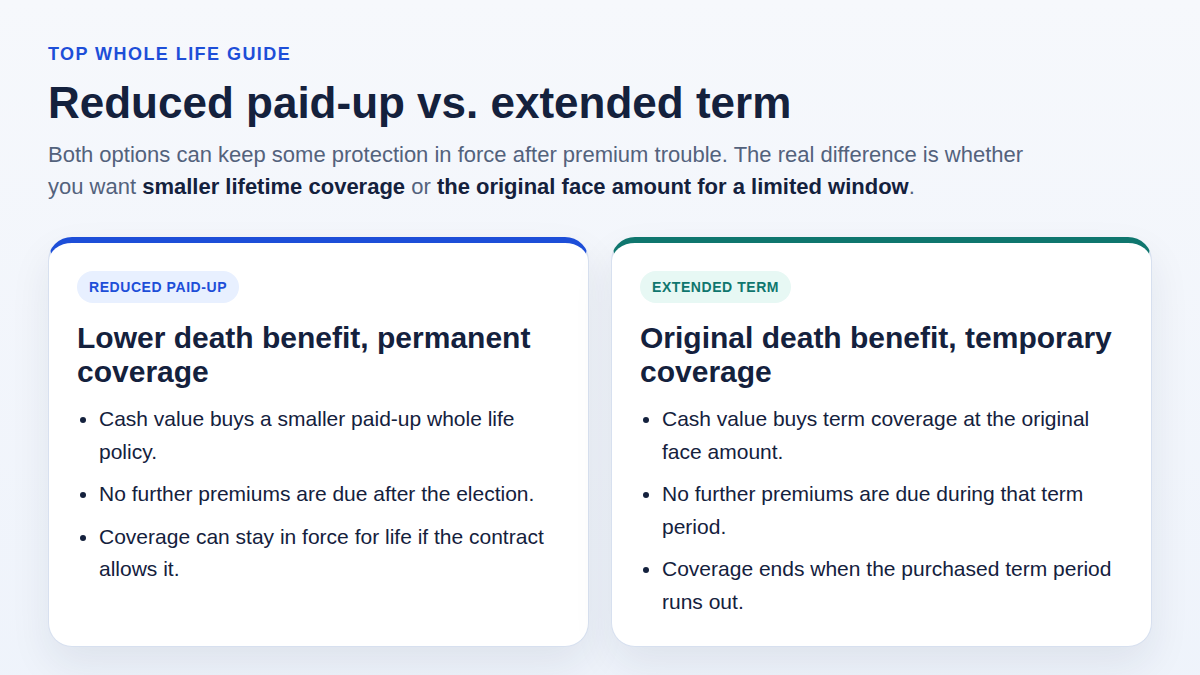
The cleanest way to think about the choice is this: reduced paid-up keeps a smaller permanent policy, while extended term tries to preserve the original face amount for a limited time.
The reduced paid-up vs extended term whole life question usually comes up at exactly the wrong moment: right when a policyowner is under pressure to cut premiums, stop a lapse, or decide whether the old contract is still worth keeping.
That pressure makes it easy to frame the decision too simply. Many people ask, "Should I just cancel the policy?" A better question is, "What am I still trying to preserve?"
That matters because most cash value policies have nonforfeiture benefits. The Virginia life insurance guide explains that these are benefits you do not lose if the policy lapses or is surrendered. For whole life owners, the practical choices often narrow down to:
- take the cash surrender value
- continue coverage as reduced paid-up insurance
- continue coverage as extended term insurance
Top Whole Life already points readers toward those broader choices in its guides on canceling a whole life policy and reducing a whole life policy. What those articles do not fully spell out is the tradeoff between the two coverage-preserving paths.
This guide is built for that decision. It is general education, not personal legal or tax advice, and your own contract still controls. But if you want a practical way to compare the options before signing a reduction sheet or letting the grace period run out, this is the framework to use.
Why nonforfeiture choices matter before you miss another premium
The worst time to learn how nonforfeiture works is after your policy has already drifted into a lapse problem.
The same Virginia guide explains that most policies have a grace period after a missed premium. It also explains that if a cash value policy lapses, the policyowner may have a limited window to choose among the available nonforfeiture options before the insurer's automatic default takes over. In that guide, the example language says the owner usually has about 60 days from lapse before the insurer's automatic option goes into effect.
That detail matters more than people expect.
If you wait too long, you may not be choosing from a calm, informed position. You may be reacting to the default already written into the contract. That is why Top Whole Life is right to urge policyowners to call the company, review the available options, and understand the cash value before making a move.
The other reason this decision matters is that nonforfeiture is not only about keeping "some" insurance. It is about deciding which part of the policy still matters most:
- lifelong coverage
- the highest available death benefit right now
- future cash value access
- rider benefits
- reinstatement flexibility
If you are not clear on that priority, the decision can feel technical when it is really strategic.
How reduced paid-up works
Under the Virginia guide, the reduced paid-up option uses the policy's cash value to buy paid-up life insurance of the same plan as the original contract. The catch is that the amount of insurance is lower than the original face amount.
That means reduced paid-up generally gives you three things:
- No further premium obligation
- Permanent coverage instead of temporary coverage
- A lower death benefit than you started with
That is why reduced paid-up often appeals to people who still want whole life to stay in force but can no longer justify the old premium.
Top Whole Life describes it in plain language on its cancellation page: the death benefit goes down, you stop paying premiums, and the policy remains in force. That is the core value proposition.
There is also an important nuance that many thin explainers miss. The Virginia guide says reduced paid-up coverage may still let the owner:
- surrender later for any cash value that accrues
- receive dividends if the original policy was participating
So reduced paid-up is not just "smaller coverage." It is often a smaller permanent policy that still keeps some of the whole life structure alive.
That does not mean everything survives unchanged.
The same guide says riders generally are not continued under reduced paid-up. If your policy includes waiver of premium, a term blend, or another rider you care about, that has to be part of the decision. You also should not assume you can restore the old death benefit later without friction. Top Whole Life warns that if you reduce coverage, increasing it again often means going back through underwriting.
Reduced paid-up tends to be strongest when the owner still values permanent insurance more than maximum face amount.
How extended term works
Extended term solves a different problem.
According to the Virginia guide, the extended term option uses available cash value to purchase term insurance for the same face amount as the original policy. The benefit is obvious: instead of shrinking the death benefit immediately, the contract tries to preserve the original face amount.
But that preservation comes with a time limit.
The same source says extended term stays in force for a shorter length of time than the original permanent policy. Once that purchased term period runs out, the coverage ends.
This is the key contrast that confuses many policyowners:
- reduced paid-up usually shrinks the death benefit but keeps the policy permanent
- extended term usually preserves the face amount but makes the coverage temporary
That temporary nature is not a small footnote. It is the entire point.
The Virginia guide makes another important point here too: most policies specify that when extended term is chosen, the owner cannot take policy loans or service dividends on the policy. It also says riders generally are not continued.
So extended term is usually not the option you choose because you want to keep using the policy like whole life. It is the option you choose because, for a limited period, the face amount still matters more than the whole life features.
That lines up with the broader principle in the Virginia guide that temporary needs are usually a better fit for term insurance, while permanent needs are a better fit for permanent insurance.
The tradeoffs: death benefit, duration, cash value, riders, and loans
The cleanest way to compare these options is to stop asking which one is "better" in the abstract.
Ask which one preserves the thing you still care about most.
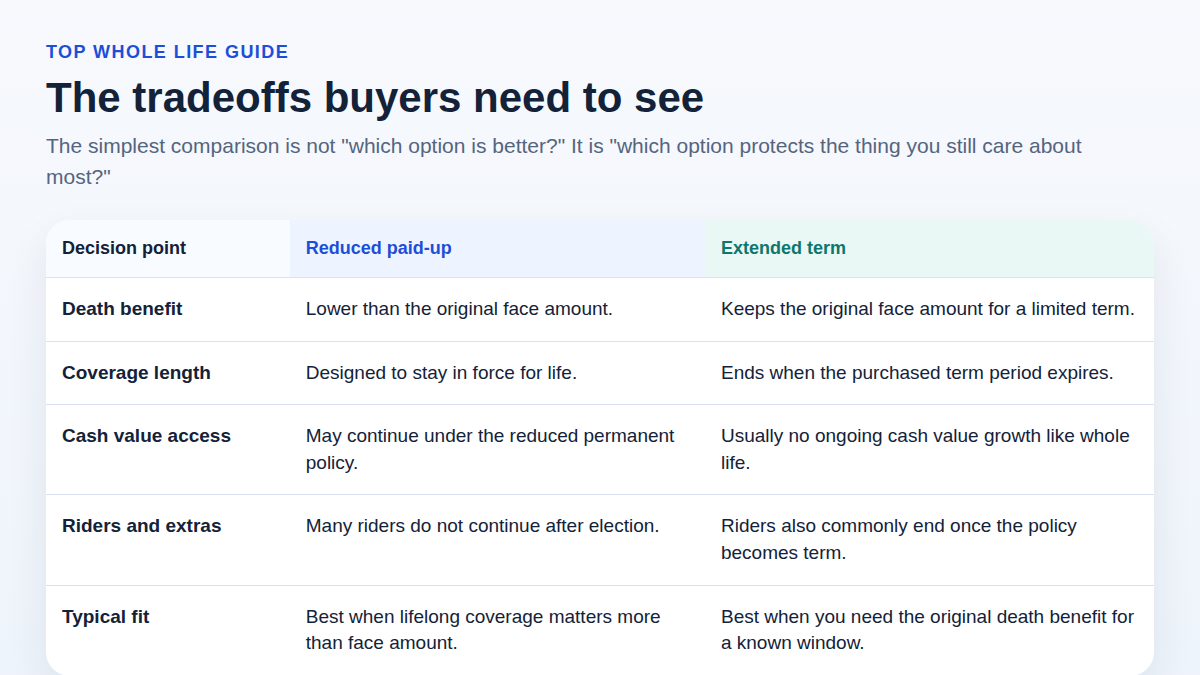 The right answer changes depending on whether you are protecting a lifelong coverage need or a shorter window when the original face amount still matters.
Here is the practical side-by-side view:
| Decision point | Reduced paid-up | Extended term |
|---|---|---|
| Death benefit | Lower than the original policy | Same face amount as the original policy |
| Coverage duration | Permanent, if the contract allows it to remain in force for life | Temporary and limited by the term purchased with cash value |
| Future premiums | No more premiums | No more premiums during the purchased term |
| Cash value / policy features | May retain some ongoing whole life characteristics | Usually stops functioning like a whole life policy |
| Loans / dividends | May still allow future cash value access and dividends on participating policies | Most policies limit loans and dividend servicing once extended term begins |
| Riders | Often lost | Often lost |
There is one more tradeoff worth calling out.
The Indiana buyer's guide reminds readers that whole life cash values can either be taken in cash or used to buy continuing insurance protection. It also notes that any unpaid policy loan reduces what is left in benefits or cash value. That means existing loan activity can affect how attractive each option looks in real life.
In other words, your decision is not only about the headline feature. It is also about what is left under the hood once loans, riders, and contract values are taken into account.
When reduced paid-up tends to fit better
Reduced paid-up is often the better fit when the owner still has a permanent need for coverage but can no longer justify the original premium.
That can describe someone who:
- still wants a guaranteed death benefit to last for life
- would rather keep some participating whole life structure than move to term
- is comfortable giving up part of the face amount
- does not need the old rider package to stay intact
This is where Top Whole Life's cancellation article is useful. It makes the practical case that outright cancellation is not the only alternative when premiums become painful. Sometimes the smarter move is not to abandon the contract but to reshape it.
Reduced paid-up can also make more sense when the owner's planning horizon is long. If you still care about having coverage at age 80 or 90, a shorter temporary term window may not solve the real problem.
The tradeoff, of course, is emotional as much as financial. Many people struggle with seeing the death benefit drop. But if the realistic alternative is lapse or surrender, a smaller permanent policy may still be the better outcome.
When extended term can fit better
Extended term tends to fit better when the owner still needs the original face amount for a known period, but no longer needs the policy to behave like long-term whole life.
That can describe someone who is still trying to protect:
- a mortgage that will be gone in a certain number of years
- children who will become financially independent on a known timeline
- a business or debt obligation that is temporary, not lifelong
This is where the state-guide distinction between temporary and permanent needs becomes useful. If the need you are protecting is temporary, it can be rational to preserve the highest death benefit you can for that shorter window rather than keeping a smaller permanent amount forever.
Top Whole Life's reduction article also points in this direction when it says some whole life policies let owners use cash value to purchase term coverage so they no longer have to keep paying premiums.
Still, this is the option where false comfort is most dangerous.
If you choose extended term without noticing when that term ends, you can feel "covered" right up until the day you are not. That is why this path works best when the owner has a clear reason for preferring the full face amount now and a realistic understanding that the coverage will not last forever.
Questions to ask before you elect any option
Before you elect reduced paid-up, extended term, or even outright surrender, you want a carrier-specific answer to a short list of questions.
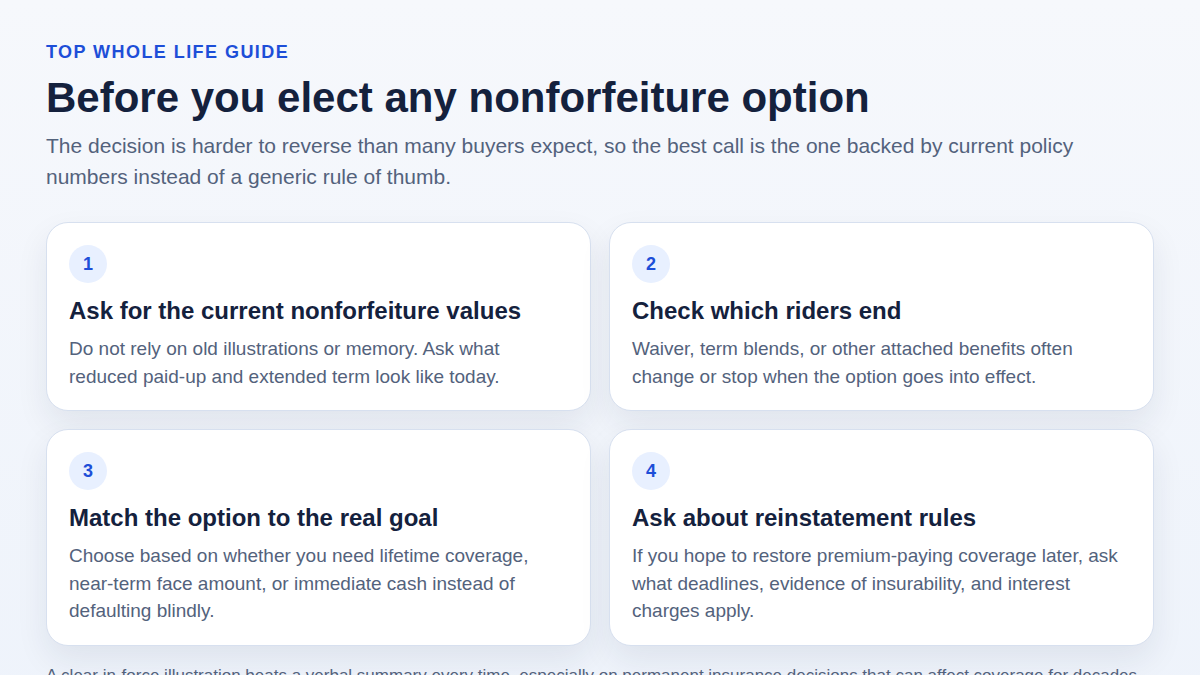 A good decision call should end with exact current values, rider treatment, and reinstatement rules—not with a vague promise that the carrier will “take care of it.”
Start here:
-
What are the current nonforfeiture values today?
Ask for the exact reduced paid-up death benefit and the exact extended term duration using the current in-force values. -
What happens to riders?
Do not assume waiver, term riders, or other attached benefits will stay intact. -
What happens to dividends, loans, and future cash value access?
The Virginia guide says these rights can differ significantly between reduced paid-up and extended term. -
If I do nothing, what automatic option applies?
You do not want the contract deciding for you by default if that default does not fit your goal. -
What would reinstatement require if I change my mind?
The Virginia guide says reinstatement usually means missed premiums, interest, and evidence of insurability. That is not something to discover after the fact. Top Whole Life's whole life policy reinstatement guide is the right next read if that is the recovery path you are weighing. -
Do you need me to sign a reduction sheet or other form?
Top Whole Life notes that many carriers use a reduction sheet and that processing can take time.
If you are still not sure which direction fits, this is usually the right moment to request a fresh policy review through Top Whole Life's single whole life quote process or to use its broader whole life insurance FAQ page as a starting point for the next questions.
The short version is simple:
- choose reduced paid-up when you still want permanent coverage and can accept a lower face amount
- choose extended term when you still need the original face amount for a shorter, temporary window
- choose neither blindly, because the wrong default can solve the wrong problem
Nonforfeiture options can preserve real value, but only if the option matches the reason you bought coverage in the first place. Confirm the details on your own policy illustration and with the carrier before you elect a permanent change.