Automatic Premium Loan Whole Life Insurance: What It Does, When It Starts, and When to Turn It Off
Automatic premium loan can keep a policy in force after a missed premium, but it does that by creating debt inside the contract, not by making the premium disappear.
If you are looking for automatic premium loan whole life insurance guidance, you will eventually run into a policy-management term that sounds more helpful than it really is: automatic premium loan, often shortened to APL.
At first glance, it can sound like a convenience setting you barely need to think about. Miss a premium, the policy handles it, and you move on. But that is only half the story.
In reality, automatic premium loan whole life insurance settings matter because they change how a policy survives a missed payment. Instead of the premium being waived, reduced, or forgiven, the insurer uses policy value to make a loan against your contract. That can be useful. It can also become a problem if you forget that the policy is now carrying debt and interest.
This guide is here to make that tradeoff easier to understand. It is general education, not personal tax or legal advice, and your own policy contract always controls. Still, if you want the plain-English version of what APL does, when it starts, and when it deserves a closer review, this is the framework to use.
Why automatic premium loan catches whole life owners off guard
APL catches people off guard because permanent life insurance already feels complicated before anything goes wrong.
Most policyowners are tracking the obvious items:
- the premium due date
- the death benefit
- the cash value
- maybe the dividend notice
What they often are not tracking is the exact backup mechanism that applies after a missed payment.
The North Carolina Department of Insurance notes that life insurance policies generally provide a minimum 31-day grace period after the due date. During that period, the policy remains in force. The Wisconsin Office of the Commissioner of Insurance glossary uses the same usual 31-day framing when it defines both the grace period and automatic premium loan.
That sounds simple enough until real life gets involved.
Maybe the missed premium is accidental. Maybe it is a short-term cash crunch. Maybe you changed bank accounts, forgot to update autopay, or assumed dividends were already offsetting more of the bill than they actually were. Whatever the reason, the policy reaches the end of the grace period and something has to happen next.
That "next" step is what matters.
If APL is not in place, the contract may lapse or move toward a nonforfeiture option depending on the policy and the available value. If APL is in place and the policy has enough loan value, the insurer can use policy value to advance the overdue premium as a loan. That is useful when the goal is preventing an accidental lapse. It is less useful when the owner has no idea it happened.
That is the central problem: APL can solve a short-term lapse risk while quietly creating a longer-term loan-management problem.
What automatic premium loan actually does
The clearest regulator wording comes from the New York Department of Financial Services optional riders page. It explains that if a premium due has not been paid by the end of the grace period, a policy loan can automatically be made from the policy's cash value to pay that premium.
That means APL is not:
- a waiver of premium
- a dividend election
- a premium discount
- proof that the policy has become "self-paying"
It is simply a loan mechanism built to keep the contract in force when an overdue premium would otherwise create a lapse problem.
The North Carolina DOI says this prevents the policy from lapsing provided the available loan value is sufficient to pay the premium. The New York DFS goes a step further and says the available cash surrender value must at least equal the loan amount plus a year of interest. In other words, APL only works if the policy still has enough room to support the advance.
That is why policyowners should stop thinking of APL as a magic button.
It is more accurate to think of it as a last-resort bridge:
- you miss a premium
- the grace period runs
- the insurer uses policy value to cover the bill
- the policy stays active
- the policy now carries more debt than it did before
If you remember step 5, APL can be helpful. If you forget step 5, it can create a false sense of safety.
When APL starts: grace period, cash value, and election rules
Timing matters here because people often assume APL starts the day a premium is missed. That is usually not how it works.
 APL is most helpful when it is used rarely and watched closely. It gets dangerous when a policyowner treats it like free premium relief instead of a growing loan balance.
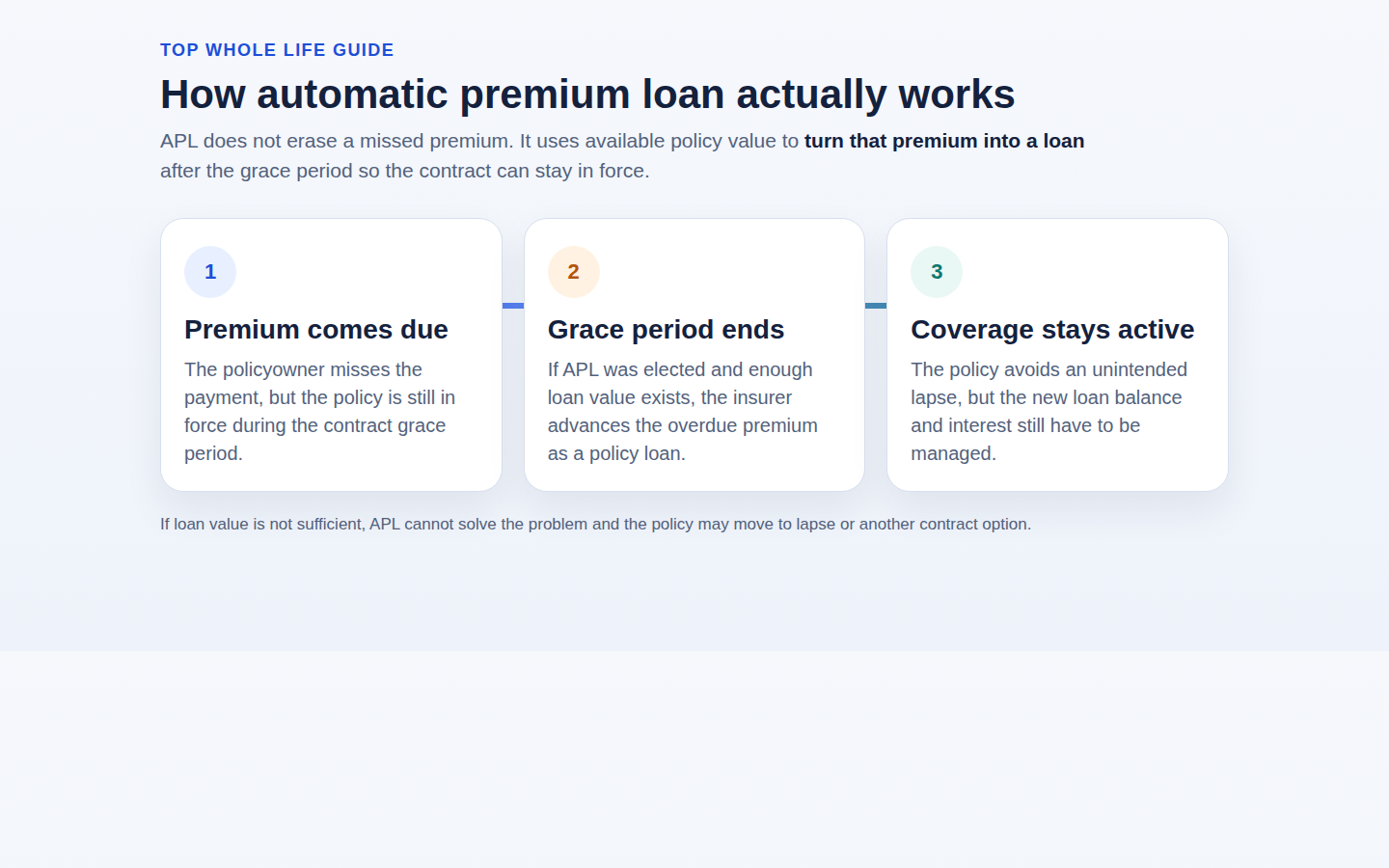
The sequence is usually closer to this:
1. The premium becomes due
Nothing unusual has happened yet. The bill is simply unpaid.
2. The grace period begins
As the North Carolina DOI explains, the policy generally remains in force during the grace period. That matters because people sometimes assume a missed payment means instant cancellation. It does not.
3. The grace period ends
This is the key transition point. If the premium is still unpaid, the policy can lapse unless another contract provision takes over.
4. APL can trigger if it was elected and enough value exists
The New York DFS says the automatic premium loan provision must be elected by the policyowner and can be canceled by the policyowner. The North Carolina DOI similarly says the owner usually has to choose the provision.
That is an important detail because some people talk about APL as if every whole life policy automatically has it turned on. That is not a safe assumption.
5. If there is not enough value, APL cannot save the policy
The Wisconsin glossary defines a lapsed policy as one that terminates at the end of the grace period because no value is available to be loaned against to cover the due premium. That is the other side of the APL equation: it only works while the policy still has enough usable value to support it.
So the right question is not just, "Do I have APL?"
It is:
- Was it elected?
- Is it still turned on?
- Is there enough value for it to work?
- If it works, what happens to the growing loan afterward?
What APL changes inside the policy
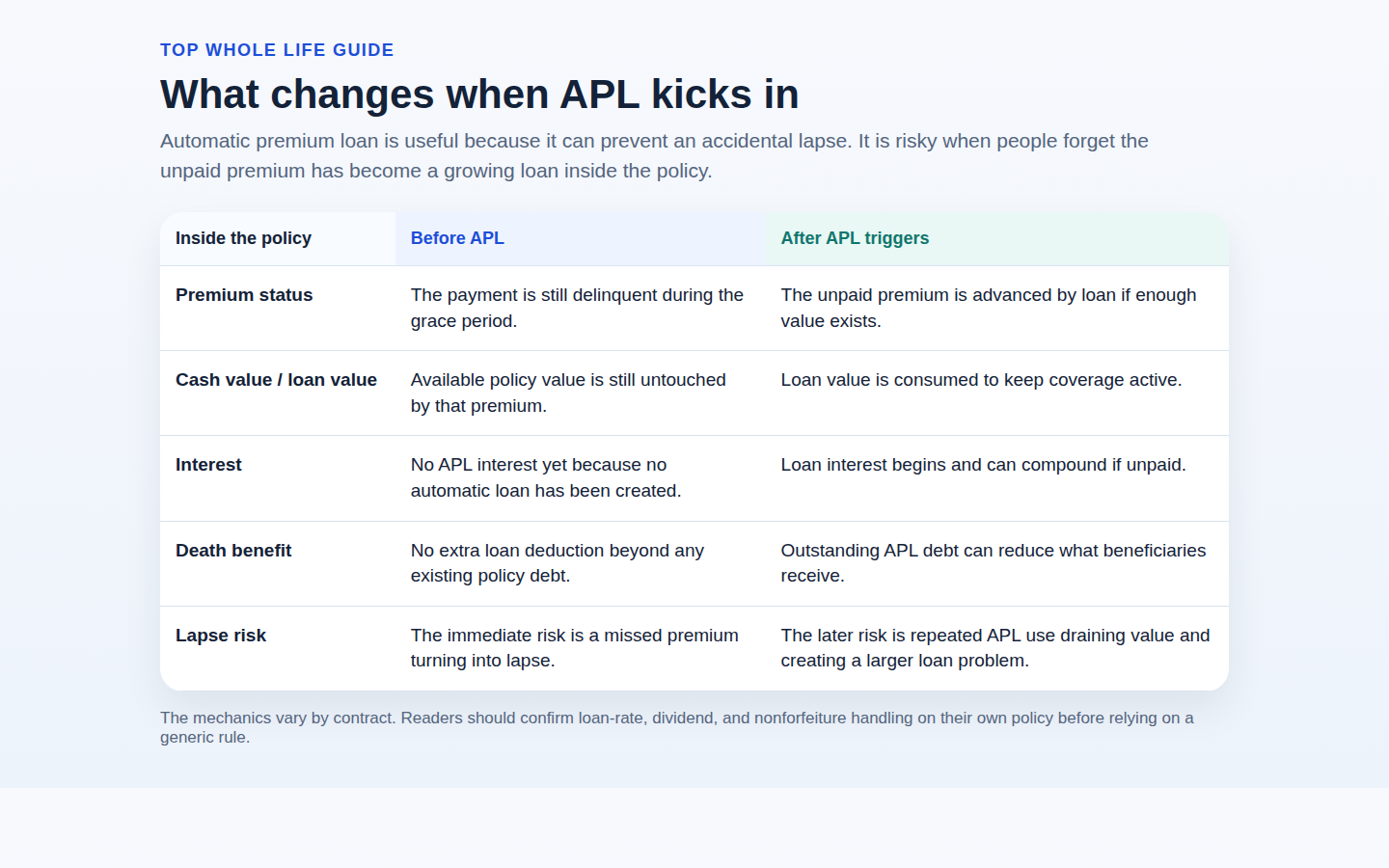
Once APL triggers, the policy may stay in force, but the contract is no longer in the same condition it was before the missed premium.
Here are the biggest changes.
The unpaid premium becomes debt
The Wisconsin OCI glossary defines a policy loan as an amount borrowed against the cash value, with the policy serving as collateral. That matters because APL uses the same basic machinery. The missed premium is no longer just a payment oversight. It becomes loan balance.
Interest starts to matter
Once the policy is carrying loan debt, interest can build. That is what turns APL from a helpful safety net into a slow-moving problem if it keeps happening.
MassMutual's life insurance taxation explainer notes that if additional policy loans are taken to pay loan interest, policy value can eventually be reduced to the point where out-of-pocket payments are required to prevent lapse. That is exactly why a policy can look stable for a while and then suddenly become fragile.
Beneficiaries may eventually feel the effect
The Wisconsin glossary says unpaid policy debt plus accumulated interest can be deducted from the claim amount payable at death. Top Whole Life makes the same practical point in its guide on reducing a whole life policy: when policy value supports premiums through a small internal loan, that balance is taken out of the death benefit.
So even if the policy never lapses, APL is not costless. It can still reduce what the contract ultimately pays.
The tax treatment may stay favorable, until it doesn't
MassMutual explains that policy loans on a non-MEC policy are generally not treated as distributions unless the policy lapses while the loan is outstanding. That is the good news.
The less comfortable news is that a lapse with loans still outstanding can create taxable income, even when the owner is not receiving a meaningful cash check on the way out. MassMutual also explains that if the policy debt plus remaining cash value exceed basis at lapse, a taxable event can result.
This is one of the easiest ways policyowners misunderstand APL. They hear "policy loans are tax-free" and stop there. A better summary is:
- policy loans are often not immediately taxable
- repeated loan growth can still increase lapse risk
- lapse with enough gain can still produce a tax problem later
MEC policies deserve extra caution
If the policy is a Modified Endowment Contract, APL deserves even more care. A MassMutual form warns that for MEC policies, an automatic premium loan may be taxable as ordinary income to the extent of gain and may also trigger the 10% tax penalty if the policyowner is under age 59 1/2.
That does not mean every APL situation is a disaster. It means you should not treat MEC and non-MEC policies the same.
When keeping APL on can help
APL exists for a reason, and there are situations where it genuinely helps.
It can prevent a stupid mistake from becoming a bigger insurance problem
This is the best use case. The owner did not intend to stop paying. The policy still has healthy value. The missed premium was incidental, not strategic. In that situation, APL can do exactly what it is supposed to do: keep the contract in force and buy time.
It can help someone through a short disruption
Top Whole Life's reduction guide describes scenarios where a whole life owner temporarily leans on policy value to manage premium pressure, with a small loan building inside the contract. That is not the same thing as an ideal long-term funding plan, but it can be reasonable during a brief disruption if the owner understands the tradeoff.
It can preserve insurability leverage
Why does that matter? Because once a policy truly lapses, getting back to the original position may be harder than people expect. The North Carolina DOI says reinstatement usually requires a written application, payment of overdue premiums plus interest, and meeting the company's underwriting requirements. That means a lapse is not just a bookkeeping inconvenience. It can reopen health and insurability issues.
If you want the step-by-step version of what carriers usually ask for after lapse, Top Whole Life's guide to whole life policy reinstatement walks through the deadlines, loan questions, and when another recovery path may fit better.
In that context, APL can be the lesser evil.
If the real choice is:
- keep the policy active with a manageable loan, or
- let it lapse and hope reinstatement stays easy later
APL may be the smarter fallback.
When you may want to revoke or review APL
APL is most dangerous when it stops being occasional.
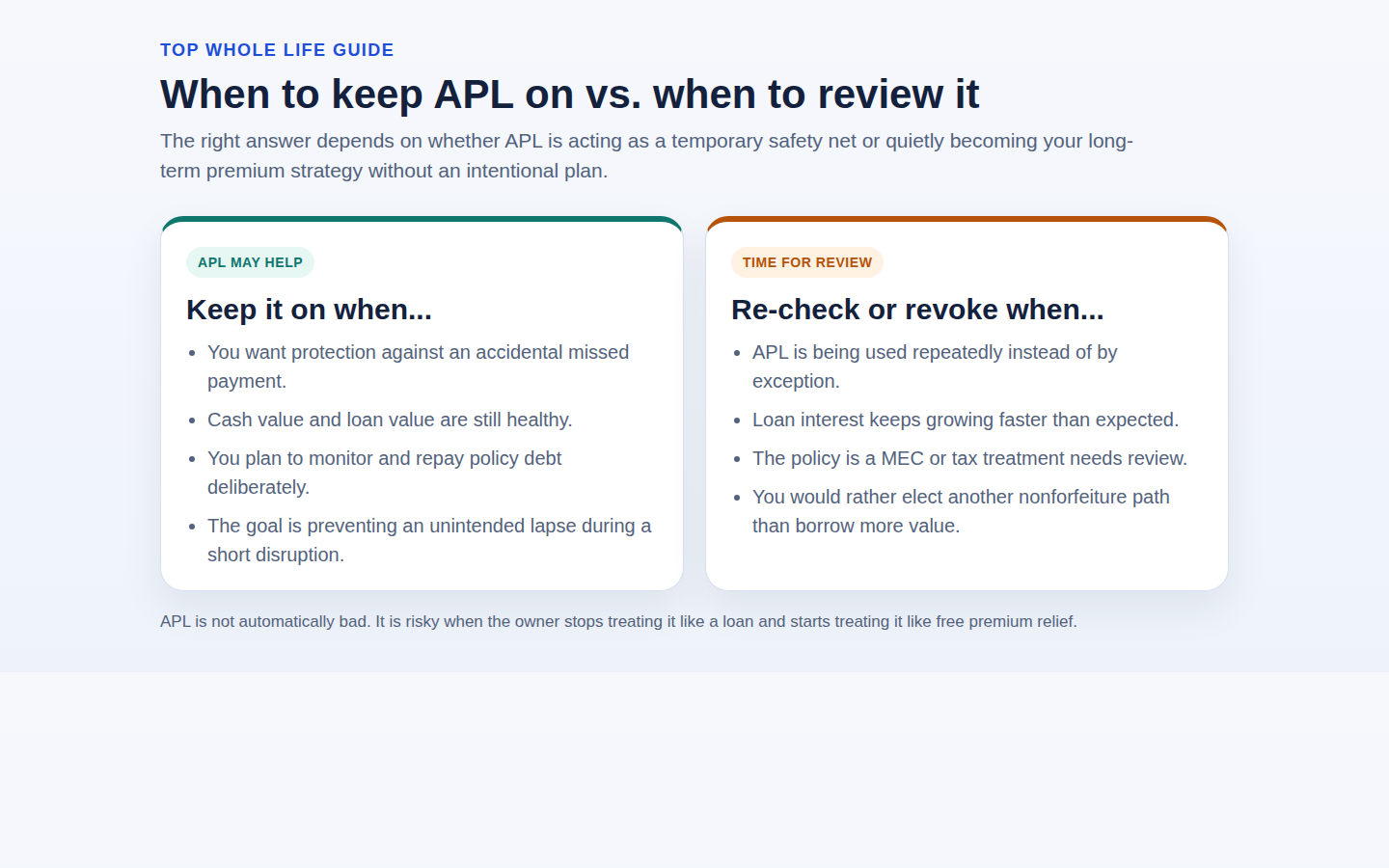 A healthy APL setup is a backup. An unhealthy one is a habit.
Here are the situations where it deserves a closer review.
APL is happening repeatedly
If the policy is using APL year after year, you no longer have a missed-payment backup. You have a different premium strategy than the one you think you have.
That is usually the moment to ask whether the better fix is:
- adjusting the overall design
- using dividends differently
- reducing the premium burden intentionally
- or choosing a different nonforfeiture path if the policy no longer fits
Top Whole Life notes that owners may be able to elect dividends to reduce premiums rather than relying on borrowed value. That is not automatically the right answer either, but it is an example of why the owner should review the design, not just react to the missed bill.
Loan interest is starting to outrun your attention
The policy can stay in force for a surprisingly long time while loan pressure quietly builds. That is why the most dangerous APL situations do not feel dangerous right away.
If you cannot quickly answer these questions, it is time for review:
- What is the current loan balance?
- What interest is accruing?
- How much loan value remains?
- How many future premiums could the policy realistically support?
You would prefer another policy outcome over more debt
Sometimes the policyowner does not want a loan to be the fallback. They may prefer a nonforfeiture decision, a policy reduction, or a cleaner reset. In that case, allowing APL to remain on by default may work against the owner's real goal.
The policy is a MEC
This is where you should slow down. As noted above, carrier documentation can warn that MEC treatment changes the tax consequences of automatic premium loans. If your policy is already a MEC, or you are not sure whether it is, that is the moment to ask before another premium date slides by.
Questions to ask before the next premium is due
The best time to review APL is not after the grace period ends. It is before the next payment becomes a problem.
Use this short checklist:
-
Is APL currently elected on my policy?
Do not assume. Confirm it. -
How much loan value is actually available?
APL only works while enough policy value remains. -
What is the current loan balance and interest rate?
If APL has already triggered before, you need the current numbers. -
Is this policy a MEC or non-MEC?
That answer can materially change the tax discussion around automatic loans. -
If another premium is missed, what happens next under my contract?
Ask whether APL, lapse, reduced paid-up, extended term, or another default applies. -
Would another strategy fit better than borrowing policy value again?
That could mean changing the dividend option, reducing the burden intentionally, or reviewing whether the policy design still fits your goal. -
Can I get an updated in-force illustration before making a change?
A real policy decision should be based on current contract values, not a vague verbal summary.
If you need a better baseline for comparing designs, carriers, or how a permanent policy should be structured in the first place, start with the Top Whole Life FAQ hub or run a single whole life quote so the review begins with current numbers rather than assumptions.
Treat APL like debt, not like magic
Automatic premium loan is neither a hidden trap nor a universal blessing.
It is a tool.
Used intentionally, it can keep a policy from lapsing over a short-term mistake or disruption. Ignored for too long, it can turn a missed premium into a loan problem, a death-benefit problem, and in some cases a lapse-and-tax problem.
That is the practical rule to remember: APL does not make the premium go away. It changes the form of the problem.
If your policy has meaningful value, meaningful debt, or any chance of MEC treatment, confirm the next-step mechanics with the insurer before the next due date. This article is general education only, and policy provisions, tax treatment, and available options can vary by contract.