Direct Recognition vs Non-Direct Recognition Whole Life
Direct recognition vs non direct recognition whole life is one of those phrases that gets repeated far more often than it gets explained. Shoppers hear that one style is "better for borrowing," somebody else says the difference is overblown, and the conversation turns into carrier fandom before anyone slows down and asks the useful question: what actually changes after a policy loan?
The short answer is that recognition type matters only when a participating whole life policy has a loan on it. It affects how the insurer treats the dividend crediting on the borrowed portion of cash value. It does not automatically tell you which company has the best policy, the best dividend, the best loan cost, or the best fit for your goals.
If you are comparing carriers, treat this as one line item in a bigger illustration review. The label matters, but only after you understand the bigger loan and illustration mechanics around it.
This article is general education, not personal tax, estate, or insurance advice. Contract language, current scales, and loan terms vary by policy.
Why this distinction keeps showing up in whole life conversations
Recognition type shows up because whole life policy loans are different from taking money out of a checking account. The policy stays in force, the carrier charges interest, and the loan balance can reduce what is left for you or your beneficiaries later.
The NAIC Life Insurance Roadmap puts the consumer version plainly: if you borrow from a whole life policy with cash value, the amount you borrow reduces what your beneficiaries receive if you die, and interest still applies.
That is the baseline. Recognition type sits on top of that baseline. It is not a replacement for understanding policy loans. It is a second-order question about how the dividend treatment behaves once cash value is collateral for the loan.
That is also why this topic mostly matters in participating whole life conversations. If dividends are a meaningful part of the policy design, then the treatment of borrowed cash value matters more. If the policy is not being used for borrowing, or the buyer's main priority is simply keeping a permanent death benefit in force, the difference can become much less important than people expect. If you need the broader baseline first, our policy-loan primer is the simpler starting point before you come back to recognition type.
What direct and non-direct recognition actually change
Our carrier reviews and borrowing explainers keep running into this distinction, so here it is in one place.
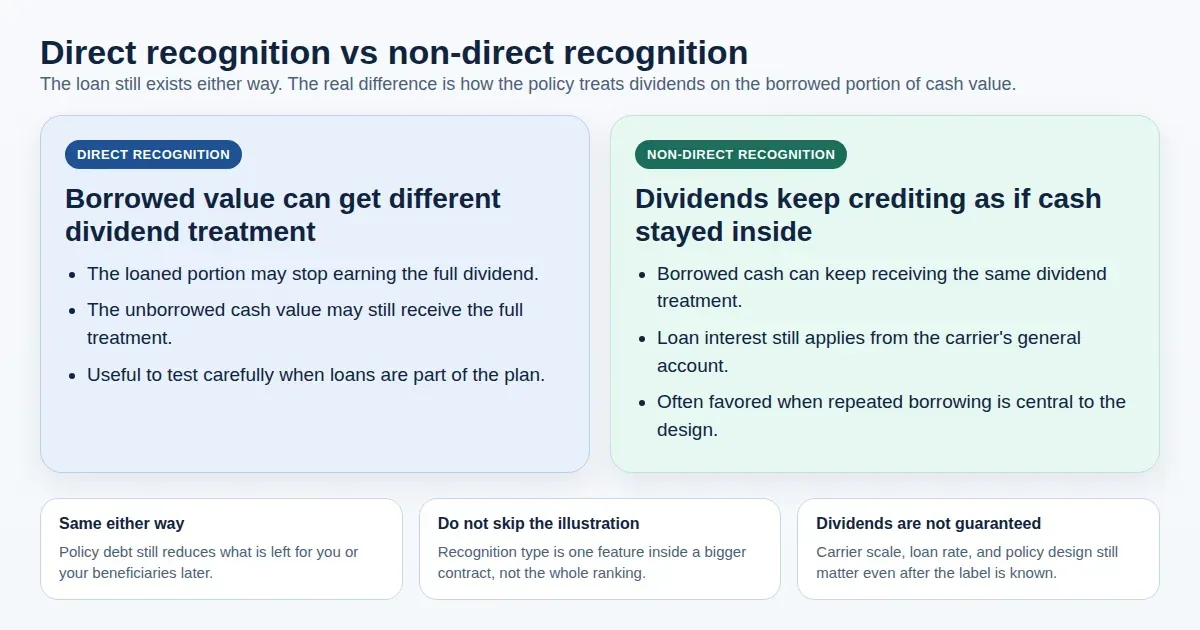
Take Penn Mutual: it is a direct-recognition carrier on loans, which means borrowed cash value generally stops earning the full dividend. A non-direct-recognition company keeps crediting dividends as if the money were still in the policy, while still charging a loan rate from the general account.
Put differently:
- Direct recognition means the loaned portion of the policy can receive different dividend treatment than the unborrowed portion.
- Non-direct recognition means the carrier does not reduce dividend treatment just because you borrowed, even though the loan itself still exists and still costs money.
That still does not make direct recognition automatically worse. At some direct-recognition carriers, the dividend adjustment on the borrowed portion is tied to the policy loan rate, so it can come out close to neutral, or even favorable, when loan rates are high. Non-direct carriers, meanwhile, often pair the feature with a variable loan rate that can rise. Neither label is automatically better; a matched illustration settles it.
Recognition type changes the dividend treatment tied to borrowed value. It does not erase loan interest, policy debt, or the need for a proper illustration review.
That is why our infinite-banking explainer leans so hard on non-direct recognition. In a borrowing-heavy design, non-direct recognition keeps paying dividends on borrowed funds, while direct-recognition carriers can reduce the dividend on the loaned-out portion and pay the full dividend only on the cash value still left inside the policy.
There is a useful consumer lesson in that explanation, but it also needs restraint. "Keeps paying dividends" is not the same thing as "borrowing is free." Loan interest still exists. Policy design still exists. The loan can still reduce net death benefit. You still need to look at how the policy behaves over time, not just the slogan attached to the loan feature.
What recognition type does not tell you by itself
This is where a lot of bad advice starts.
Recognition type does not automatically tell you which carrier has the strongest long-term economics. Our dividend history page makes two points that people miss:
- Dividend interest rate is an input into the dividend formula, not the policy's return.
- Carrier choice also depends on policy design, access to cash value, recognition type, and the job the policy is trying to do.
That matters because a direct-recognition carrier can still be worth illustrating if the rest of the design is strong. Penn Mutual is a good example: it is direct recognition on loans, yet we still put it in the first three quotes when the job is maximum illustrated cash value or flexible limited-pay whole life. In other words, direct recognition does not automatically remove a carrier from the conversation.
Recognition type also does not tell you:
- whether the current dividend rate is attractive enough for your goal
- whether the policy uses a fixed or variable loan rate
- whether the policy is designed with enough paid-up additions or other funding features
- whether a limited-pay design fits better than pay-to-100
- whether you should even be borrowing from the policy in the first place
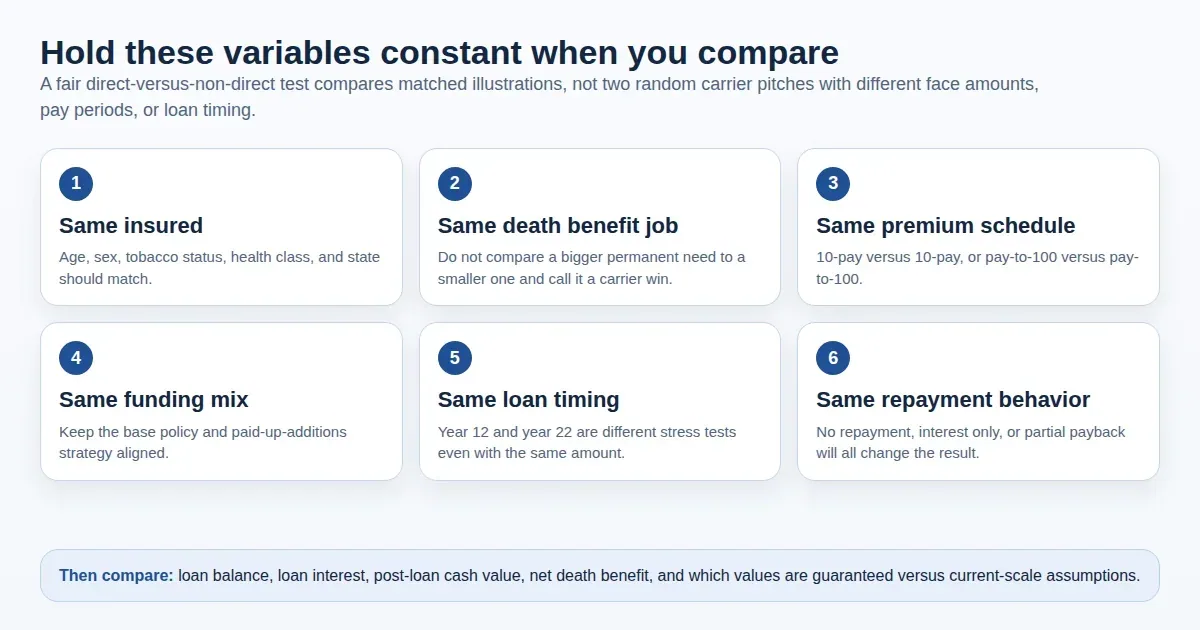 The wrong comparison is "direct vs non-direct" in the abstract. The right comparison is two matched illustrations with the same buyer, funding pattern, and loan timing.
That is why the cleanest way to think about recognition type is this: it is a policy-behavior feature, not a full ranking system.
If the buyer's entire strategy depends on repeated loans, then yes, non-direct recognition deserves extra attention. If the buyer mostly wants a stable permanent death benefit and only expects occasional borrowing, then the difference may matter less than dividend history, carrier strength, policy structure, or how much permanent premium the household can comfortably support.
How to compare two illustrations without fooling yourself
If you want to know whether recognition type is helping or hurting you, do not compare two random carrier pitches. Compare matched illustrations.
It is the same habit we recommend in our carrier reviews. With Penn Mutual, for example, we suggest comparing it on the same design to MassMutual before deciding.
Here is what should stay constant when you compare:
- Same insured profile — age, sex, tobacco status, underwriting class, and state.
- Same core death benefit target — otherwise one carrier may look "better" simply because you are not looking at the same job.
- Same premium pattern — for example 10-pay vs 10-pay, or pay-to-100 vs pay-to-100.
- Same funding intent — especially if one design uses heavier paid-up additions or a different base/rider mix.
- Same loan timing and amount — year 12 and $40,000 is not comparable to year 20 and $15,000.
- Same repayment behavior — interest-only, no repayment, partial repayment, or disciplined repayment all change the outcome.
Once the inputs match, compare the outputs that actually matter:
- loan balance and loan interest
- cash value after the loan
- net death benefit after the loan
- guaranteed versus non-guaranteed columns
- whether the policy keeps compounding cleanly or starts looking stressed later
The NAIC Life Insurance Buyer's Guide is still the right outside reminder here: ask for an illustration showing future values and benefits, and do not rely on broad product descriptions when the real question is what your policy could do after your loan.
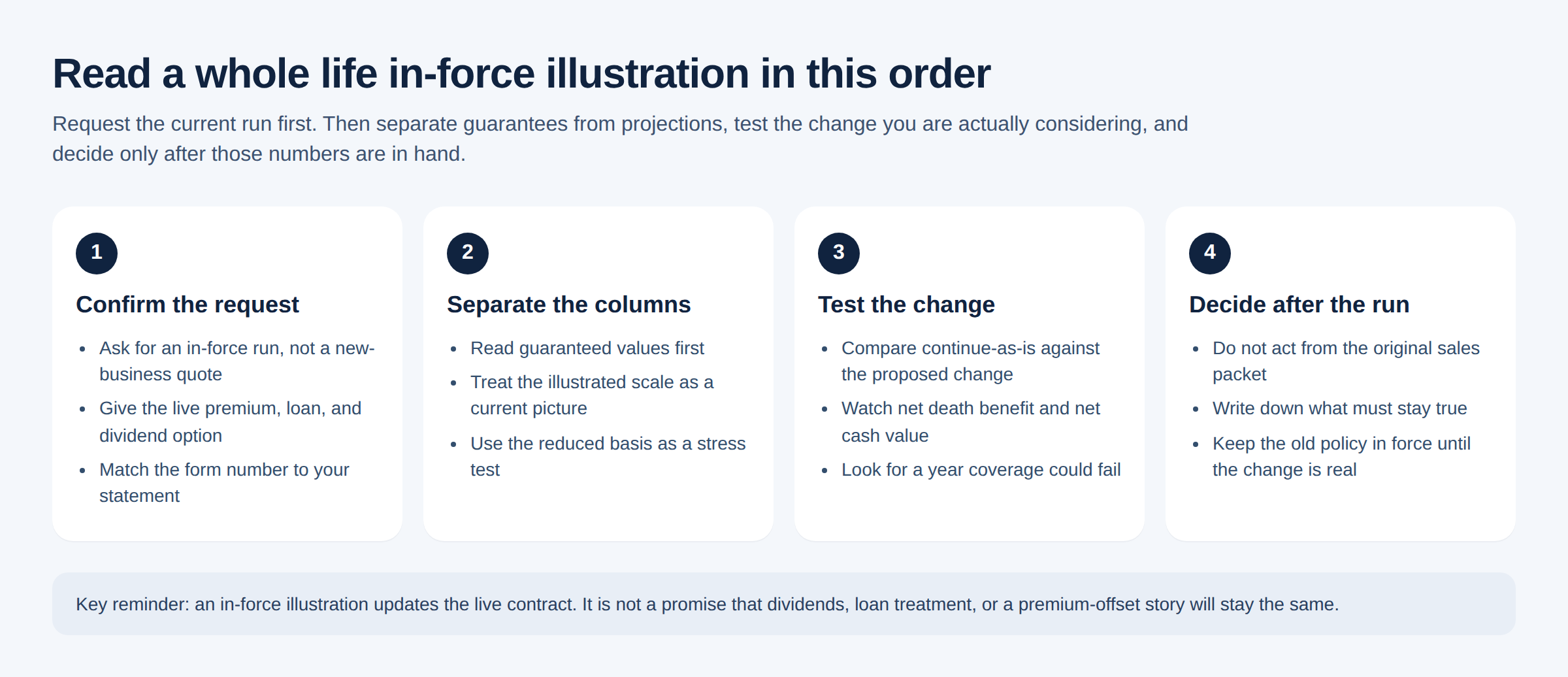
If you already own a policy, the more useful document is often a current in-force illustration, not the original sales pitch. If you are still shopping, ask for the with-loan version and the no-loan version so you can see what the borrowing plan is really costing you.
When the distinction matters most
Recognition type matters more when borrowing is not an occasional emergency move but a recurring part of the design.
That usually means cases like these:
- the policy is being considered for a borrowing-heavy cash value strategy
- the owner expects to take retirement-income-style loans later
- the owner regularly talks about using policy loans for business, real-estate, or recurring opportunity costs
- the owner is comparing two otherwise similar participating whole life illustrations and needs a tie-breaker
It matters less when:
- the buyer mainly wants permanent death benefit first and cash access second
- loans are possible but not central to the plan
- one carrier's overall illustration is stronger even though the recognition label is less fashionable
- the household budget makes premium discipline the bigger risk than loan efficiency
That is also where tax and contract-status risk stop being theoretical. If a policy lapses or is surrendered with a loan outstanding, the cash value used to pay off the loan counts as money you received, so the amount above your cost basis (generally the premiums you paid) can be taxable income even though no check arrives. IRS Publication 525 explains how surrender proceeds above your cost are taxed, and our loan repayment guide covers how growing loan debt drifts toward lapse. Funding matters too: a policy paid in faster than the federal seven-pay limit becomes a modified endowment contract (MEC), and loans and withdrawals from a MEC are taxed gain-first as they are taken, often with a 10% additional tax before age 59½.
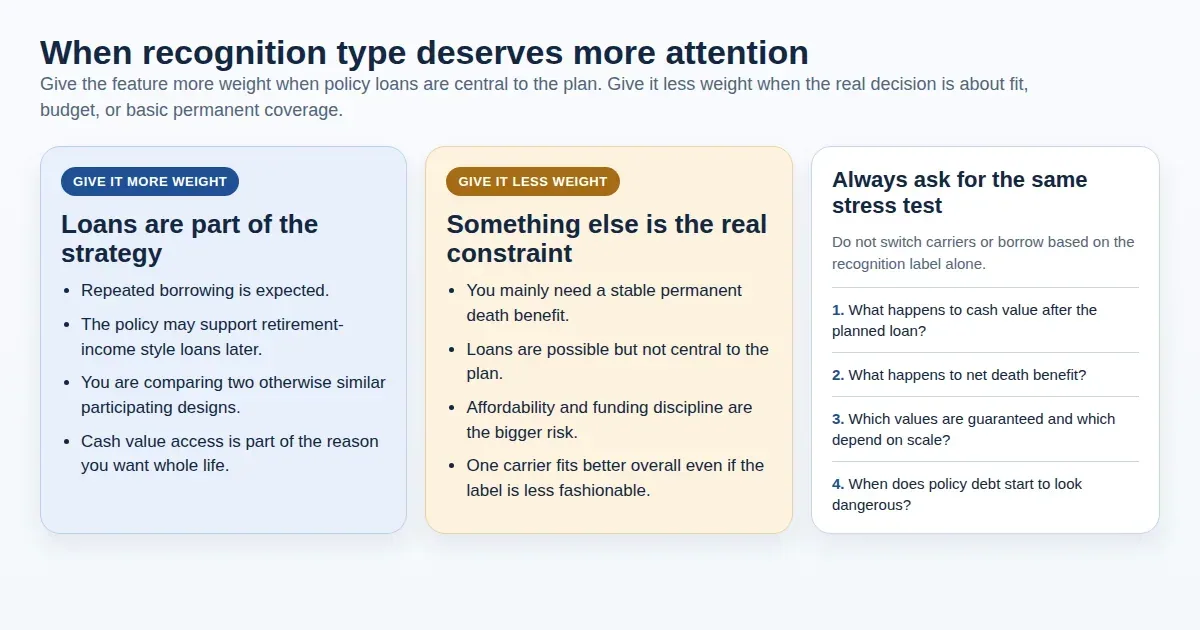 Recognition type deserves more weight when loans are central to the plan. It deserves less weight when the real constraint is affordability, fit, or a basic permanent-coverage need.
This is also where replacement mistakes happen. Someone hears that non-direct recognition is "better," assumes the current policy is defective, and starts shopping for a new carrier without accounting for surrender costs, age change, underwriting change, or the fact that their actual usage pattern may never make the feature decisive.
If you are replacing or materially changing a policy, slow down. Recognition type is a real feature. It is not, by itself, a reason to start over.
Questions to ask before you borrow or switch carriers
Before you let anyone turn this topic into a slogan, ask these questions:
- Is this policy direct recognition or non-direct recognition on loans?
- What is the current loan interest rate, and is it fixed or variable?
- If I take the planned loan, what happens to cash value, net death benefit, and dividend treatment on the next illustration?
- Which values on this page are guaranteed, and which depend on the current dividend scale?
- If I keep borrowing or delay repayment, when does the policy begin to look stressed or drift toward lapse?
- If this policy ever lapses or is surrendered with loan debt still outstanding, how is cost basis and potential taxable income being evaluated?
- Is the policy still non-MEC, and if not, how do loans or withdrawals change from the tax treatment I expected?
- If a different carrier is being recommended, is the comparison actually matched on design, funding, and loan timing?
Those eight questions will get you further than most online arguments.
If you already know you want a side-by-side illustration built for your age, health class, and premium target, request a multi-carrier whole life quote.
The useful takeaway is simple: direct recognition versus non-direct recognition is not fake, but it is not the whole policy either. It is one real feature inside a bigger contract. Treat it that way and you will ask better questions, compare better illustrations, and make fewer expensive assumptions.
This article is general education only. Dividends are not guaranteed, policy loan terms vary, and past carrier performance does not predict future results. Review your own illustration and policy language with a licensed professional before you borrow, replace, or restructure coverage.