Whole Life Insurance Loan Repayment: When To Pay It Back, What Changes If You Wait, and How To Avoid a Lapse Surprise
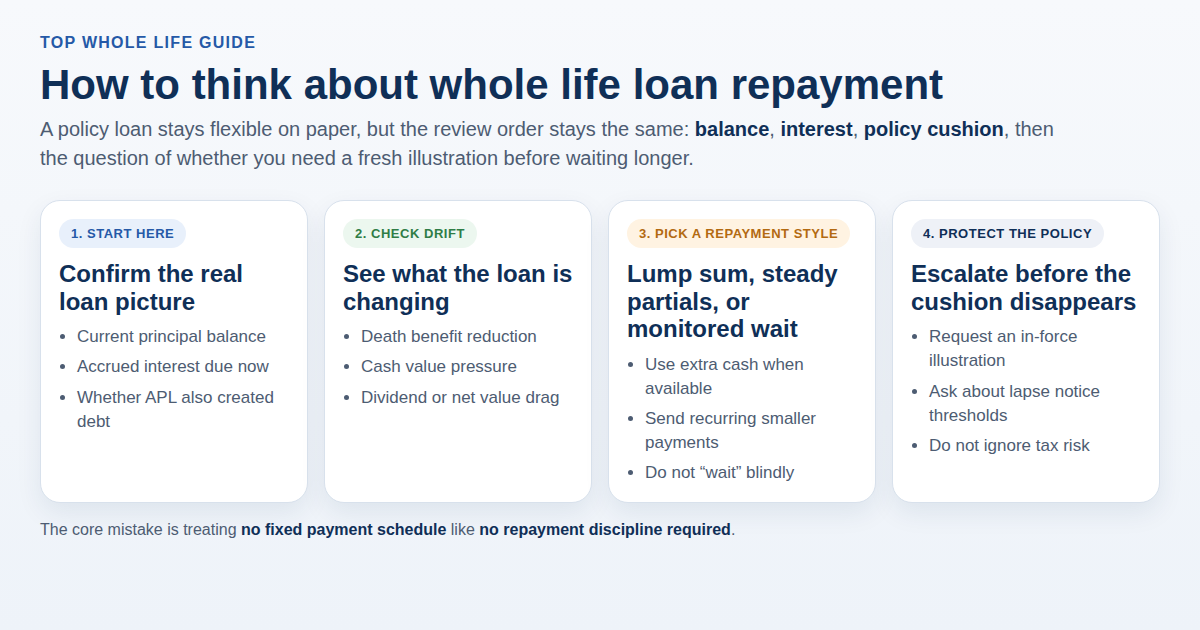
A whole life policy loan stays manageable when you review it in order: confirm the balance, understand the interest, pick a repayment style, and escalate before the policy cushion gets thin.
If you are trying to understand whole life insurance loan repayment, the first thing to know is that the loan feels more forgiving than it really is.
That is because most whole life policy loans do not come with the kind of strict monthly payment schedule people expect from a bank, credit card, or home equity loan. Guardian says you can repay on whatever schedule works for you, whether that means a lump sum, smaller regular payments, or even no repayment at all. That flexibility is real. It is also the reason many policyowners underestimate what a loan can do inside the contract if it sits there too long.
The better way to think about repayment is simple: a flexible loan is still a live policy decision. Interest can keep building. Death benefit can shrink. Cash value can get tighter. And if a loan grows far enough relative to policy value, the conversation can shift from "Should I pay this back?" to "How close am I to a lapse notice, and what happens if I ignore it?"
This guide is built for that moment. It is general education, not personal tax, legal, or investment advice, and your own policy language still controls. But if you want a practical framework for repaying a whole life policy loan without turning a useful feature into a policy-health problem, start here.
Why whole life loan repayment confuses policyowners
Most confusion starts with one sentence: "You do not have to pay it back."
Technically, that is often true. But it is incomplete.
The New York Department of Financial Services says the cash value is used as collateral for the loan and that any outstanding policy debt is deducted from the benefits at death or from cash value at surrender. In other words, the policy does not forget the loan just because the insurer is not mailing you a coupon book.
That is why whole life loan repayment gets misunderstood in two directions:
- some policyowners assume flexibility means the loan is harmless
- others assume every unpaid loan automatically means disaster
Neither view is accurate.
A better summary is this:
- a policy loan can be managed calmly for years when the policy still has room
- an ignored loan can still become a death-benefit problem, a lapse problem, or a tax problem
- the difference is usually not the existence of the loan alone, but whether the owner is still monitoring how it affects the contract
Top Whole Life's guide on automatic premium loan whole life insurance makes the same broader point from the missed-premium side: once debt is inside the policy, the contract may stay in force while the real pressure shifts into loan balance and interest. That is exactly why repayment deserves its own review discipline.
What changes inside the policy the moment a loan is outstanding
The easiest mistake is acting as if the loan lives outside the policy.
It does not.
Once the loan exists, it changes the policy's math in at least three ways.
The loan reduces what is cleanly available inside the policy
New York Life defines cash surrender value as cash value minus unpaid policy loans, loan interest, surrenders, and surrender charges. That matters because it means the relevant number is not only "What is my cash value?" It is also "What is left after debt?" A hypothetical whole life cash value chart shows cash value by policy year before a loan is subtracted.
That distinction gets more important as the loan gets older.
If you glance at a statement and only look at gross values, the policy can feel healthier than it really is. That is one reason Top Whole Life's recent annual statement guide pushes readers to treat loan balance and accrued interest as decision-driving items rather than background noise.
The death benefit may be smaller if the loan is still there later
Guardian says plainly that unpaid loan balance and accrued interest reduce the death benefit. The New York DFS says the same thing in simpler policy language: money owed on an outstanding policy loan is deducted from the benefits upon death.
This is where repayment becomes personal.
Some policyowners are comfortable with that tradeoff. If the policy's original protection need has changed, a smaller eventual payout may be acceptable. Others borrowed assuming they would clean up the loan later and simply have not done it yet. Those are different situations, and the repayment decision should reflect that difference.
Loan pressure can change the policy before it looks urgent
Top Whole Life's APL guide makes a useful point here: policy debt becomes most dangerous when it blends into the scenery. A contract can remain in force while flexibility quietly shrinks.
That is why a "fine for now" loan still deserves review if:
- interest is being added rather than paid
- the loan is no longer small relative to policy value
- the policy has already relied on internal value for premium support
- you are unsure what would happen if you borrowed again, skipped another payment, or left the policy alone for one more year
How loan interest compounds and why partial repayments still matter
Interest is where a manageable loan can start acting older than it looks.
New York Life says policy loan interest typically accrues daily at the current rate and is compounded annually. It also says that if the interest is not paid when due, it becomes part of the outstanding policy loan and then accrues interest itself.
That one detail changes how you should think about repayment.
If you cannot or do not want to clear the full balance right away, partial payments can still matter because they may:
- reduce the base that future interest is working on
- keep the balance from growing invisibly
- preserve more cash-value room inside the policy
- reduce the chance that you will drift toward a lapse notice later
That does not mean every small payment solves the problem automatically. If interest keeps capitalizing faster than the balance is falling, you may only be slowing drift rather than reversing it. But slowing drift is still better than pretending the balance is standing still.
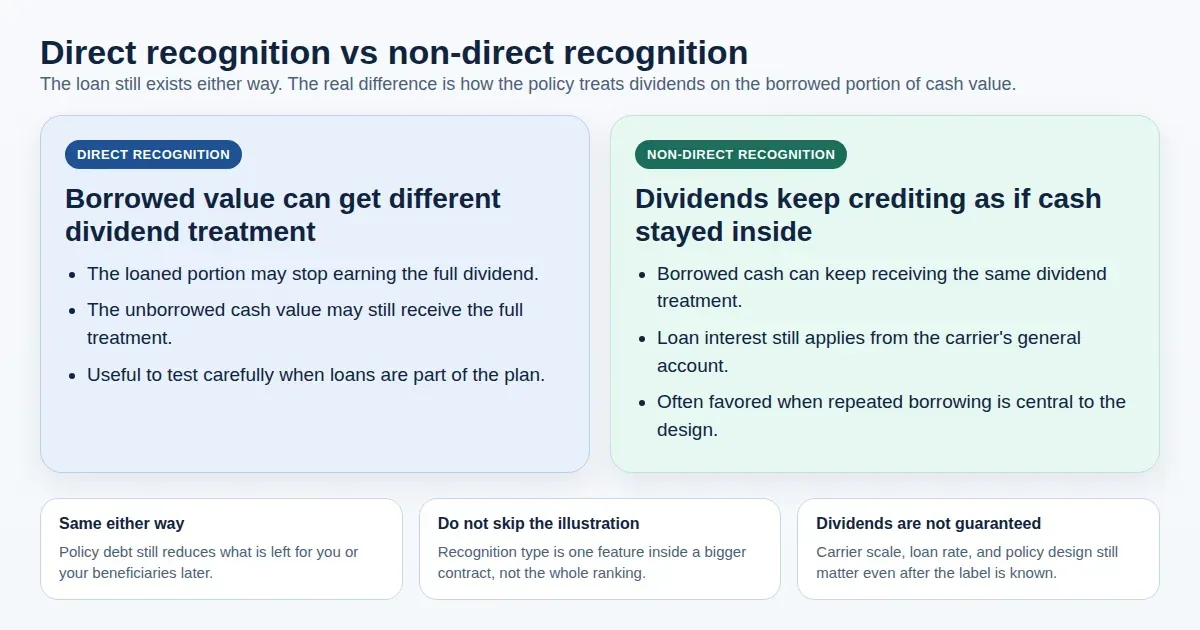
If your carrier uses direct recognition, an outstanding loan can also change the dividend credited on the borrowed portion. Our explainer on direct vs non-direct recognition whole life covers what that changes and what it does not.
MassMutual's tax guidance adds another important warning: if additional policy loans are taken to pay loan interest, policy values can eventually be reduced to the point where out-of-pocket payments are required to prevent lapse. That is the moment when a policyowner realizes the loan was never really "paying for itself." It was just buying time.
Three realistic ways to repay a whole life policy loan
There is no single best repayment pattern for every policy. The right answer depends on cash flow, current policy values, and whether you are trying to restore protection, preserve flexibility, or simply stop the balance from snowballing.
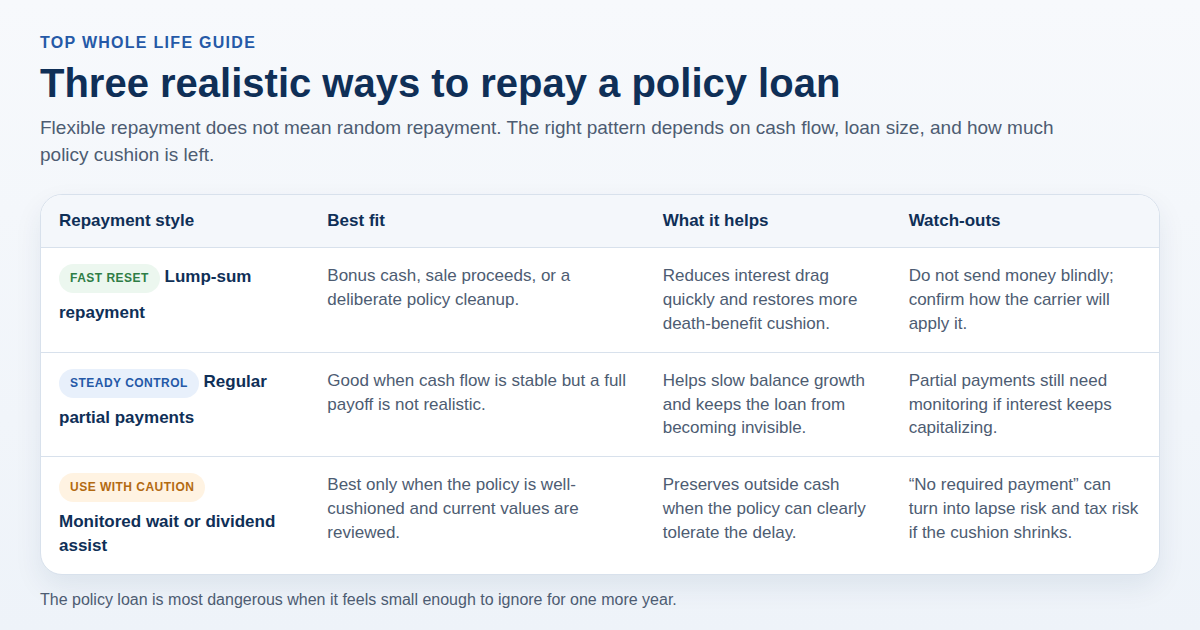 The best repayment style is the one that matches both your cash flow and the current policy cushion. The worst style is unmonitored delay.
Here are the three most realistic approaches.
1. Lump-sum cleanup
This is the cleanest option when you have available cash and want the loan off the policy quickly.
It often makes the most sense when:
- the balance is already large enough to bother you
- a bonus, sale, or liquidity event gives you room to fix it
- the policy is important enough that you want the full death-benefit cushion back
- you are preparing for another policy decision and want current numbers without lingering loan distortion
A lump sum is not always emotionally fun, but it is easy to understand. It is usually the fastest way to reduce future interest drag and simplify the contract.
2. Regular partial payments
Guardian notes that many policyowners repay over time through smaller regular payments. That is often the practical middle ground.
This style makes sense when:
- the loan is manageable, but you do not want it to become permanent furniture
- your monthly or quarterly cash flow is dependable
- you want to slow balance growth without draining savings
- you are paying down the loan while you gather better policy data
The key is to treat "regular partial" as a real strategy, not a vague intention. Even flexible repayment needs a cadence.
3. Monitored wait, sometimes with dividend assist
This is the option that causes the most trouble when it is used casually and the least trouble when it is used deliberately.
Guardian says whole life dividend options can include applying dividends to outstanding policy loans, and its whole life explainer says annual dividends can help pay back policy loans. The New York DFS also notes that participating whole life dividends may be used in several ways, including reducing premium payments, though dividends are not guaranteed.
That means some owners may decide not to attack the loan aggressively with outside cash if:
- the policy still has meaningful room
- the loan is being watched closely
- the current dividend behavior and policy values are understood
- a current illustration supports the choice
This is where people get sloppy. "I can wait" is only safe when it really means "I reviewed the numbers and the policy can tolerate the wait." Without that review, waiting is just another form of guessing.
When a flexible loan becomes a policy-health problem
A policy loan rarely feels like an emergency at the start. That is exactly why it can become one later.
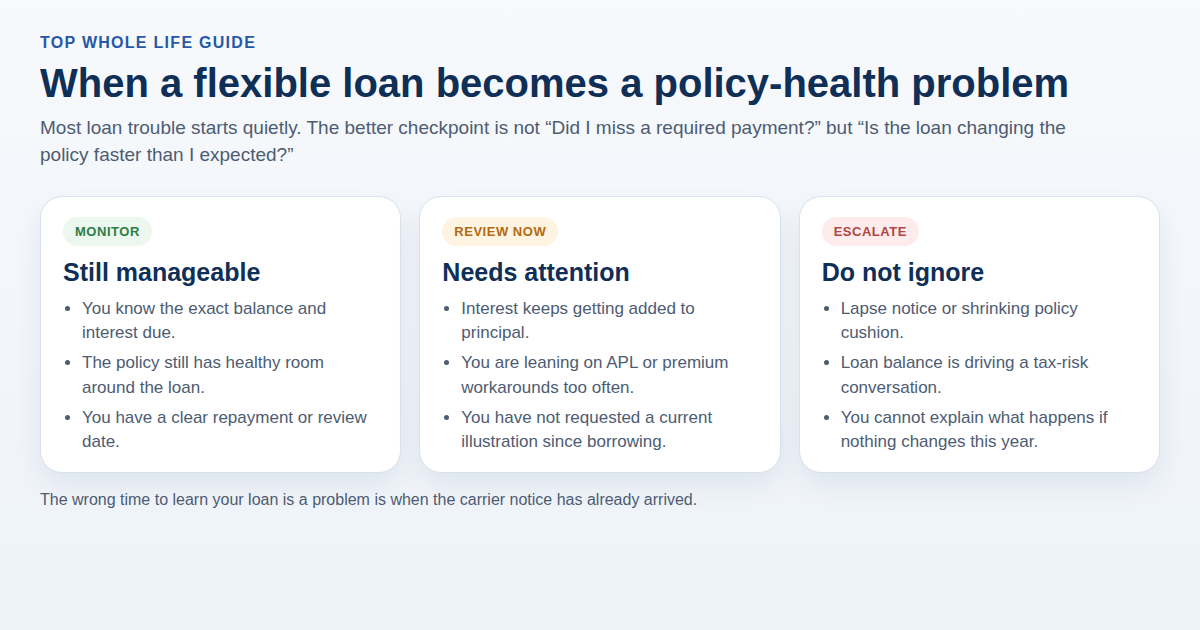 The real checkpoint is not whether the insurer forced a payment this month. It is whether the loan is changing the policy faster than you expected.
Here are the warning signs I would treat seriously.
You do not know the current balance, interest due, or remaining cushion
Top Whole Life's APL guide frames the right checklist well: you should be able to answer the current loan balance, what interest is accruing, how much loan value remains, and how many future premiums the policy could realistically support.
If you cannot answer those questions quickly, you do not yet have a repayment strategy. You have a hope.
Interest is being added faster than the balance is shrinking
This is the classic slow-burn problem.
You may feel disciplined because you sent money recently, but if the balance is flat or rising after interest, the policy is still drifting in the wrong direction. That is where partial payments need to be re-evaluated rather than emotionally credited as "progress."
The policy is leaning on other internal workarounds too
If the contract has also used APL, dividend premium reduction, or other internal value support, the loan question becomes bigger than loan principal alone. Policyowners sometimes manage each feature one at a time and miss the combined pressure.
That is a strong reason to request updated numbers before assuming the policy can keep absorbing more debt or less outside cash.
You are about to make another policy decision
Top Whole Life's annual-statement guide says the annual statement is the wrong document when you plan to change funding, borrow more, adjust benefits, review rider changes, or sort through MEC or longevity concerns. In those moments, what you need is a current in-force illustration. The whole life in-force illustration guide covers how to request that run and how to read the guaranteed columns before you borrow more.
That is especially true when the loan is no longer a side note.
What happens if you never repay the loan
Sometimes the honest answer is that you may never repay it in full.
That does not always mean failure. But you should know exactly what that choice means.
First, the policy debt does not vanish. As the New York DFS and Guardian both explain, the unpaid balance and accrued interest can reduce what beneficiaries receive later.
Second, the policy can lapse if debt outruns available value. Guardian warns that if the loan balance plus interest exceeds cash value, the insurer may surrender the policy. The New York DFS says that when outstanding loans plus interest exceed the policy loan value, the insurer must provide at least 30 days notice before termination, giving you a window to fix the problem.
Third, lapse can create a tax surprise that feels wildly unfair if you were expecting "tax-free policy loans" to be the whole story.
MassMutual explains the rule clearly for non-MEC policies:
- policy loans are generally not treated as distributions while the policy stays in force
- if the policy lapses with the loan outstanding, total policy debt is treated as a distribution
- taxable income can arise to the extent that debt plus any remaining cash value exceeds cost basis
- that can happen even when there is little or no surrender value left for you to receive
That is why the phrase "You do not have to pay it back" should always have a second sentence attached:
You may not owe the insurer a fixed monthly installment, but you are still choosing how the policy will absorb that debt over time.
Questions to ask before sending a repayment or requesting a new illustration
Before you send money, skip money, or assume the loan can wait another year, slow the conversation down with better questions.
Ask the carrier or your agent:
-
What is my exact current loan balance, and how much of that is accrued interest?
Do not rely on memory or last year's statement. -
How is interest charged on this specific policy, and when is it added if unpaid?
Daily accrual and annual compounding change the feel of a loan over time. -
If I make a partial repayment, how will it be applied?
You want to know how much actually reduces the balance and what still remains due. -
What happens to death benefit, cash value, and surrender value if I do nothing for another year?
This is where a current illustration becomes more useful than general explanations. -
Can dividends be used toward premiums, paid-up additions, or outstanding policy loans on this contract, and what tradeoff does that create?
Available options vary, and "possible" is not the same thing as "best." -
At what point would the policy trigger a lapse warning or require out-of-pocket action to stay in force?
Know the boundary before you get close to it. -
Do I need a new in-force illustration before I borrow more, reduce payments, or change the policy design?
If there is already meaningful loan activity, the safe default is usually yes.
If you want a better baseline before deciding how aggressive the cleanup should be, start with Top Whole Life's whole life insurance FAQ hub and compare your current contract questions against a fresh single whole life quote or updated policy review.
The big takeaway is not that every policy loan is bad. It is that a whole life policy loan becomes safer when you stop treating repayment as optional background noise and start treating it as part of ongoing policy management.
This article is general education only. Confirm current values, repayment mechanics, dividend options, MEC status, and any lapse or tax implications with your insurer and your own tax professional before acting.