How to Read a Whole Life Insurance Annual Statement Without Missing the Red Flags
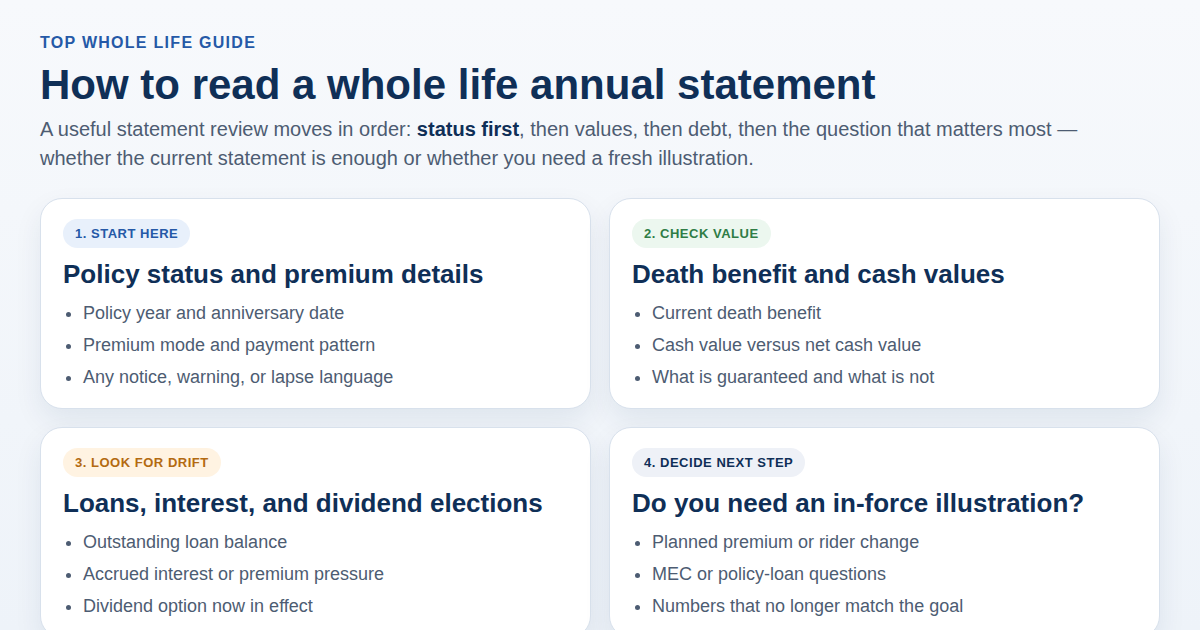
A useful annual statement review moves in order: status first, then values, then debt, then the question of whether you need a fresh illustration before making a change.
If you are trying to understand a whole life insurance annual statement, the first thing to know is that the document is more useful than most people think and less complete than many people assume.
Useful, because it gives you a yearly snapshot of where the policy stands now. Less complete, because it does not automatically answer what will happen if you change the premium, borrow more, reduce the death benefit, or rely on an old assumption that no longer fits the contract.
That is why the smartest way to read the statement is not to stare at every line item equally. Start with the parts that change your decision-making: payment status, death benefit, cash value, loan balance, dividend treatment, and any signal that you should stop relying on the statement alone and ask for a current in-force illustration.
The NAIC's life insurance review guidance is still the best starting point for that mindset. It tells policyowners to review whether premiums or benefits vary from year to year, how benefits build up in the policy, what part of the policy is not guaranteed, how interest affects the numbers, how cash values can be accessed, and whether conversion or other options exist. That is exactly the lens you want to bring to the annual statement.
Why annual statement review matters even on a permanent policy
Whole life gets sold as the policy you can put on autopilot. There is some truth in that. A properly funded whole life policy can be much more stable than a flexible-premium design. But stable does not mean invisible.
The NAIC says regular review matters because your life situation changes over time. The practical version of that advice is even simpler:
- your policy can still be in force and still be drifting from the job you want it to do
- a loan balance can still be manageable and still be growing faster than you realize
- a dividend election can still be familiar and still deserve a fresh look
- a statement can still look "normal" while quietly telling you to ask better questions
This is also why it helps to separate two different review tasks:
- Snapshot review - what does the policy look like right now?
- Decision review - what happens if I change something?
Your annual statement handles the first question. It only partly helps with the second.
That difference matters because many policy problems do not start with a dramatic lapse notice. They start with a policyowner who has not compared this year's statement with last year's goals.
Start with the status block: premium mode, policy year, and warning language
The status section is not always glamorous, but it is where a lot of expensive misunderstandings begin.
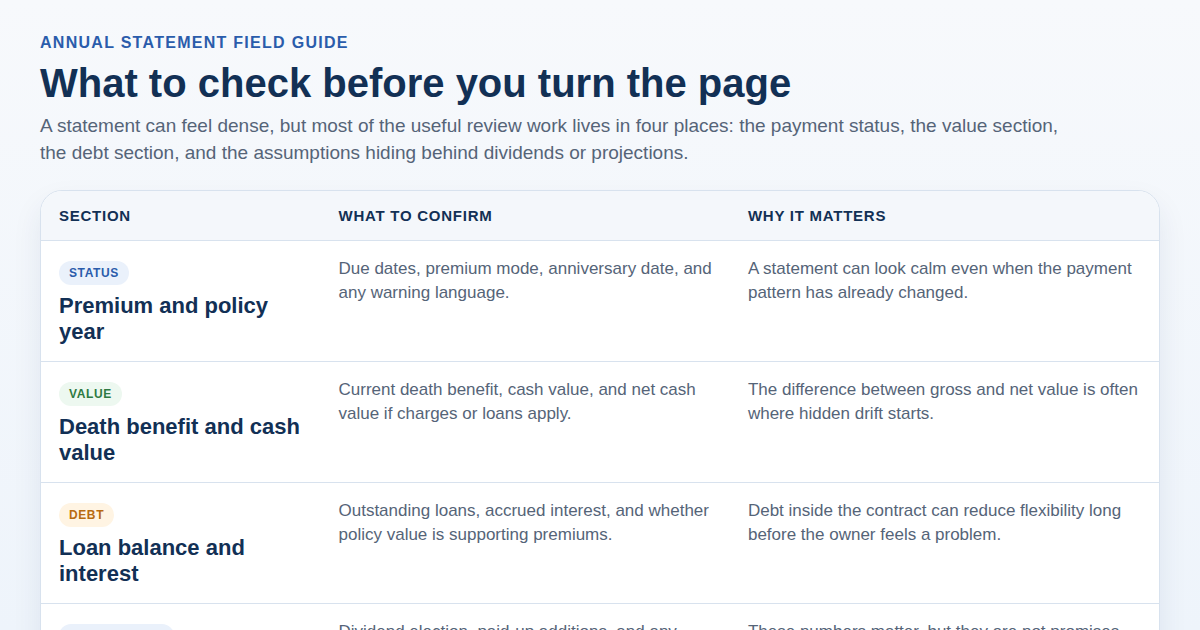 Most statement reviews become clearer when you break the page into four buckets: status, value, debt, and assumptions.
Before you study cash value or dividends, confirm the boring details:
- policy anniversary date
- premium mode
- whether the premium pattern is still what you expect
- whether any notice language suggests a change in policy behavior
That matters because the statement is not only a balance sheet. It is also a signal about policy mechanics.
Top Whole Life's older guide on how to break down a life insurance illustration makes this point in a simpler quote context: the premium rate is one of the first numbers that deserves attention because it tells you what you are expected to pay for coverage. On an annual statement, you are no longer looking at a sales quote. You are checking whether the live contract still matches that expectation.
If the payment pattern changed, if the statement language around status looks different, or if you see terms you have ignored in past years, stop there before you move deeper into the document. The goal is not to read faster. The goal is to avoid missing the one line that tells you the policy is behaving differently than you thought.
This is also a good moment to review beneficiaries. The NAIC recommends revisiting them every few years, especially after life changes. That is not the most technical part of the statement review, but it is one of the most important.
Check death benefit, cash value, and net cash value
Once the status section looks right, move to the value section.
Most policyowners jump straight to the biggest number on the page. That is understandable, but it is not enough. The better approach is to look at the relationship between the numbers:
- current death benefit
- cash value
- net cash value, if the carrier shows it separately
- any value after charges, surrender adjustments, or debt
Top Whole Life's illustration guide reminds readers that the death benefit is the amount a beneficiary receives and that cost and coverage should be understood together. The annual statement takes that same logic and brings it into the real contract year. You are no longer asking only, "What was promised at issue?" You are asking, "What does the policy actually look like today?"
This is also where the guaranteed versus non-guaranteed distinction matters. The NAIC illustration overview says life insurance illustrations include both guaranteed and non-guaranteed elements such as benefits, premiums, values, credits, and charges. Top Whole Life says the same thing in plainer language: the non-guaranteed side is where dividends enter the picture, and those values are not promises.
So when you look at statement values, do not ask only whether the number is higher than last year. Ask:
- Is this value guaranteed or partly tied to non-guaranteed assumptions?
- Does the net value tell a different story from the gross value?
- Is the policy still building the kind of value I expected?
That is the difference between reading the statement as a receipt and reading it as a policy review tool.
Review loans, accrued interest, dividends, and rider activity
If there is one section readers skip too casually, it is the debt-and-options section.
Loans inside a whole life policy can stay manageable for a long time. That is exactly why they deserve attention every year. The danger is often not immediate catastrophe. The danger is gradual drift.
Top Whole Life's recent guide on automatic premium loan whole life insurance makes the point clearly: once policy value is being used to support a premium or a loan balance, the contract may remain in force while debt and interest still build inside the policy. That kind of line item should never be treated like harmless background noise on a statement.
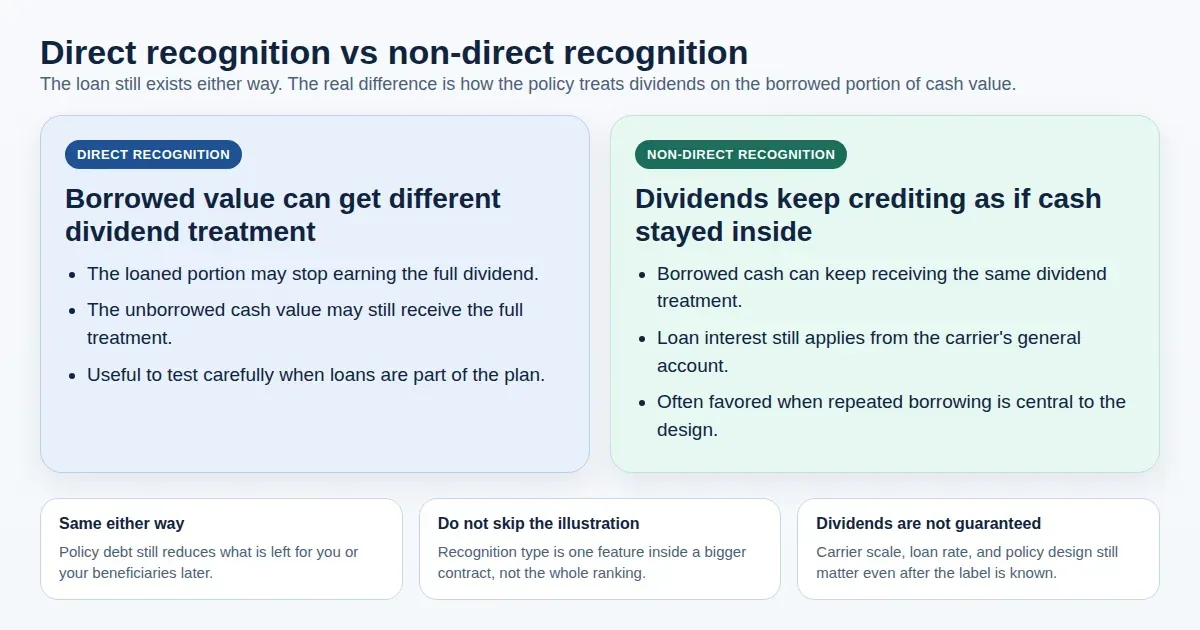
Dividends belong in the same conversation. In Top Whole Life's dividend explainer, dividends may be taken in cash, used to reduce premiums, left to accumulate, or used to buy paid-up additions. Each choice can change how the statement should be interpreted.
What to look for:
- Is the dividend option still the one you want?
- Is a premium-reduction election making the statement easier to live with right now but changing the longer-term plan?
- Are paid-up additions increasing value the way you expected?
- Is loan interest turning a manageable policy feature into a creeping drag on net value?
These questions are why a statement review should not stop at "my cash value went up." A policy can still grow and still deserve a harder conversation.
Rider activity matters too. If a rider changed, was removed, or was added earlier in the year, do not assume the statement tells you the entire future effect. It tells you what is currently visible. That may be enough for routine review. It may not be enough for planning.
Know when the annual statement is not enough without an in-force illustration
This is the point most policyowners miss.
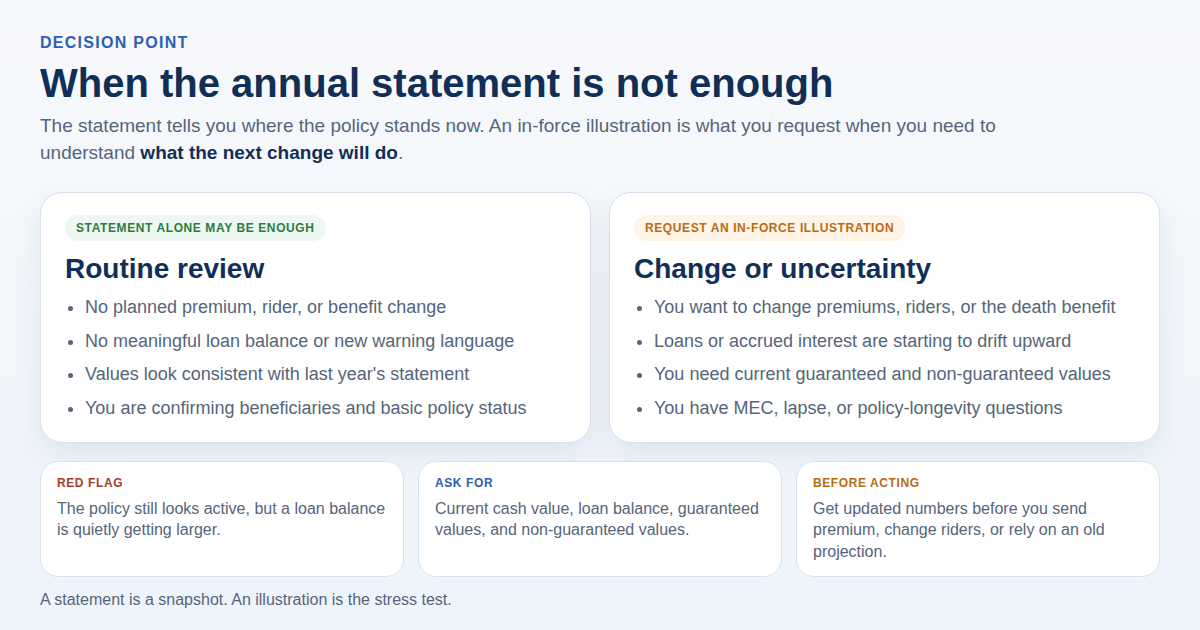 The annual statement tells you where the policy stands now. An in-force illustration tells you what a proposed change is likely to do next.
The annual statement is not the wrong document. It is just the wrong document for certain questions.
The NAIC illustration guidance says policyowners may request periodic updates on policy performance in the form of in-force illustrations after the first policy anniversary. That is the document you want when you need more than a snapshot. For the request steps, guaranteed-versus-illustrated columns, and the questions to ask before you rely on the run, use Top Whole Life's whole life in-force illustration guide.
Top Whole Life's recent Modified Endowment Contract Whole Life Guide drives this home from a design-risk angle: request a fresh illustration before changing premium, benefits, or rider structure. That article also pushes readers to ask for current cash value, current outstanding loan balance and interest, current MEC room, and the difference between guaranteed and non-guaranteed values.
In plain English, the statement may be enough when:
- you are doing a routine yearly review
- you are confirming the contract is still behaving as expected
- you are checking whether the policy still matches your current life situation
The statement is usually not enough when:
- you plan to change funding
- you plan to borrow more
- you want to reduce or adjust benefits
- you are evaluating rider changes
- you have a MEC or policy-longevity question
That is because the statement shows where you are. The in-force illustration is what helps you think through where the policy may go from here.
Red flags that deserve a carrier call before the next policy anniversary
You do not need to call the carrier because one number moved. You do need to call when the movement changes the decision.
These are the red flags I would not ignore:
1. The loan balance is no longer a side note
If the outstanding loan and accrued interest are now a meaningful part of the statement, that deserves review. A policy can stay active while flexibility quietly shrinks.
2. The premium pattern looks different than expected
If the payment picture changed, especially after a missed premium or a temporary workaround, you need to understand why. Do not assume the policy is "self-paying" just because the statement looks calmer than you expected.
3. The policy depends more heavily on non-guaranteed behavior than you realized
Top Whole Life's illustration and MEC guidance both emphasize the same discipline: know which values are guaranteed and which are not. If the success of your plan depends on future dividend behavior, that should be obvious before you make another decision.
4. You are thinking about changing the policy
The moment you go from reviewing to changing, the statement becomes only part of the work. That is the point to request the fresh illustration, not the point to rely on last year's assumptions.
5. The statement no longer matches the job you want the policy to do
Maybe the policy is still fine. Maybe your goals changed. Either way, the mismatch is what matters.
Questions to ask before you make any policy change
If you only use the statement once a year, use it to prepare better questions.
Bring these into the next conversation with the carrier or agent:
- What is my current premium pattern, and has anything changed from last year?
- What is the difference between current cash value and net cash value on this statement?
- What is my exact outstanding loan balance and accrued interest today?
- Which values or assumptions on this statement are guaranteed, and which are not?
- If I change premium, riders, or benefits, what does the current in-force illustration show?
- If I have loan, lapse, or MEC concerns, what additional document should I request right now?
- What changed since the last anniversary that I should not gloss over?
Those questions do two things. They slow down impulsive policy decisions, and they turn the statement from a passive document into an active review tool.
If you want a fresh comparison baseline before making a bigger decision, the practical next step is to request updated numbers and compare them against a new design through the Top Whole Life quote tool.
Your annual statement is not supposed to answer every question. It is supposed to tell you which question comes next.
This article is general education, not tax, legal, or investment advice. Confirm your policy language, current values, and any planned changes with your insurer before acting.