Modified Endowment Contract Whole Life Guide: 7-Pay Rules, Tax Risk, and the 60-Day Return Rule
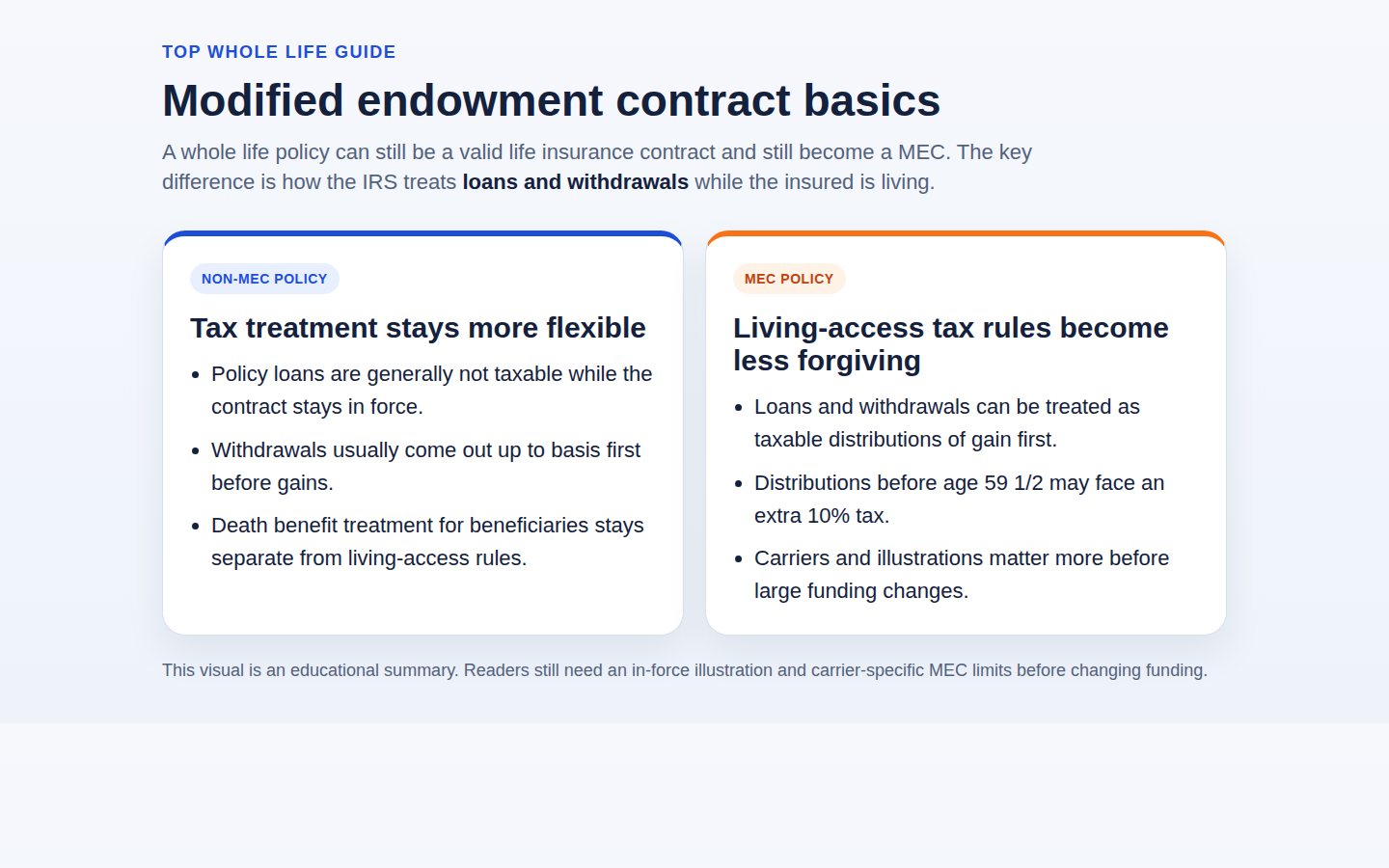
The real risk is not that a policy stops being life insurance. The real risk is expecting one set of living-access tax rules and finding out the IRS sees the contract differently.
A modified endowment contract whole life question usually shows up after the buyer has moved beyond the basics.
At that stage, you are no longer asking only, "Should I buy whole life?" You are asking harder design questions:
- should I overfund the policy?
- should I reduce the death benefit?
- should I add or change riders?
- how much cash value can I build without hurting future flexibility?
That is where MEC status matters.
Top Whole Life already tells readers in its overfunded whole life guide to confirm that an aggressive design does not cross into MEC territory. That warning is important because a whole life policy can still be a valid life insurance contract and still become a modified endowment contract under 26 U.S.C. § 7702A. When that happens, the biggest change is usually not the death benefit. The biggest change is how loans and withdrawals are treated while you are alive.
This guide is meant to help you understand the rules before you send extra premium, reduce benefits, or rely on an old illustration. It is general education, not personal tax advice. For a real policy decision, you still need the carrier's current MEC limits and an updated in-force illustration.
Why MEC status matters before you overfund
Whole life buyers often look at cash value first for good reasons. They may want:
- stronger early liquidity
- a better long-term policy loan strategy
- a paid-up design in fewer years
- a way to compare carriers on more than just face amount
That is why guides like Top Whole Life's single whole life quote tool and its top whole life companies for cash value attract shoppers who care about policy structure, not just price.
But there is a tradeoff hiding underneath that search behavior.
The more aggressively you push premium into a policy, the more important MEC testing becomes. Top Whole Life describes overfunded designs as policies that maximize cash value and minimize death benefit. That can be exactly the right design for the right buyer. It can also be the point where sloppy structuring creates a tax result the buyer never intended.
The short version:
- a non-MEC whole life policy usually preserves more flexible treatment for loans and basis-first withdrawals
- a MEC can change those living-access rules even if the policy still has permanent coverage and cash value
That distinction matters most to buyers who care about using the policy, not just owning it.
If your plan is to build cash value and never touch it, MEC status may matter less in practice. If your plan involves future loans, withdrawals, or flexible funding changes, it matters a lot.
What the 7-pay test actually means
The 7-pay test sounds technical because it is technical. The good news is that the practical takeaway is simple.
Under 26 U.S.C. § 7702A, a contract fails the 7-pay test if the amount paid during the first seven contract years is more than the amount that would have funded paid-up future benefits with seven level annual premiums.
In plain English, the IRS is asking a version of this question:
"Did this policy receive more premium, this early, than a seven-pay funding pattern would allow?"
That does not mean you need to sit at your kitchen table and calculate the limit yourself. In real life, the carrier and illustration system do that work. Your job is to know when the question needs to be asked.
Two practical points matter here:
- The test looks at the accumulated amount paid, not only one payment in isolation.
- The rule is tied to the policy's design, so the safe funding limit is not a universal number you can borrow from another quote.
That is why two policies with the same face amount can have very different MEC headroom.
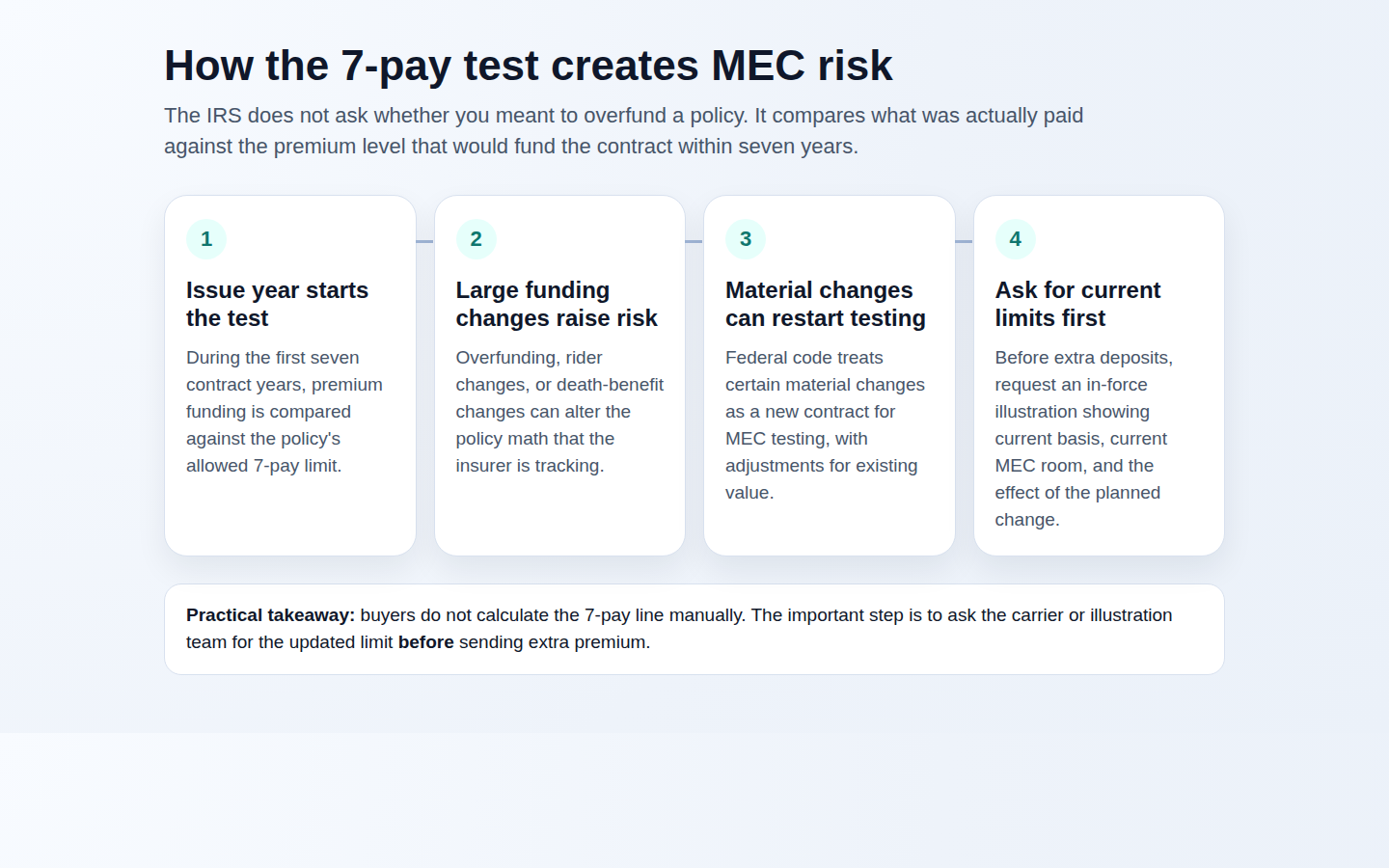 The safest habit is not trying to guess the limit. The safest habit is requesting the current limit before extra premium leaves your account.
The biggest mistake shoppers make is assuming an old illustration still answers a current funding question. It may not. If the design changed, if a rider changed, if premiums were skipped, or if the death benefit was adjusted, the policy may need to be tested under different facts than the original proposal.
What can trigger a new MEC test
This is the part many consumers miss.
MEC testing is not only an issue on day one. Federal code also addresses what happens when benefits change later.
Section 7702A says that if benefits are reduced during the first seven contract years, the contract is tested as if it had originally been issued at the reduced benefit level. It also says that certain material changes are treated as a new contract for MEC testing purposes, with adjustments that take the existing cash surrender value into account.
That matters because buyers often think only extra premium causes risk. Extra premium is a major risk point, but it is not the only one.
Examples that should make you slow down and ask for a fresh illustration include:
- reducing the death benefit
- adding or increasing a qualified additional benefit
- changing riders in a way that changes the policy economics
- making a funding change after a policy has already been in force for a while
The code is also more specific than most blog posts about what counts as a material change. It includes increases in death benefit and increases in, or additions of, qualified additional benefits. That means "I am just tweaking the design" can still be a real MEC question.
There is also an important narrow exception. If benefits were reduced because premiums were not paid, section 7702A says that reduction is not taken into account under the reduction rule if the benefits are reinstated within 90 days after the reduction.
That is a useful rule. It is not a permission slip to wing it.
The practical lesson is this: once a policy is in motion, every meaningful change should be evaluated in context of the current contract, not the original sales idea.
How MEC tax treatment changes loans and withdrawals
This is where a non-MEC vs. MEC distinction becomes more than a technical label.
IRS guidance in Rev. Proc. 2007-19 summarizes the consequences cleanly. It explains that MEC distributions are taxed under section 72 rules that:
- treat non-annuity distributions on an income-out-first basis
- generally treat loans, assignments, or pledges of MEC value as non-annuity distributions
- can impose a 10% additional tax on the taxable portion if the recipient is under age 59 1/2, unless an exception applies
That is a big change from the way many people casually talk about whole life.
A lot of consumer content says, "policy loans are tax-free." That statement can be directionally true in the right non-MEC context, but it is incomplete. Once a policy is a MEC, you cannot assume the same result.
For a shopper, the practical differences are:
1. Loans stop being something you can describe casually
If a policy is a MEC, the tax conversation around loans gets more serious. You are no longer dealing with a simple marketing statement about "accessing your cash value." You are dealing with section 72 treatment.
2. Withdrawals can hit gain first
Income-out-first treatment means you cannot assume you will pull out basis first the way many buyers expect from a non-MEC framework.
3. Age matters
If you are under age 59 1/2, the extra 10% tax risk can change the economics of using the policy for near-term access.
4. The death benefit conversation is separate
A MEC is not the same as "your beneficiaries no longer get a life insurance death benefit." The more direct issue is how living distributions are taxed while the insured is alive.
This is one reason buyers who care about future flexibility should compare more than just projected cash value. They should also compare how the policy is designed, how much MEC room it has, and how loans are expected to function if they are ever used.
How the 60-day return rule and other correction windows can work
The phrase "fix window" gets thrown around too loosely online. There is a real returned-premium rule in section 7702A, but it needs to be described carefully.
Under section 7702A, if part of a premium is returned with interest within 60 days after the end of the contract year in order to comply with the 7-pay test, that returned premium amount is treated as reducing premiums paid for that year.
That is useful. It is also narrower than many readers assume.
What this does not mean:
- it does not mean every bad funding decision has a simple consumer undo button
- it does not mean you should intentionally overpay and clean it up later
- it does not mean every carrier admin issue is resolved by one call
What it does mean is that returned-premium treatment exists in the statute and should be part of the conversation when a buyer thinks excess premium may already have been accepted.
There is also the separate 90-day reinstatement rule for certain benefit reductions caused by nonpayment, which is related but not the same thing.
Then there is a third layer that serious buyers should know about: issuer-level remediation. IRS Rev. Proc. 2007-19 explains that the Service may enter closing agreements for inadvertent non-egregious MEC failures. That is not a casual self-help strategy. It is an administrative relief path that involves the issuer and detailed contract information.
The consumer takeaway is simple:
If you think a policy may have crossed the line, escalate quickly.
Do not wait six months because the policy still "looks fine" on the portal. Ask the carrier or your licensed advisor whether:
- excess premium was accepted
- any portion can or should be returned
- a material change triggered a new test
- the carrier sees the policy as a MEC already
Questions to ask before you change a whole life design
Top Whole Life's overfunding article already asks the right kind of buyer-behavior questions: why you want whole life, what you plan to use the policy for, how you plan to fund it, when you want to access the cash value, and whether you can keep funding it during a bad income year.
That is a good start. Before any funding change, add these MEC-specific questions:
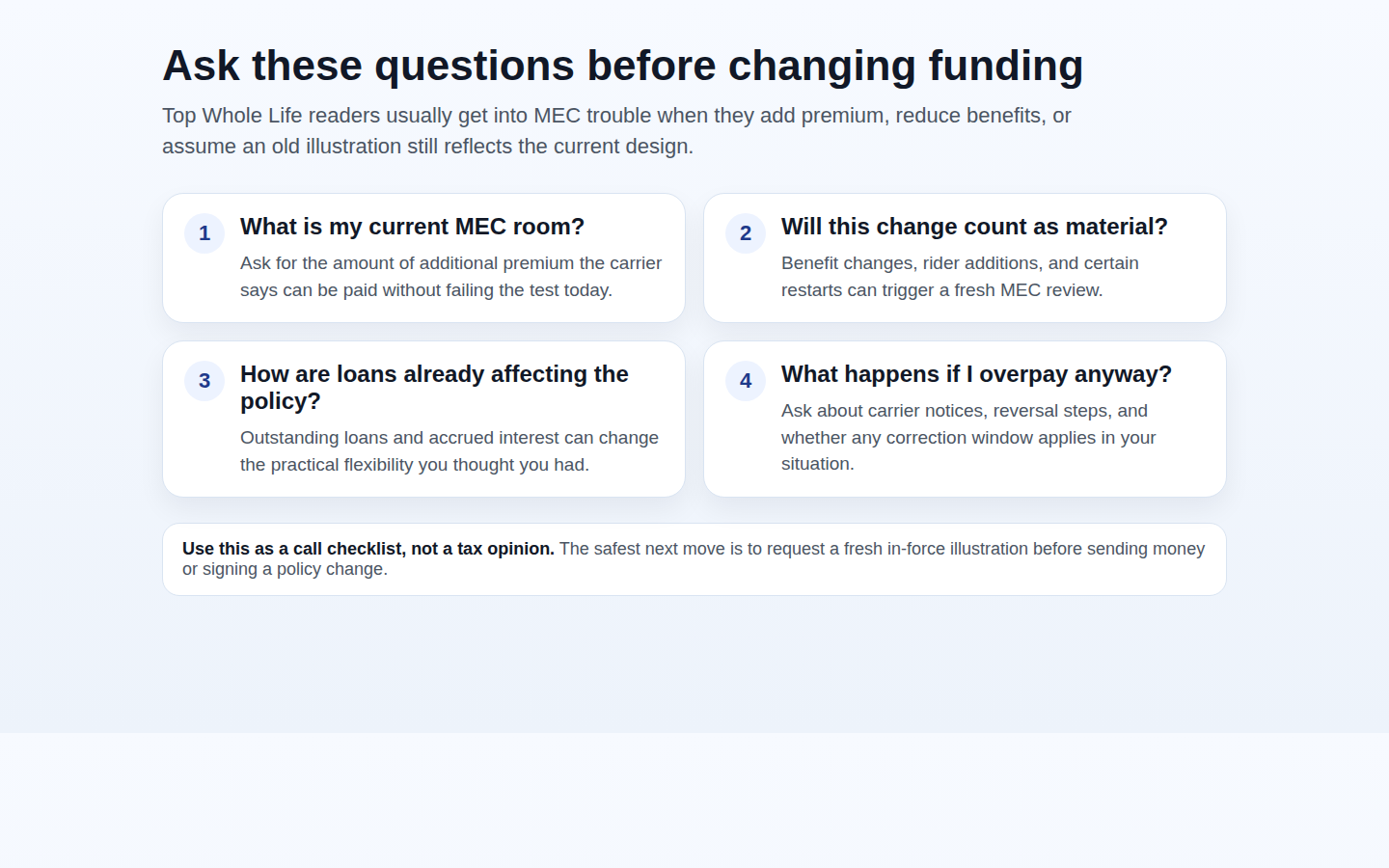 A good call with the carrier or agent should end with numbers, not vague reassurance.
-
What is my current MEC room?
Ask for the maximum additional premium the carrier says can be paid today without failing the test. -
Has anything changed since the last illustration?
This includes loans, rider changes, missed premiums, death-benefit adjustments, or benefit reductions. -
Would this change be treated as material?
If yes, ask how the carrier is re-testing the policy. -
What happens if I send the money and it is too much?
Ask specifically about returned-premium procedures, notices, and timing. -
How do current loans affect flexibility?
Outstanding loans and accrued interest can change what looks practical on paper. -
Which values are guaranteed and which are not?
Dividends are not guaranteed, and policy design decisions should not pretend otherwise. -
What is the recommended next document?
Usually the answer should be a current in-force illustration, not a verbal estimate.
These are the kinds of questions that make the difference between "I was told this would work" and "I reviewed the design before changing it."
When to request a fresh illustration
If you remember only one tactical move from this article, make it this one:
Request a fresh illustration before changing premium, benefits, or rider structure.
That request should happen when you are:
- planning to overfund
- reducing the face amount
- restarting funding after a disruption
- adding or increasing riders
- comparing whether a new design is still better than a simpler structure
What should you ask the carrier or agent to show?
- current basis
- current cash value
- current outstanding loan balance and loan interest
- current MEC limit or remaining headroom
- whether the planned change is treated as material
- how the change affects guaranteed values
- how the change affects non-guaranteed values
That last distinction matters. Top Whole Life correctly emphasizes guarantees and performance, but a serious buyer should always remember that dividends and illustration projections are not guaranteed. When a design decision depends on future dividend assumptions, that should be obvious in the conversation.
If you want help reviewing whether a policy design is still aligned with your goal, the practical next step is to request a fresh comparison through the Top Whole Life quote tool or compare it against the site's broader whole life tax guide and cash-value company comparison.
The bottom line for whole life buyers
A modified endowment contract is not a random technical footnote. It is one of the main rules that separates an aggressively funded whole life design from one that preserves the living-access treatment many buyers expect.
The safest sequence is:
- decide what you want the policy to do
- ask how the current design is being tested
- request updated numbers before sending money
- confirm how loans and withdrawals would be treated if the policy ever became a MEC
That is the kind of due diligence that protects flexibility later.
This article is general education, not tax or legal advice. Confirm your own policy details, carrier notices, and tax treatment with the insurer and a qualified tax professional before making funding or distribution decisions.