What Filings Show About Politicians' Life Insurance
People type a famous name plus “life insurance” because they want a shortcut: if a senator or a governor owns a certain policy, maybe that is the smart product. Public ethics law is a terrible shopping catalog for that instinct. It is a pretty good catalog for a different skill — reading a form without inventing a policy.
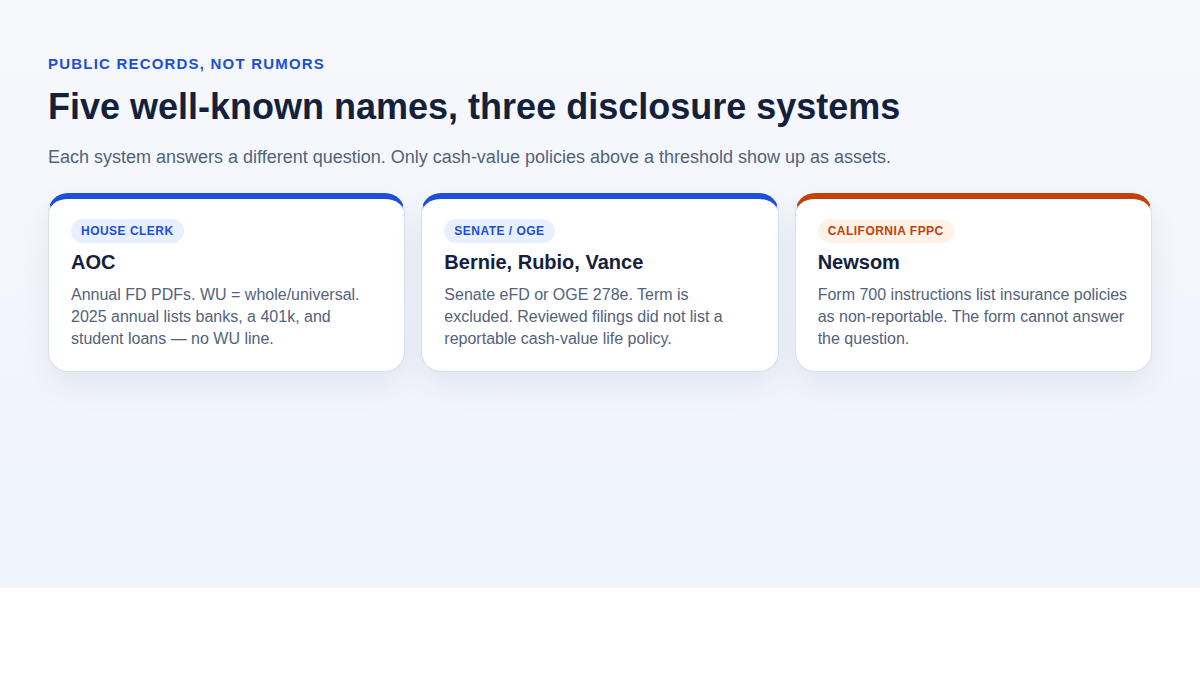
This roundup looks at five people readers asked about by name: Alexandria Ocasio-Cortez, Bernie Sanders, JD Vance, Marco Rubio, and Gavin Newsom. Each has a public financial-disclosure trail. None of the primary records we opened listed a reportable cash-value life-insurance policy we could quote. One of them files a state form that is instructed not to list insurance at all.
That is still a publishable story if you stay inside the documents. It is a malpractice story if you pad it with “they must have whole life.” For the reporting rules in one place, use the companion explainer on how financial disclosures report life insurance. For the presidential form in particular, see the updated Trump disclosure piece.
This is education, not a claim about anyone’s private term coverage, FEGLI election, or estate plan. Confirm the live PDF before you repeat a line.
What counts as evidence on these forms
Federal public financial disclosure grew out of the Ethics in Government Act. The House Clerk publishes member PDFs. The Senate has an electronic filing system. The President, Vice President, and many Senate-confirmed appointees file OGE Form 278e. California’s Form 700 is a conflict-of-interest statement with a different exclusion list.
On the House side, the asset type code list is the decoder ring:
- WU — whole/universal insurance
- VI — variable insurance
- FN / VA — fixed or variable annuity (related, not the same as a death-benefit policy)
The House instruction guide says term life policies are not reportable. Whole and universal life are reported with the company name, the type, and the cash value. Convertible term that has not converted yet stays off the schedule.
OGE’s Part 6 guide says the same thing in executive-branch language: report whole or universal life above $1,000 of value (or $200 of income); do not report term.
So a blank is allowed to mean “term,” “tiny cash value,” “no policy,” or “wrong form.” A WU line with a name on the first page of the PDF is the only kind of hit this article will treat as a named policy.
Alexandria Ocasio-Cortez: a House PDF with no WU line
The Clerk index file 2025FD.txt lists Hon. Ocasio-Cortez, NY-14, annual report DocID 10076462, filed August 6, 2026. The PDF itself names her on page one. That identity check matters, because search engines often title House PDFs by the first unusual asset, not by the member.
Schedule A on that annual report shows:
- Allied Bank savings, $15,001–$50,000, interest $201–$1,000
- Charles Schwab Bank checking, $1,001–$15,000
- Charles Schwab One brokerage, $1–$1,000
- National Hispanic Institute 401(k) holding Prudential High Yield Z, $1,001–$15,000, tax-deferred
Schedule D shows U.S. Department of Education student loans from 2007–2011 in the $15,001–$50,000 band. Schedule F notes continued participation in that 401(k). There is no WU, VI, or “life insurance” asset.
An amendment filed the next day (DocID 10081499) is the same shape: banks, 401(k), student loans. Still no cash-value life line.
What this filing does illustrate is an early- and mid-career balance sheet: cash, a small workplace retirement account, and student debt. It does not prove she has no term coverage. House rules would hide term on purpose. It also does not prove a death benefit. There is no death-benefit field on Schedule A.
If you are in a similar place financially, the boring version of the lesson is the useful one. Term is usually how people put a meaningful death benefit in force while cash is tight. Permanent coverage is a different budget. Neither decision requires a member of Congress as a mascot. If you want carrier math for your own age and state, use the quote form.
Bernie Sanders: retirement and annuity lines, not a life policy
Senator Sanders’s Senate annual reports are public. The calendar-year 2022 annual, filed May 11, 2023 and hosted on DocumentCloud, lists spouse retirement plans at TIAA-CREF and VALIC, including fixed annuity and traditional annuity lines in the usual Senate bands, plus a joint mortgage. The extracted asset table does not include a separately labeled life-insurance policy.
A later 2024 annual exists (filed May 15, 2025). A direct download of that PDF was blocked in this research pass; contemporary write-ups of the 2024 report describe the same family of holdings — credit-union cash, TIAA/VALIC retirement and annuity vehicles, royalties — without a life-insurance policy line. Treat 2024 as consistent with 2022 unless you open the Senate PDF yourself.
Annuities on a disclosure are easy to confuse with life insurance. They can be tax-deferred accumulation products. They are not automatically a death-benefit whole life contract. TIAA Traditional and VALIC fixed accounts in a spouse’s teacher retirement are especially easy to misread if you only search the word “annuity.”
Senate ethics sits in the same federal family as OGE and the House: cash-value life can appear; term generally does not. A missing life line on Sanders’s annual is not a statement that a U.S. senator lacks FEGLI or a private term policy. It is a statement that the annual we could read did not report a cash-value life asset.
JD Vance: an OGE 278e without a life-insurance asset
Vice President Vance’s certified 2025 annual OGE Form 278e is posted through the same OGE notice as the President’s report. A text extract of that filing lists employment/investment assets in the usual 278e style (funds, book-related items, and other holdings). It does not include a life-insurance asset line we could quote.
OGE’s own definitions file is the constraint. Term is on the not-reportable list. Whole, universal, and variable life are reportable as assets when cash surrender value (not face amount) clears the threshold.
Vance’s public report is therefore a clean teaching case for high-income households: you can have a thick 278e and still show no cash-value life line. That can mean the household uses term, uses a policy too small to report, uses no policy, or holds coverage in a way the instructions do not pick up as a Part 6 life-insurance entry. The PDF does not pick a winner among those options.
If you are building coverage for a working-years income need, term is usually the tool that matches the job. If you want a permanent contract with cash value, you are shopping a different product, with a different premium, which is what whole life is for. Neither conclusion is hiding in a Vice President’s ETF list.
Marco Rubio: Senate years and an older OGE 278, still no policy line
Rubio’s paper trail is split across Senate annuals and an executive-branch form from his 2016 presidential campaign. The 2016 candidate OGE 278, which is public, lists ABA retirement funds, a Florida pension interest, 529/prepaid plans, Tallahassee rental property, book royalties, and several mortgages. The extracted asset list does not include a life-insurance policy.
He later filed Senate annuals through 2024 and, after moving to the cabinet, appears in executive-branch ethics collections. A ProPublica parse of the appointee-style disclosure similarly did not surface a life-insurance asset among the liabilities and holdings it tabulated. That is secondary to opening the latest 278e yourself, but it is consistent with the 2016 candidate form.
So the honest Rubio sentence matches the others: no reportable cash-value life policy in the primary documents we could itemize. Mortgages and 529 plans are not a substitute for a WU line. They are a reminder that ethics forms are built to flag conflicts and large assets, not to publish a family insurance binder.
Gavin Newsom: Form 700 cannot answer the question
This is the one name where “we did not find a policy” is the wrong frame. California’s Form 700 is not trying to list life insurance.
The FPPC Schedule A-1 and A-2 instructions tell filers they are not required to disclose insurance policies, annuities, bank accounts, diversified mutual funds, cryptocurrency, and several other categories. Form 700 is a conflict statement: investments, real property, income, and gifts that could collide with state decisions.
Newsom files Form 700 as Governor. A 2025/2026 statement is public through FPPC’s portal. Because insurance is on the non-reportable list, that document cannot confirm or deny a life-insurance policy. Using it that way is a category error, like using a flood map to diagnose a slab leak.
If he ever files a federal public financial disclosure as a candidate or appointee, the OGE/House/Senate rules would apply instead. Until then, California ethics law is the reason this roundup stops at the instruction page rather than inventing a carrier.
What a real WU hit looks like (and the AOC mix-up)
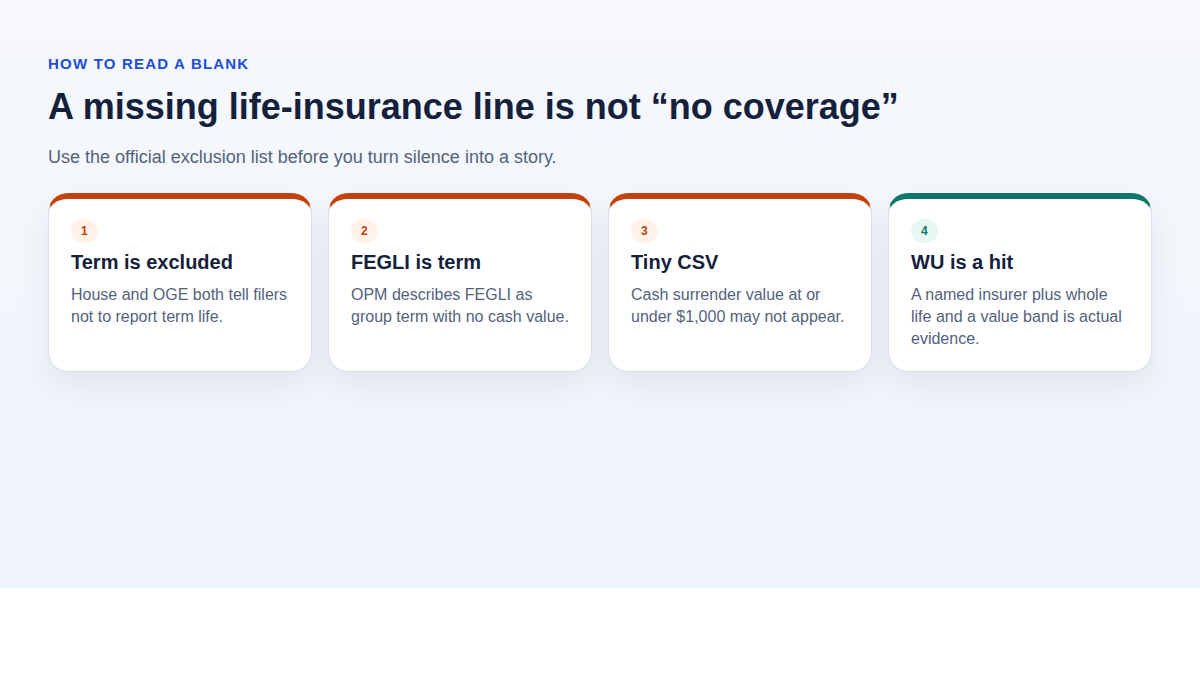 Term, FEGLI, and small cash values can all leave Schedule A blank. A named WU line is the hit.
While searching for AOC, Clerk search results titled a PDF “AIG Life Insurance.” The file was not hers.
Filing ID 10074771, filed August 6, 2026, page one: Hon. Young Kim, Member, CA-40. Schedule A includes:
- AIG Life Insurance [WU], $1,001–$15,000, income None
Comment: Whole Life Insurance Cash Accumulated Value - Mass Mutual fixed annuity [FN], $1,001–$15,000, tax-deferred
That is what a real hit looks like: filer name on page one, code WU, company name, type in the comment, cash-value band. The band is not the death benefit. OGE and House both value these contracts on cash surrender / cash accumulated value.
The same week’s Clerk index also points to other WU-heavy reports that belong on a future list, not in this five-name roundup: Rep. Monica De La Cruz (NY Life and State Farm whole life on her 2024 annual), Rep. Mark Messmer of Indiana (Knights of Columbus, Northwestern Mutual, Farm Bureau, Catholic Financial Life on his 2025 annual). Those PDFs passed the filer-name test. They are not substitutes for AOC or Newsom.
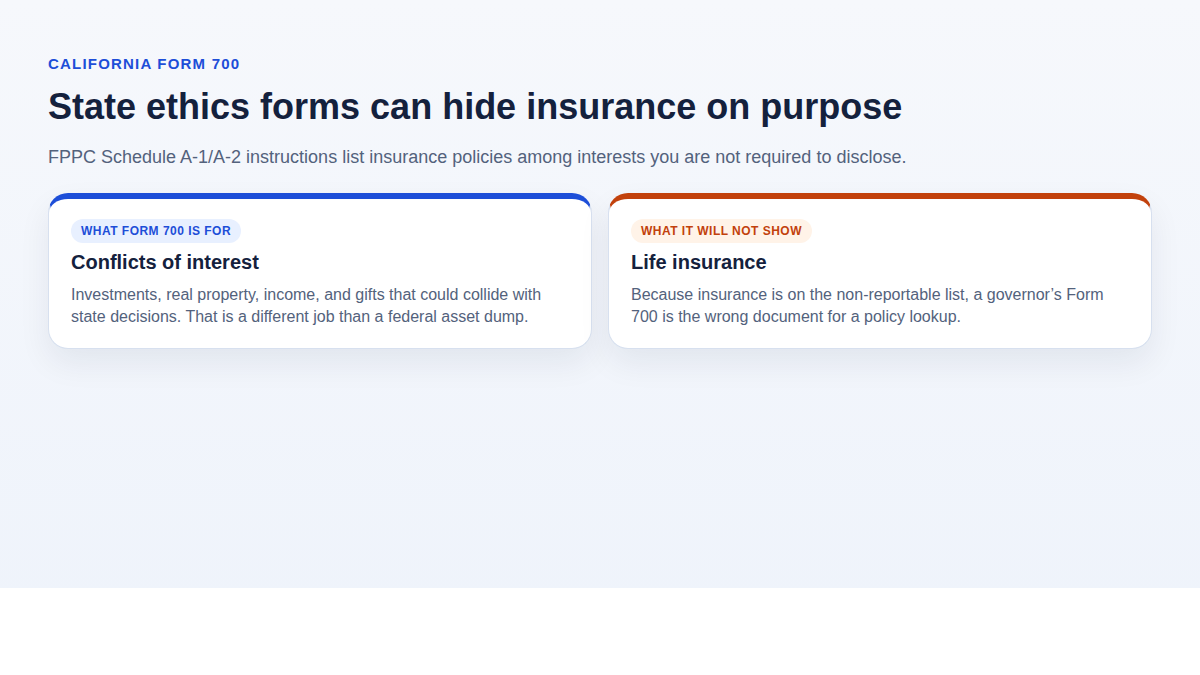 If the instructions exclude insurance, you cannot mine the PDF for a policy. You can only teach the exclusion.
What to copy from the method, not the famous names
The five requested names did not give Top Whole Life a row of celebrity whole-life quotes. They gave a cleaner editorial rule: open the PDF, confirm the filer, quote the code, and stop.
If you are shopping for yourself, translate that rule into ordinary coverage decisions:
- Need a large death benefit for a defined number of years? Term is usually the efficient tool, and it would not show up on these forms anyway.
- Need something that is supposed to last, with cash value and guarantees? That is the what whole life insurance is conversation, and it should be driven by your illustration, not by whether a senator’s annuity line looked similar in a search box.
- Saw a WU band on someone else’s filing and want the same cash value? You still do not know their death benefit, health class, or premium. Ask for quotes instead of cloning a range.
Public records are how this site can write something the SERP cannot copy without doing the work. They are not a way to announce that a politician is uninsured, over-insured, or clever. The forms were not written for that.
This article is general education, not tax, estate, or insurance advice. Filings and instructions change. Confirm the Clerk, Senate, OGE, or FPPC document before repeating a line, and review your own coverage with a licensed professional.