How Financial Disclosures Report Life Insurance
How financial disclosure life insurance lines work is simpler than the gossip around them. A cash-value policy is one of the few insurance contracts that can show up in public. It is also one of the easiest lines to misread. Search engines title House PDFs by the asset, not always by the member. OGE values whole life at cash surrender value, not the death benefit. California’s Form 700 is told not to list insurance at all.
If you want a celebrity shopping list, stop here. If you want a method you can reuse on the next PDF — or on your own illustration — the rest of this page is the decoder.
Worked examples using that method are in what public filings show about politicians’ life insurance and the updated Trump OGE piece. Product mechanics still live on what whole life insurance is.
This is education, not advice about any named person. Instructions change; open the current guide before you quote a rule.
Start with the instructions, not a rumor
Ethics forms exist to flag conflicts and sizable assets. They are not policy illustrations. They do not ask for face amount, health class, or premium. They often use ranges ($1,001–$15,000, $15,001–$50,000) instead of a single dollar figure.
That design creates two failure modes:
- False positive: You see “AIG Life Insurance” in a search snippet and write the wrong person’s name.
- False negative: You see no life-insurance line and announce that someone is uninsured, even though term is excluded and FEGLI is group term.
The fix is dull and reliable. Read the instruction booklet for that form. Then open the filing. Then copy only what is on the page. If a sentence is not on the page, it does not belong in the article, the caption, or a social teaser.
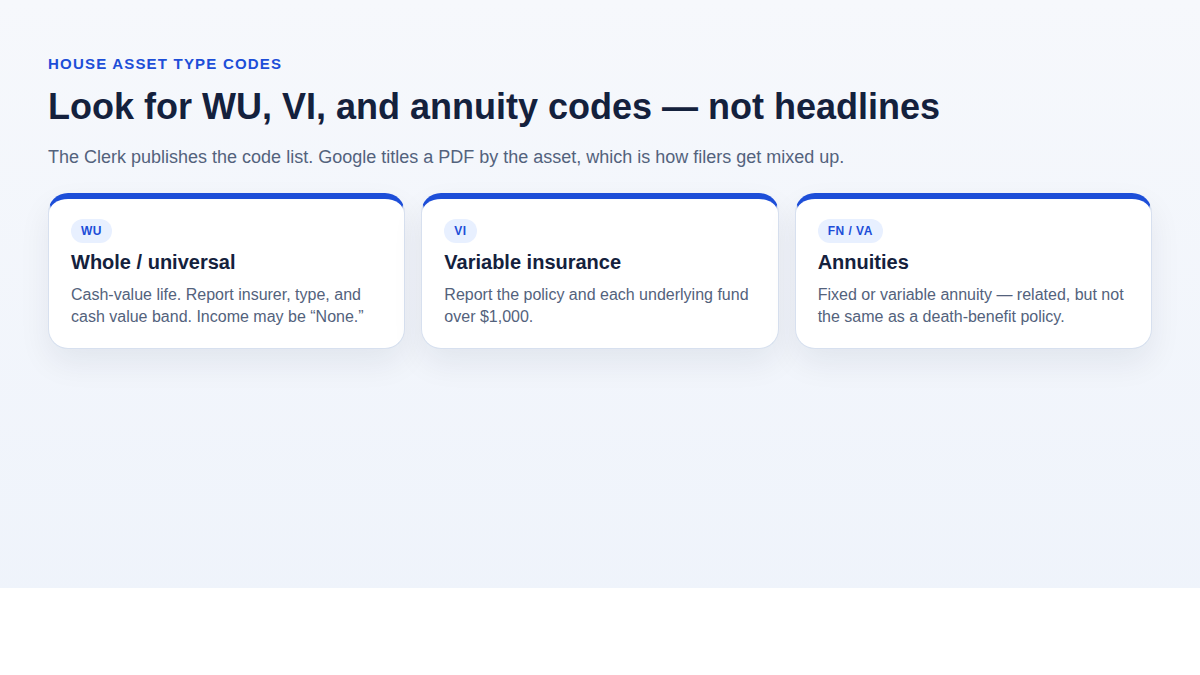
House codes: WU, VI, and the annuity cousins
The House electronic system tags every asset with a code. The public code list is short enough to keep open in a second tab:
- WU — Whole/Universal Insurance
- VI — Variable Insurance
- FN — Fixed Annuity
- VA — Variable Annuity
The 2024 instruction guide (still the booklet paired with recent cycles) says:
- Term life policies are not reportable.
- Whole or universal life: disclose the company, the type, and the cash value. Income may be reported as None.
- Variable life: disclose each investment option that was worth more than $1,000 or that generated more than $200.
- Convertible life that has not been converted to whole life is not required. After it converts, it is a whole life asset.
The House Committee on Ethics common oversights page adds a practical reminder: include the type of life insurance (whole, universal, or an annuity) with the asset name, and break out underlying holdings inside a variable contract.
Income reported as “None” is normal on a WU line. Whole life cash value is an asset. It is not a paycheck. Dividends, if the contract is participating, may still be silent on the ethics form because the instruction set is not an illustration. Do not upgrade “None” into “the policy is worthless,” and do not upgrade the top of the band into a premium.
A worked WU example, with the filer confirmed on page one: Rep. Young Kim (CA-40), filing ID 10074771, August 6, 2026, lists AIG Life Insurance [WU] at $1,001–$15,000 with the comment “Whole Life Insurance Cash Accumulated Value,” plus a Mass Mutual fixed annuity. That is a real hit. It is still only a cash-value band. It is not her death benefit. The same first page also lists residential property in a much higher band. That contrast is the point: ethics forms will show a house more loudly than they show a modest cash-value life contract, because they are measuring reportable assets, not family protection.
OGE Form 278e: report cash value, skip term
Presidential, vice-presidential, and many Senate-confirmed filers use OGE Form 278e instead of the House Clerk PDF. The Part 6 guide is the map.
Report whole or universal life in Part 6 if the value was more than $1,000 at period-end or income was more than $200. Write the company name and “whole life” or “universal life.” Variable life adds underlying holdings over $1,000.
Do not report a term policy for the filer, spouse, or dependent child.
The OGE FAQs close the valuation loophole: for disclosure, the value of whole, universal, or variable life is the cash surrender value, not the face value.
If you take nothing else from OGE, take that. A $1,001–$15,000 band is not a $1,001–$15,000 death benefit. Treating it as face amount is how a blog turns a small cash-value contract into a fake “tiny policy” story — or, in the other direction, how a large estate rumor becomes a fake “must have millions of whole life” story.
Senate electronic filings sit in the same Ethics in Government Act family. The screens look different. The economics do not: cash-value life can appear; term generally does not; numbers are bands.
OPM’s FEGLI page is the other document to keep next to any executive-branch 278e. FEGLI is group term. It has no cash value to park in Part 6. A cabinet officer can have Basic coverage plus optional multiples and still file a report that never uses the words “life insurance.” That is compliance, not a secret.
California Form 700: insurance is excluded on purpose
State forms are not junior versions of OGE. They have their own job.
The FPPC Schedule A-1 / A-2 instructions list insurance policies among interests you are not required to disclose, alongside annuities, bank accounts, and diversified mutual funds. Form 700 is a conflict-of-interest statement: business investments, real property, income, gifts.
The exclusion list is the tell. Form 700 is trying to catch a conflict: a business holding, a parcel, a gift, or income that could collide with a state decision. A diversified mutual fund, a bank account, and a life-insurance policy are treated as the wrong kind of interest for that job. Insurance is not uniquely “hidden.” It is grouped with other personal-finance accounts the FPPC does not need for conflict screening.
So if the person you are curious about is a California official and you only have Form 700, you cannot answer “what life insurance do they have?” You can only teach the exclusion. That is the Newsom case in the politicians’ filings roundup. Mining the PDF for a carrier would be inventing data the filer was told not to provide. If that official later files a federal public financial disclosure as a candidate or appointee, switch forms. Do not keep quoting Form 700 as if it were OGE.
The filer-name trap
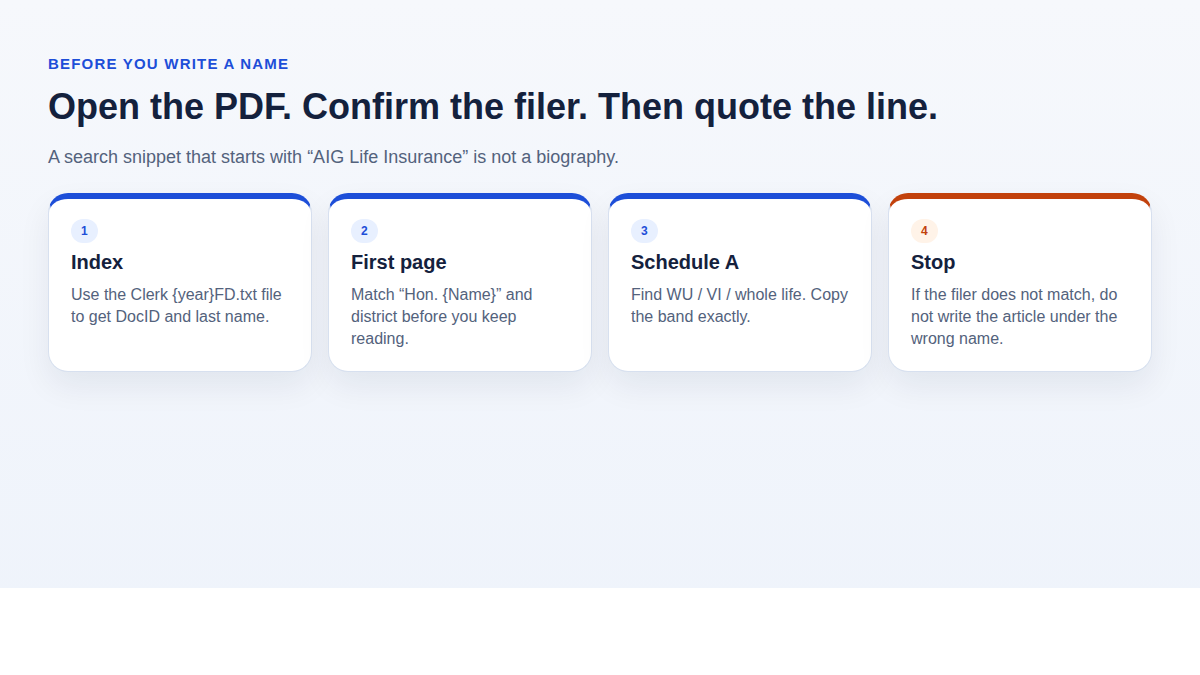 Google will title a House PDF “AIG Life Insurance.” Page one will name the actual member. Believe page one.
Here is the mechanical workflow that would have stopped a wrong AOC story:
- Index. Download the House Clerk 2025 financial-disclosure index (or the 2026 file). The columns are name, filing type, state/district, year, date, DocID.
- URL. PDFs live under the Clerk financial-pdfs folder, in a year subfolder plus the DocID. The folder year is not always the calendar year in the form header — trust the PDF.
- Page one. Match “Hon. {Name}” and the district. If it is not the person in your headline, stop.
- Schedule A. Search for WU, VI, “whole life,” “universal,” “variable.” Copy the band exactly. Do not upgrade it to a face amount.
- Comments. House filings often put “Whole Life Insurance Cash Accumulated Value” in a description field. That sentence is doing the valuation work OGE puts in a FAQ.
The Young Kim / AOC mix-up is the exhibit. Search titled 10074771 as AIG Life Insurance. The header is Hon. Young Kim, CA-40. Ocasio-Cortez’s own 2025 annual is 10076462 and has no WU line. If you skip step 3, you will write the wrong article with great confidence.
Keep a text index of DocIDs. Do not attribute a policy from a snippet.
What to do with a hit — and with a blank
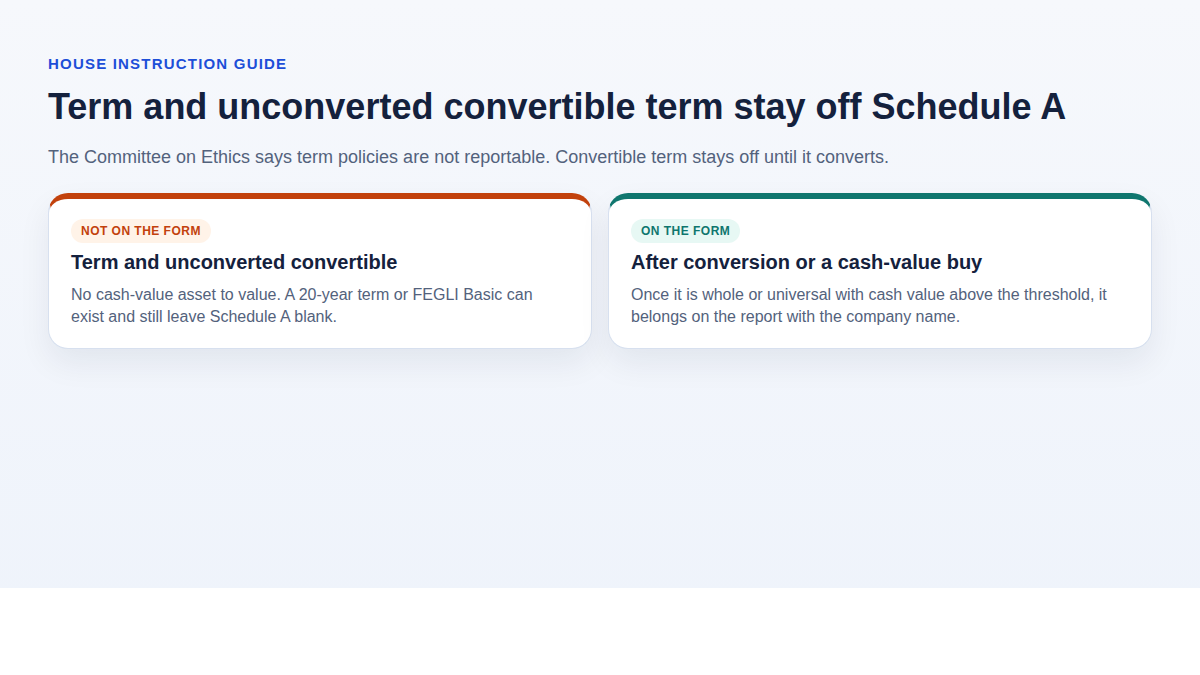 Convertible term is invisible until it converts. That is an instruction, not a loophole you should narrate as secrecy.
If you have a WU or OGE whole-life line: Quote filer, date, filing ID, company, type, and range. Link the PDF. Say out loud that the number is cash value. Then, if you are writing for people who buy insurance, translate: this is evidence that a permanent contract exists in that cash-value band. It is not a recommendation, a premium, or a face amount. Readers who want their own numbers still need an illustration and, if they want quotes, the multi-carrier form.
If you have a blank: Quote the form and the exclusion. Mention term, FEGLI, and the $1,000 cash-value floor. Do not write “uninsured.” Do not write “they only believe in term” unless the person said that in a different primary source.
If you have Form 700 and no federal 278: Stop at the instruction page. The absence is structural.
If you are shopping for yourself: The disclosure skill is the same as a good illustration review. Ask which number you are looking at. Cash value is not death benefit. Term premium is not whole life premium. A conversion privilege is a contract line, not a vibe. Public PDFs will not complete that review for you, and neither will a famous name.
A practical translation of Young Kim’s band: someone can own a permanent contract whose surrender value still sits in a four-figure or low five-figure range. That can be an early-year policy, a small face amount, or a contract that has been borrowed against. You cannot tell which from Schedule A. Your own illustration has to answer those questions with a product name, a premium pattern, and a guaranteed column — not with a politician’s PDF.
The point of this method is not to build a trading card set of politicians. It is to keep YMYL writing honest when the internet offers a shortcut. Official records can create articles competitors cannot copy without opening the same PDF. They cannot create a policy that is not on the page.
This article is general education. It is not tax, estate, or insurance advice. Confirm current ethics instructions and the live filing, and review your own coverage with a licensed professional.