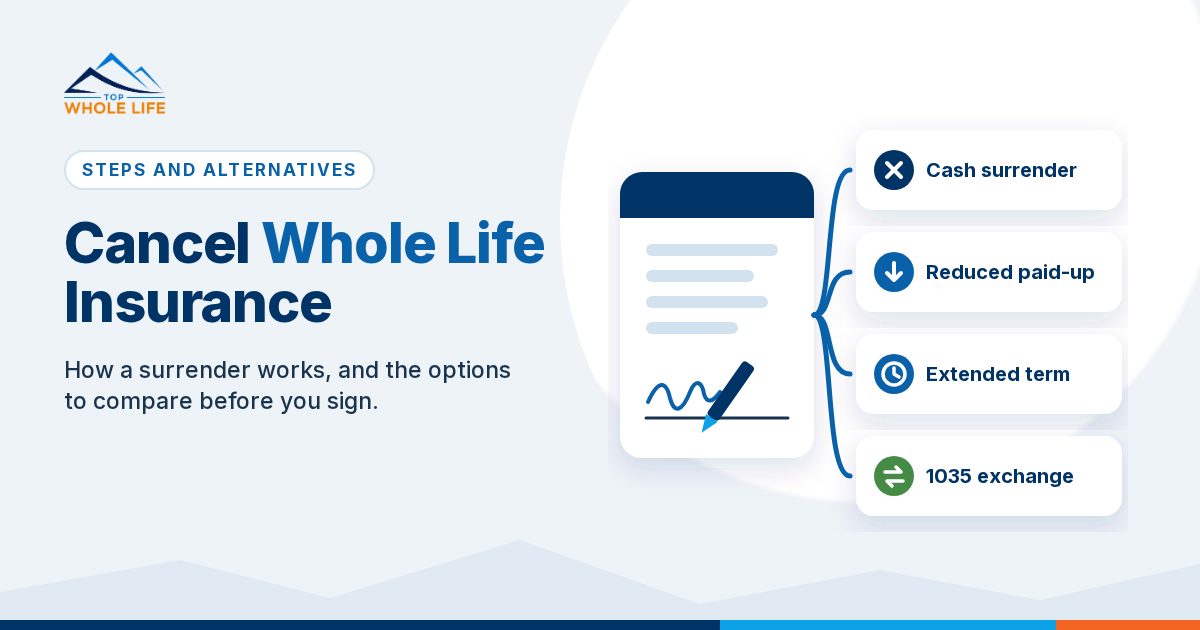
Cancel Whole Life Insurance (2026): Steps and Alternatives
Updated October 17, 2026
Quick answer: Yes, you can cancel a whole life insurance policy. If the policy just arrived, return it during the free-look printed on the contract and the insurer refunds the premium. After that, cancellation is a written surrender: the owner signs the insurer's surrender form, the policy ends, and the insurer pays the cash surrender value, with any outstanding loan deducted. Compare the alternatives in the table before you send that form. A cash surrender is taxable when the proceeds are more than your cost. As of October 17, 2026.
This page is general education. It is not personal tax, legal, or policy advice. The contract and your state set the deadline and the amount.
How to cancel a whole life insurance policy
1. Use the free-look when the policy was just delivered
Return a new policy during the free-look and the insurer refunds the premium. These sources do not use one national day count. Each figure below is that source's own number, as of Oct 17, 2026.
- The NAIC Life Insurance Buyer's Guide (© 2026) says you can return a new policy for a full refund within a certain period, usually 10 days after you receive it. The review period usually is stated on the first page of the policy.
- The Texas Department of Insurance life insurance guide says Texas policies have a free-look period of at least 10 to 20 days. During that time you may cancel for any reason and get a full refund.
- The Washington Office of the Insurance Commissioner life insurance guide says every new life insurance policy issued in Washington state comes with a 10-day free look period, and that you may return the new policy within 10 days after you receive it.
- California Insurance Code section 10127.9 says the period set by the insurer on an individual life policy delivered or issued for delivery in California shall be not less than 10 days nor more than 30 days.
The number printed on your policy is the deadline that applies to you.
Send the policy back to the insurer or to the agent who sold it. California Insurance Code section 10127.9 requires that path on the cover of an individual life policy delivered in California. The Washington Office of the Insurance Commissioner life insurance guide says to mail it to the company's home office or hand it back to the agent, and to keep a dated receipt.
2. Keep the current policy until a replacement is in effect
When the plan is to buy another policy, keep the current one until the new policy is in effect. As of October 17, 2026, the NAIC Buyer's Guide says not to cancel the current policy until you get the new one. Washington's guide says not to drop the old policy until the new one takes effect.
3. Ask for the cash surrender value before you sign
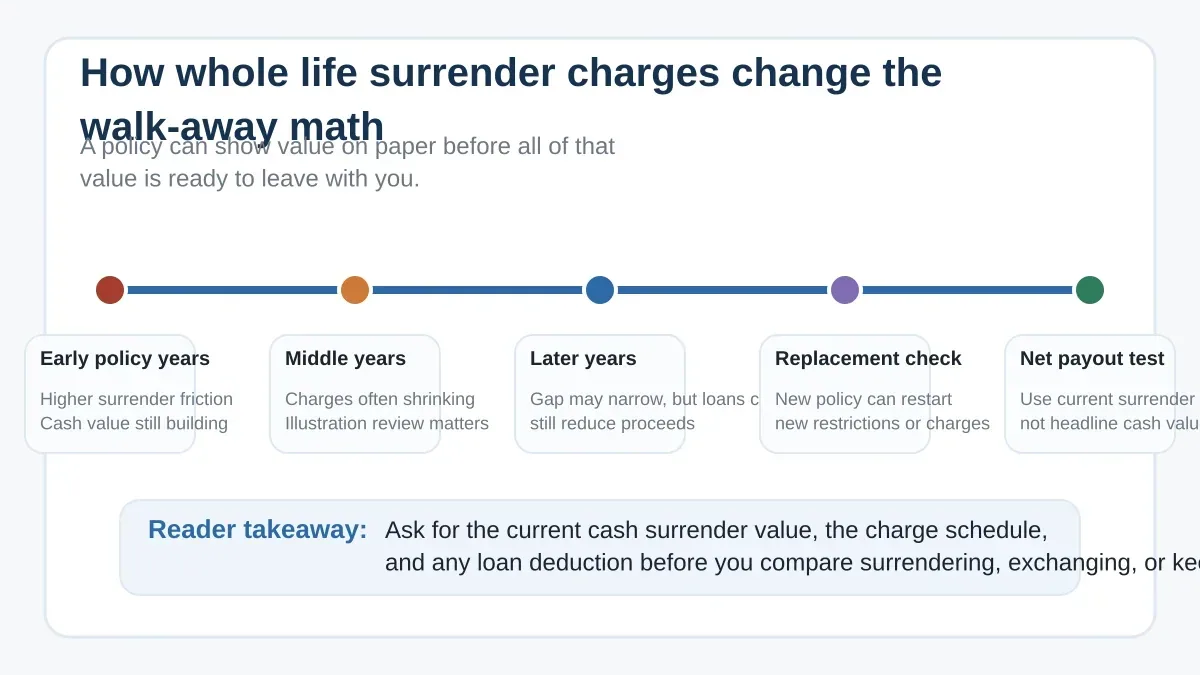
Ask the insurer, in writing, for the current cash surrender value, any loan balance, and the nonforfeiture options in your contract. NAIC Model 808, the Standard Nonforfeiture Law for Life Insurance (January 2014 text), describes a cash surrender value paid in place of the paid-up nonforfeiture benefit, and a policy table of those values. Your contract's table is the number that applies to you. How cash value and cash surrender value come apart is explained in whole life surrender charges.
4. Sign the insurer's surrender form
After the free-look, cancel with the company's surrender form. The policy owner signs it. As of October 17, 2026, two carrier forms describe the same request:
- MetLife's Full Policy Surrender Request is the form for a full surrender and termination. Every policy owner signs and dates it, and the form asks for payment of the proceeds.
- American Fidelity's Surrender/Cancellation Statement says to complete and return the form. The policy owner signs. The cash value, after any debt to that company is deducted, settles all rights under the policy.
Use the form your own insurer provides. Those two forms show the shape of the request. They are not a form you can send to a different company.
5. Keep a copy until the insurer confirms the end date
The signed surrender is what ends the contract. MetLife's form requests full surrender and termination. American Fidelity's form states that the cash value is accepted in full settlement of all rights under the policy. Keep a copy of the signed form and the insurer's confirmation of the end date and the amount paid.
Stopping premiums is a different path. NAIC Model 808 says a missed premium leads to a paid-up nonforfeiture benefit unless you surrender for the cash value. The National Association of Letter Carriers life insurance definitions (June 2022) say that when a whole life policy ends for non-payment, the owner receives a nonforfeiture value. Sign the surrender form when the goal is the cash.
Surrender value versus the alternatives
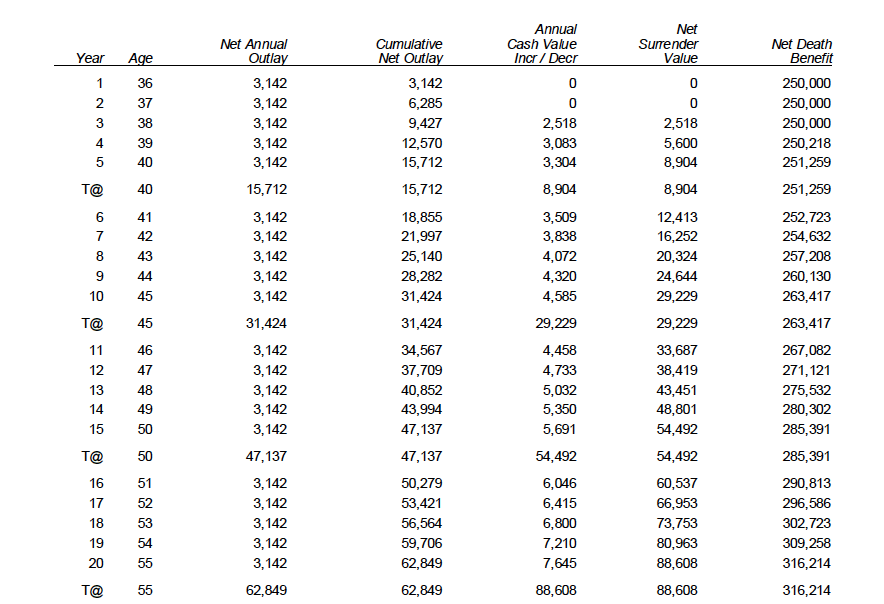
Cash surrender ends the policy and pays the cash surrender value. The other rows keep some coverage, or move the contract, instead of taking that check. As of October 17, 2026. The amount on your own contract is the one in that contract's current table.
| Option | What happens | Tax note |
|---|---|---|
| Cash surrender | The policy ends. The insurer pays the cash surrender value. An outstanding loan or other debt to the insurer is deducted from that cash. | Proceeds above your cost are included in income. |
| Reduced paid-up | Premiums stop. You keep paid-up insurance in the amount the nonforfeiture value buys. | You are not paid the surrender proceeds. A later surrender of that paid-up policy follows the surrender rule. |
| Extended term | Coverage continues as term insurance under the nonforfeiture option. The period and the death benefit are the ones in your policy table. | You are not paid the surrender proceeds. |
| Policy loan | You borrow against the cash value and the policy stays in force. An unpaid loan, plus interest, is subtracted from the death benefit. | On a later surrender, unrepaid loans that were not already included in your income reduce your cost. |
| 1035 exchange | The contract can be exchanged for another life insurance contract, or for an endowment, an annuity, or a qualified long-term care contract. | No gain or loss when section 1035 applies. |
| Partial surrender | You take part of the value. On the universal life forms checked below, the death benefit is reduced by that partial surrender, and the contract may also deduct a charge. Your whole life contract controls whether this option exists. | The amount is included in income only above your investment in the contract, with a separate rule in the first 15 years. |
Sources for the rows are in the next section. The side-by-side of the two nonforfeiture choices is in reduced paid-up versus extended term. If the goal is a lower premium and you want to keep the policy, use can I reduce my whole life insurance policy instead of a surrender. A policy loan is the borrow-and-keep path. The paperwork order for an exchange is in the whole life 1035 exchange checklist.
If you still want new coverage, compare a whole life quote after you have the surrender figure. Keep the current policy until that new policy is in effect.
Tax notes on canceling whole life insurance
As of October 17, 2026. Each note below is limited to what the cited sources say.
Cash surrender
If you surrender a life insurance policy for cash, you include in income any proceeds that are more than the cost of the policy. In general, that cost (your investment in the contract) is the total premiums you paid, minus refunded premiums, rebates, dividends, and unrepaid loans that were not included in your income. You should receive a Form 1099-R showing the gross proceeds and the taxable part. Report those amounts on lines 5a and 5b of Form 1040 or Form 1040-SR.
That wording is shared by two IRS pages checked on October 17, 2026:
- IRS FAQ, "For senior taxpayers", page last reviewed or updated September 23, 2026
- IRS Publication 525 (2025), Taxable and Nontaxable Income, under "Surrender of policy for cash"
Revenue Ruling 2009-13 treats the gain on a complete surrender as ordinary income and relies on Revenue Ruling 64-51 for that character. Publication 525 and the FAQ state the include-in-income rule. They do not use the words "ordinary income."
Death proceeds are a different payment. Publication 525 and the IRS life insurance proceeds FAQ (page last reviewed or updated October 11, 2026) say proceeds paid because the insured died generally are not included in gross income. Interest you receive on those proceeds is taxable.
Loan deducted from the surrender
Washington's guide says that if you cancel, the company subtracts the loan balance from the cash value you receive. American Fidelity's surrender form deducts indebtedness to the company from the cash value. On the tax side, the IRS FAQ and Publication 525 both subtract unrepaid loans that were not already included in your income when they measure your cost.
An unpaid loan also reduces the death benefit while the policy stays in force. The NAIC consumer life insurance page says loans you have not repaid, plus interest, are subtracted from the death benefit. Washington's guide says the same thing: the company subtracts the unpaid loan and the interest from the benefits when you die.
Reduced paid-up and extended term
These rows do not pay you the surrender proceeds. NAIC Model 808 provides a paid-up nonforfeiture benefit when a premium is missed, and it pays the cash surrender value instead of that benefit when you surrender. The NALC definitions describe reduced paid-up insurance as using the cash value as a single premium to buy paid-up insurance in the amount that value provides, and extended term insurance as continuing coverage as term insurance for as long as the cash value will buy. The model also treats paid-up term insurance as a nonforfeiture benefit. The period and the death benefit on your contract are in the policy table.
The IRS surrender rule above applies to proceeds you receive. Electing the paid-up benefit or the term benefit is the choice not to take those proceeds.
1035 exchange
26 U.S.C. § 1035(a)(1) says no gain or loss is recognized on the exchange of a life insurance contract for another life insurance contract, or for an endowment contract, an annuity contract, or a qualified long-term care insurance contract. Treasury Regulation § 1.1035-1 states the same nonrecognition rule. The regulation also says section 1035 does not apply when the policies exchanged do not relate to the same insured. An IRS private letter ruling (PLR-120953-12) cites that same regulatory sentence.
If the exchange also pays you money or other property, Treasury Regulation § 1.1035-1 says that exchange does not come within section 1035, and it points to section 1031(b) and section 1031(c).
Partial surrender
As of October 17, 2026, two universal life forms say a partial surrender pays part of the value and reduces the death benefit by that amount. Whether a whole life contract offers a partial surrender is in that contract. Security Mutual Life Insurance Company of New York's universal life partial-surrender form says the death benefit and the cash surrender value are reduced by the partial surrender requested, and that a surrender charge or processing fee in the policy can also apply. The Trustmark universal life partial-surrender form says a partial surrender reduces the face amount, the accumulated value, and the death benefit by the amount of the partial surrender, and that the contract's schedule can include a partial-surrender charge. The charge printed on the Trustmark form belongs to that contract, so it is not repeated here.
For the tax, Revenue Ruling 2009-13 restates section 72(e)(5): when a life insurance contract is not a modified endowment contract, an amount received before the annuity starting date is included in gross income only to the extent it exceeds the investment in the contract. The same limit applies on a complete surrender, redemption, or maturity. Section 72(e)(6), as restated in that ruling, defines investment in the contract as the premiums or other consideration paid, minus amounts already received that were excluded from income.
A second rule can change the result. 26 U.S.C. § 7702(f)(7) says that when benefits are reduced during the 15-year period that begins on the issue date, and a cash distribution is made because of that reduction, section 72 other than subsection (e)(5) applies to the distribution up to the recapture ceiling. Revenue Ruling 2003-95 describes that rule. Read both before treating a partial surrender as a tax-free return of premium.
Can you cancel life insurance?
Yes. The owner can cancel. On a whole life policy, use the free-look when the policy was just delivered. After that, the owner signs the insurer's surrender form. The answer to "can you cancel life insurance" and the answer to "cancel whole life insurance" are the same steps on this page.
Can you cancel whole life insurance during the free-look?
Yes. Return the new policy during the free-look and the insurer refunds the premium. As of Oct 17, 2026, the NAIC Buyer's Guide says that period is usually 10 days, Texas says at least 10 to 20 days, Washington says a new policy issued there has a 10-day free look, and California's statute sets not less than 10 days nor more than 30 days. The number printed on your policy is the one that applies.
What is paid when you surrender after the free-look?
The insurer pays the cash surrender value the contract provides. Washington's guide and American Fidelity's surrender form both deduct an outstanding loan or other debt to the insurer from that cash. It is the contract's surrender value, not a refund of every premium paid.
Is a whole life surrender taxable?
It is included in income to the extent the proceeds are more than your cost. The IRS FAQ last reviewed on September 23, 2026, and Publication 525 (2025) state that rule, and both say the insurer should issue a Form 1099-R. Death proceeds generally are not included in income. Interest on those proceeds is taxable.
What if I want to keep some coverage?
Choose a row other than cash surrender. Reduced paid-up and extended term are the nonforfeiture options. A policy loan keeps the contract in force. A 1035 exchange moves the contract when section 1035 applies. A partial surrender pays part of the value. On the universal life forms cited above, that also reduces the death benefit. If the real goal is a lower premium, the reduce-the-policy page is the one to read before you cancel.