1035 Exchange Into Whole Life Insurance: A Consumer Checklist Before You Replace an Existing Policy
A 1035 exchange into whole life insurance conversation usually starts with one appealing phrase: tax-free exchange.
That phrase is useful, but it is also incomplete.
A Section 1035 exchange can let you move from one life insurance policy into another without recognizing gain right away when the transaction is structured correctly. The IRS describes a tax-free Section 1035 exchange as an exchange of a life insurance contract for another life insurance contract, or for certain other insurance contracts such as an annuity. That is the part most people hear.
The part they often do not hear is that a 1035 exchange is still a replacement decision. The National Association of Insurance Commissioners warns that replacing life insurance may be costly, that buyers should not drop one policy and buy another without a thorough study, and that the old policy should not be canceled until the new one has been received and reviewed. In other words, the tax rule does not remove the buyer's homework.
That is why this guide focuses on the checklist side of the decision. If you are thinking about using cash value from an existing policy to move into whole life, you need to confirm more than whether the transfer can be labeled a 1035 exchange. You need to confirm whether the new policy is actually better suited to your needs, whether the transfer is being handled correctly, and whether hidden issues such as policy loans, new surrender schedules, or lost benefits will leave you worse off.
This article is general education only, not personal tax, legal, or suitability advice. Your own policy language, state replacement rules, and tax situation still control. But if you want a disciplined way to review a possible exchange before you surrender anything, start here.
Why a 1035 exchange comes up in whole life planning
Most people do not wake up looking for a tax code section. They are trying to solve a policy problem.
A 1035 exchange usually enters the picture because someone owns a contract that no longer feels like the right fit. Common examples include:
- an older policy with features the owner no longer values
- a universal life policy that feels harder to monitor than expected
- a policy with cash value that could be redirected into a more stable whole life design
- a contract purchased years ago without a clear long-term strategy
- a desire to simplify coverage, guarantees, or premium expectations
The logic is understandable. If the current policy no longer matches the owner's goals, moving that value into a different contract may sound cleaner than surrendering the policy, taking a taxable gain, and starting over with entirely new money.
That is exactly why Section 1035 exists. The IRS has long described nonrecognition treatment as appropriate for people who exchange one insurance policy for another better suited to their needs. The idea is continuity, not cashing out.
Still, that phrase better suited to their needs matters more than people realize.
A 1035 exchange is not automatically smart just because it is permitted. It only makes sense when the new whole life policy improves the owner's real position after you account for guarantees, projected values, premium commitment, health changes, replacement costs, loan complications, rider loss, and the simple reality that the current contract may still have options worth keeping.
That is why the right first question is not, "Can I do a 1035 exchange?" It is, "What problem am I solving, and is whole life the best answer to that problem?"
If you cannot answer that clearly, you are not ready to exchange yet.
What Section 1035 actually allows and what it does not
The tax rule is narrow enough that sloppy handling can ruin the outcome.
The IRS instructions for Forms 1099-R and 5498 describe a tax-free Section 1035 exchange as an exchange of one life insurance contract for another life insurance contract, or for certain other allowed contract types. For this article, the practical use case is simpler: an existing life policy is being exchanged into a new whole life policy.
Here are the core rules readers should understand.
It has to be an actual exchange, not a casual withdrawal-and-rebuy move
One of the most important IRS warnings comes from Revenue Ruling 2007-24. When the owner received a check and then endorsed it to a second company, the IRS said that transaction did not qualify as a tax-free Section 1035 exchange. That is why the handling matters. The clean version is carrier-to-carrier, not cash-to-you-to-new-carrier.
The exchange must still satisfy the same-insured rule
IRS guidance also says Section 1035 nonrecognition does not apply when the policies exchanged do not relate to the same insured. That sounds technical, but it protects against a common assumption that any policy value can be repurposed however you want. It cannot.
Tax-free does not mean consequence-free
Even when the exchange qualifies, that does not mean every moving part is harmless. The IRS instructions say that cancellation of a contract loan at the time of the exchange may be taxable and reportable on a separate Form 1099-R. That one sentence is a major reason you should never treat an exchange with policy debt as routine paperwork.
The rule does not promise the new policy is better
A 1035 exchange only tells you how the transfer may be treated for tax purposes. It does not say the new policy has stronger guarantees, lower long-term cost, better dividend performance, or more suitable riders. Those are separate questions.
That distinction is where many bad replacements happen. The exchange may be valid under tax law while still being mediocre or harmful for the owner.
Why a 1035 exchange is still a replacement decision
This is the point too many articles skip.
The NAIC replacement model defines replacement broadly. A new policy can count as a replacement when the old one is surrendered, assigned to the replacing insurer, reduced in value, or used to finance the new purchase. In plain English, a 1035 exchange is usually not an escape hatch from replacement scrutiny. It is a form of replacement with a specific tax path.
That matters because replacement decisions come with real friction:
- new policy charges may restart
- new surrender schedules may apply
- old riders or benefits may disappear
- your current health and age may change the value of your options
- the new policy may have a different premium commitment than the old one
- paperwork and disclosures exist for a reason, not as busywork
The NAIC Buyer's Guide goes even further. It warns that replacing a policy may be costly, that buyers may pay new issue costs again, and that older age or worse health can make a new policy more expensive. It also points out that you may have valuable rights and benefits in the current policy that are not available in the new one.
That is the real moat in this topic. The tax rule is not the whole decision. The replacement math is.
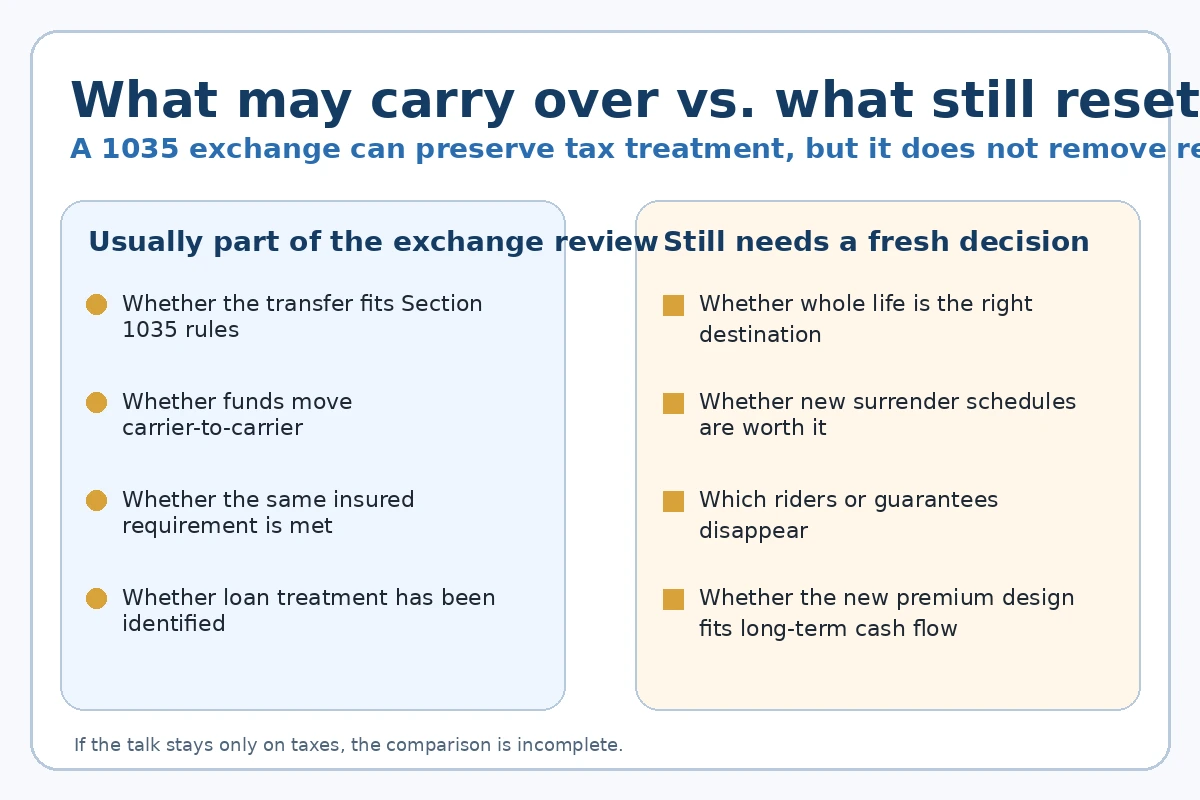 Some things can carry forward in a 1035 exchange, but many of the decision-driving items still need a fresh review on the new contract.
A practical way to think about it is this:
| Usually part of the exchange review | Still needs a fresh decision |
|---|---|
| Whether the transfer may qualify under Section 1035 | Whether whole life is the right destination policy |
| Whether the cash value is transferred carrier-to-carrier | Whether new surrender schedules or charges make the move worth it |
| Whether the same insured requirement is satisfied | Whether current benefits, riders, and premium structure are being improved or lost |
| Whether loan issues create tax or reporting complications | Whether the owner can comfortably fund the new policy going forward |
If a producer or article only talks about the left-hand column, the buyer is missing the real work.
The 7-point checklist before you surrender anything
This is the buyer workflow I would want in front of me before signing replacement paperwork.
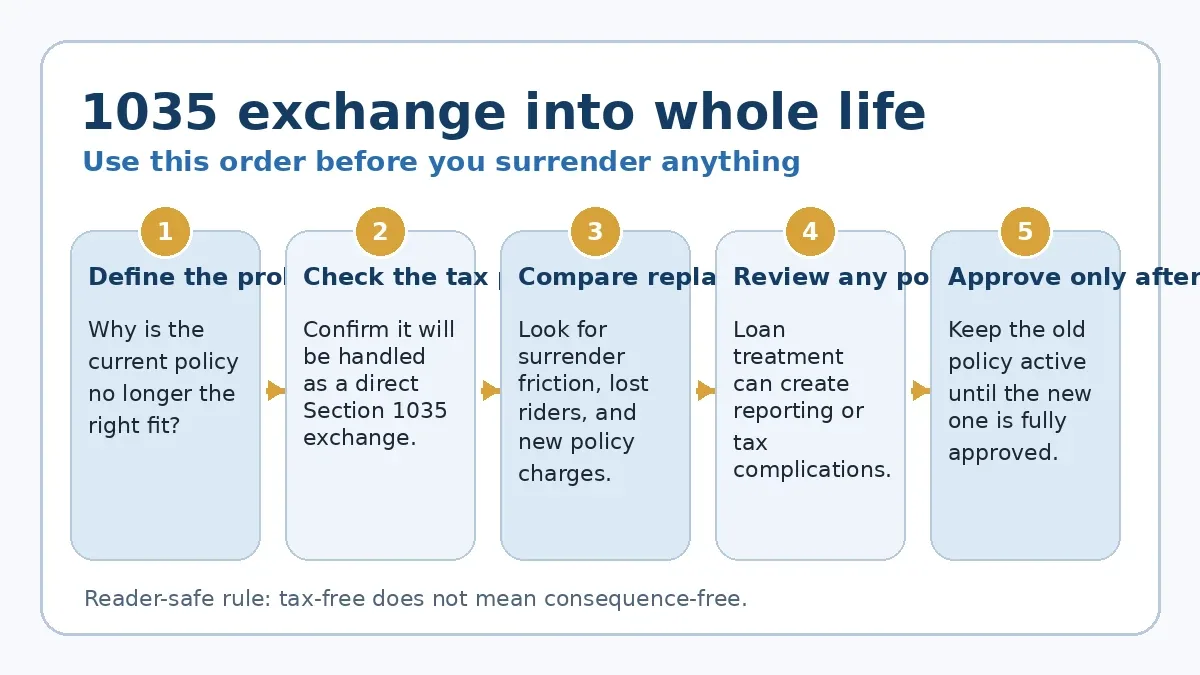
1. Define the policy problem in one sentence
Are you fixing weak performance expectations, unstable premium mechanics, a poor original design, missing guarantees, or simply a mismatch between what you bought and what you want now?
If the answer is vague, the exchange is premature.
2. Request a current in-force illustration on the existing policy
The NAIC Buyer's Guide says buyers should ask the company or agent for an updated illustration before replacing a policy. That is one of the best pieces of consumer advice in this area.
Without current numbers, you are comparing a real new policy to an imagined old one.
If you need a refresher on how to review the existing contract before making a change, Top Whole Life's guide to the whole life insurance annual statement helps readers identify which values deserve attention before taking the next step.
3. Confirm the transfer will be handled as a direct exchange
The IRS ruling on receiving and endorsing a check is the warning sign here. Ask exactly how the funds move, which forms are being used, and whether the carrier or agent expects the transfer to qualify as a Section 1035 exchange.
If the explanation is fuzzy, slow down.
4. Compare what you keep versus what you lose
This includes more than premiums. Review:
- guaranteed death benefit structure
- current and projected cash value behavior
- dividend status if the destination policy is participating
- riders that would disappear
- surrender timing on the old policy
- surrender timing on the new policy
- whether the old policy has flexibility you will miss later
5. Review outstanding policy loans before assuming the move is clean
The IRS and carrier forms both point to policy loans as a complication zone. If the existing policy has an outstanding loan, ask for a written explanation of how it affects the exchange, what gets reported, and whether any part of the transaction could become taxable.
This is also a good time to review Top Whole Life's whole life insurance FAQ hub if you need background on how cash value, loans, and policy mechanics interact before making a replacement decision.
6. Keep the old policy in force until the new one is fully approved and issued
This point is easy to underestimate. Protective's 1035 exchange assignment language states that the replacement is conditioned on underwriting approval and that the policyowner remains responsible for keeping the old policy in force until the new policy is approved.
Even when another carrier uses different wording, the lesson is durable: do not create a coverage gap because you treated the exchange like a guaranteed administrative transfer.
7. Decide whether a replacement is truly better than an adjustment
The NAIC guide makes an overlooked point: if the policy you have now no longer meets your needs, you may not have to replace it. Sometimes a policy can be changed or supplemented instead.
That is not always the right answer, but it is the right question.
If the better next step is a fresh comparison rather than a rushed surrender, start with a new single whole life quote and compare that against the current in-force illustration before authorizing any exchange.
How policy loans, surrender charges, and new underwriting change the math
This is where an exchange moves from an interesting tax concept to a real financial decision.
Policy loans can turn a "simple exchange" into a tax-risk conversation
The IRS says that cancellation of a contract loan at the time of the exchange may be taxable and reportable. Protective's exchange form goes a step further and warns that when there is an outstanding policy loan, the exchange may not be characterized as tax-free and gain can be taxed to the extent of the outstanding loan.
That does not mean every loaned policy should never be exchanged. It does mean no one should authorize the transfer until the loan treatment is spelled out clearly.
Surrender costs are often invisible because buyers focus only on cash value
The NAIC guide warns that replacement may be costly because some of what you paid in the early years of the current policy went toward selling and issuing that contract, and those types of costs may be paid again on the new one.
This is why a policy with meaningful cash value is not automatically a "free funding source" for a new whole life design. You need to know what the old policy gives up and what the new policy starts over.
New underwriting or new product assumptions can reset the risk profile
Not every replacement is a guaranteed upgrade. The owner's age is higher than it was when the original policy was issued. Health may have changed. The new policy's design may be stronger in one dimension and weaker in another.
A stable whole life structure may still be the right destination. But the exchange should happen because the full picture improved, not because the words tax-free made everything else feel secondary.
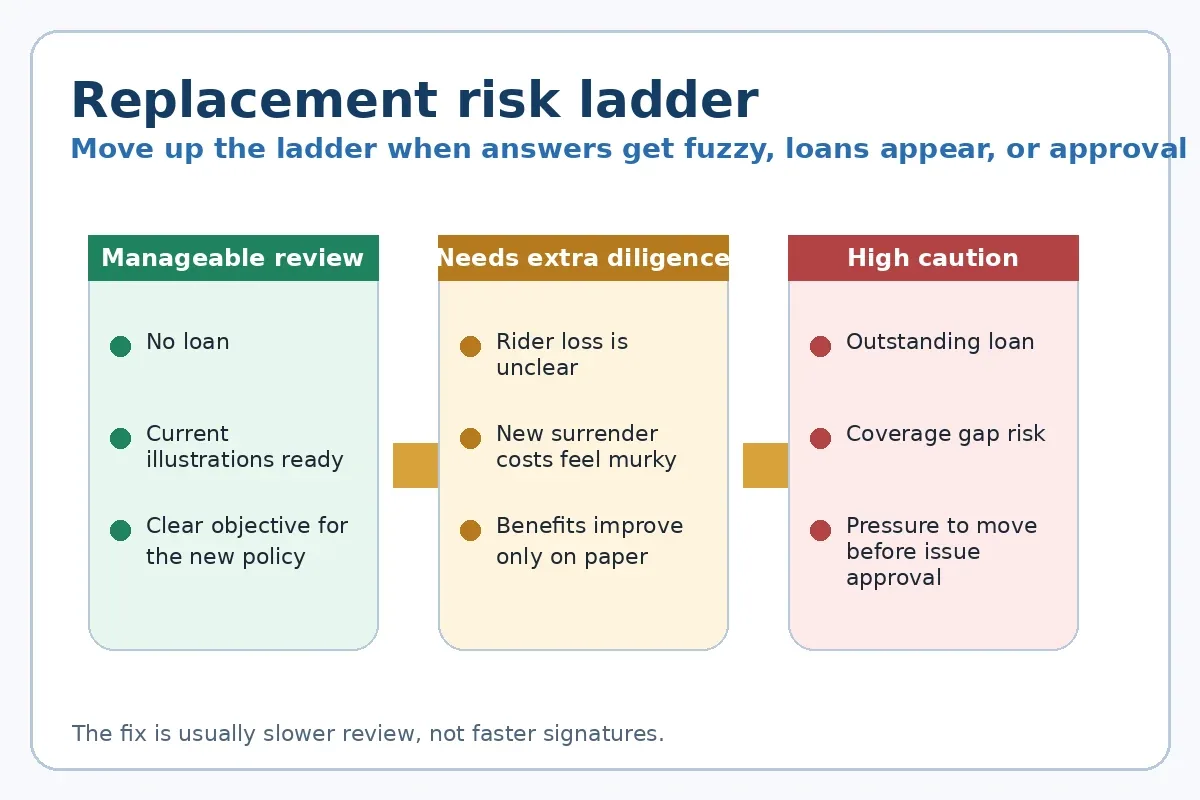 The biggest problems usually appear when loan treatment, approval risk, and replacement cost are reviewed too late instead of first.
A useful shorthand is to sort the exchange into three levels:
- Manageable review: no loans, clean objective, current illustrations in hand, clear explanation of what the new policy improves.
- Needs extra diligence: uncertain surrender tradeoffs, unclear rider loss, or optimistic assumptions about how the new policy will behave.
- High caution: outstanding loans, health uncertainty, pressure to move quickly, or fuzzy answers about how the transfer is being processed.
When you are in level three, that is not a sign to panic. It is a sign to slow down.
Questions to ask before approving the transfer
If a producer, carrier rep, or advisor cannot answer these cleanly, the exchange is not ready.
- What exact problem does the new whole life policy solve better than my current policy?
- Can you show me a current in-force illustration for the old policy and an illustration for the proposed new one?
- Will this be handled as a direct carrier-to-carrier exchange?
- Are there any outstanding loans, withdrawals, or reporting issues that could make part of the exchange taxable?
- What benefits, riders, or guarantees do I lose if I surrender the current policy?
- What new surrender schedule, charges, or funding commitments start on the replacement policy?
- Do I need underwriting approval, and who is responsible for keeping the old policy active while that is pending?
- If I decide not to exchange, what other policy-adjustment options do I still have?
A serious replacement conversation should welcome these questions. If it becomes defensive the moment you ask them, that is useful information too.
When keeping or adjusting the old policy may be smarter
A 1035 exchange into whole life can absolutely be the right move. It may help someone leave a policy that no longer fits and move into a structure with clearer guarantees, better alignment, or a cleaner long-term design.
But there are also cases where the smarter answer is to pause.
Holding the current policy a little longer may be better when:
- you still do not have current illustration data
- the existing policy's surrender cost is heavier than expected
- a policy loan creates unresolved tax or reporting questions
- the proposed whole life design is not clearly stronger after full comparison
- you are being rushed into a replacement before the new policy is fully approved
- the real problem may be fixable without replacing the contract
That final point matters. Sometimes the better outcome is not "exchange now." Sometimes it is "review the current policy, get new quotes, compare carefully, and move only when the reason is clear."
If you want help sorting whether a replacement is actually improving your position, Top Whole Life's guide to what whole life insurance is can help reset the basics before you compare policy designs side by side.
The big takeaway is simple: a 1035 exchange is most useful when it supports a better policy decision, not when it replaces one.
This article is general education only. Confirm exchange eligibility, replacement paperwork, current policy values, policy-loan treatment, and any tax implications with your insurer and your own tax professional before acting.