Term Conversion to Whole Life: What To Check Before Your Window Closes
A term conversion to whole life option can be one of the most valuable lines in a term policy, especially if your health has changed since you bought the coverage. The basic attraction is easy to understand: many term policies let you move into a permanent cash-value policy during a stated conversion period, even if you are no longer in perfect health.
That advantage is real, but it is not the whole decision.
The NAIC consumer life insurance overview says many term policies may be traded for a cash value policy during a conversion period, even if the insured is not in good health, while also warning that the new premiums will be higher than the term premiums. That is the key tension in this topic. A conversion right can protect insurability, but it can still lead to a poor long-term decision if you never stop to ask what the new whole life policy costs, what the contract actually allows, and whether you even need to convert the full amount.
That is why the best way to approach this topic is not "Can I convert?" It is "What does my contract let me do, what problem am I solving, and will this permanent policy still make sense after the premium changes?"
This article is general education only. Policy forms, conversion windows, and eligible products vary by carrier and contract. Confirm the exact conversion provisions in your own policy and review permanent-policy fit with your insurer or a licensed professional before acting.
Why conversion rights matter before your term window closes
Most people do not start thinking about conversion because they love policy mechanics. They start thinking about it because life changed.
Maybe your health is not as strong as it was when you first bought the term policy. Maybe your original plan was "protect the kids while they are young," but now you want at least some permanent coverage for a spouse, a business obligation, estate liquidity, or final expenses. Maybe you still want the flexibility of term for part of the need, but not all of it.
That is where the conversion privilege can matter more than buyers expect.
The NAIC Life Insurance Buyer's Guide and the NAIC consumer overview both make the same basic point: term insurance is usually the lower-cost coverage in the early years, while cash-value coverage such as whole life costs more because it provides longer-term protection and builds policy value over time. A conversion right can bridge those two worlds. It may let you move from temporary coverage into permanent coverage without starting from zero on insurability.
That does not mean every term policy should be converted. It means the option has value precisely because you may not be able to get the same answer from a brand-new application later.
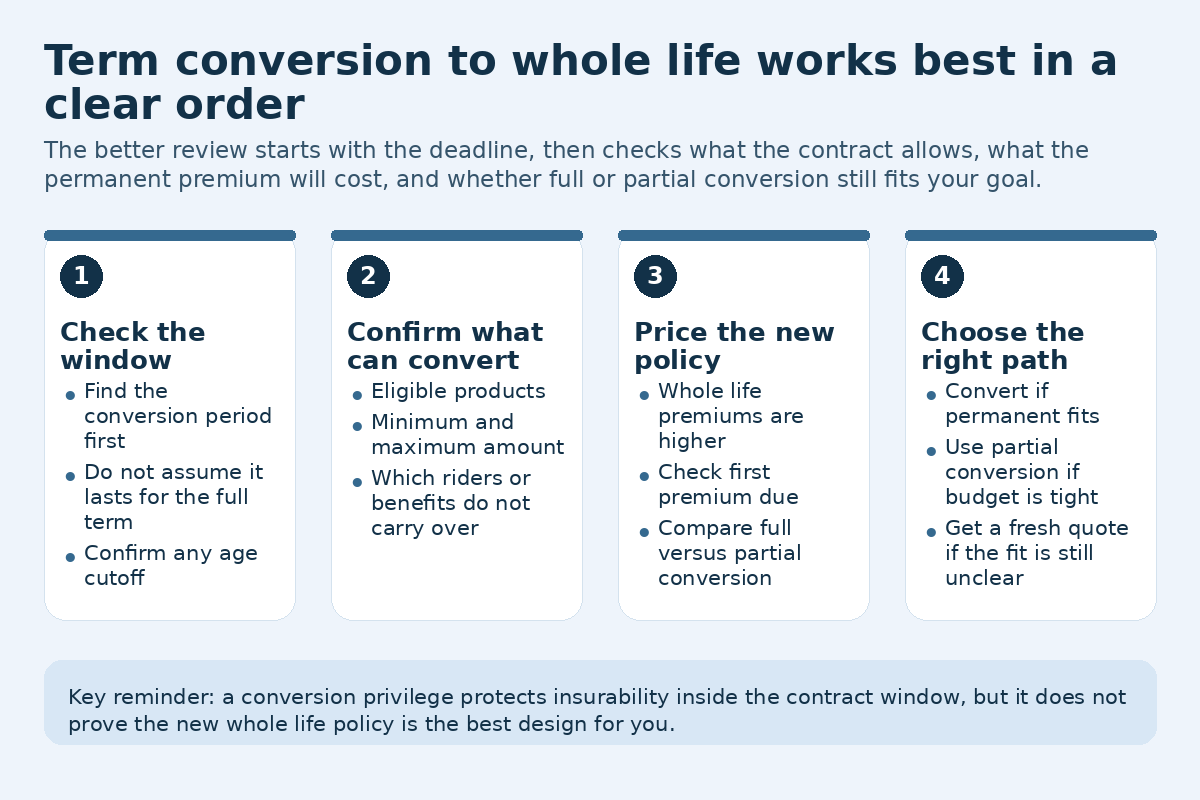
Another reason this matters: the conversion window may end earlier than the day the term policy itself expires. Some policies tie the right to a limited number of years. Others tie it to an age cutoff. If you wait until the last minute because the term still looks "active," you may discover that the most valuable feature already expired.
In other words, the conversion privilege is not just a convenience feature. It is often a time-sensitive form of insurance leverage.
What a conversion privilege usually does and does not do
Here is the simple version most readers need first: a conversion privilege usually gives you a path to move from term coverage into a permanent policy without having to re-qualify on health for the converted amount.
That is the upside.
The part buyers miss is everything the conversion privilege does not promise.
It does not promise that the new policy will be cheap. The NAIC consumer guidance is direct on that point: the new premiums will be higher than your term premiums. Whole life is a different product with different economics. You are not simply "keeping insurance." You are choosing lifetime protection and a cash-value design that usually requires a much larger ongoing commitment.
It does not promise that every permanent product at the carrier will be available for conversion. It does not promise that the full face amount must be converted all at once. It does not promise that riders, benefit structures, or premium patterns will look the same after the move.
And it certainly does not prove that converting is smarter than applying fresh, keeping part of the term coverage, or converting only a slice of the death benefit.
That is why readers who need a refresher on the permanent side of the decision should review Top Whole Life's guide to what whole life insurance is before they treat conversion as an automatic upgrade. Whole life can be a strong fit, but only when you actually want the guarantees, premium structure, and long-term design that come with it.
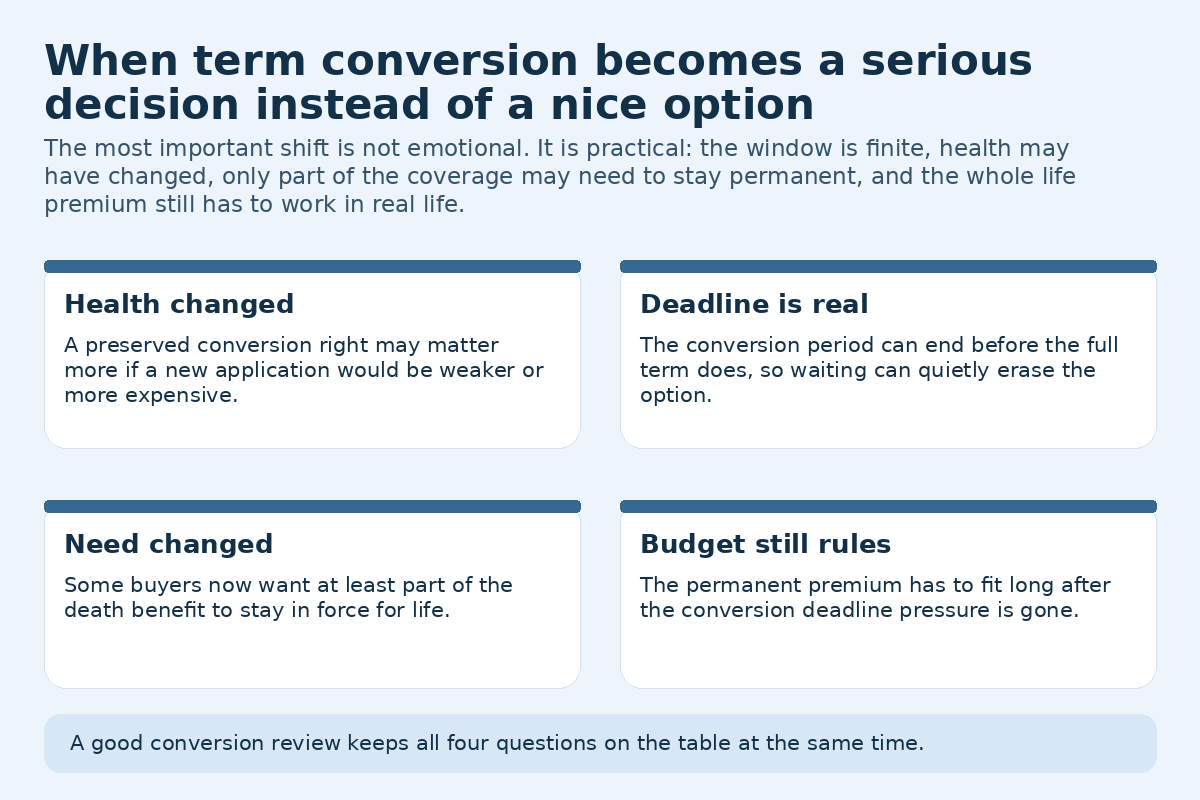 Conversion gets more serious when health, timing, permanent-coverage needs, and budget all start pulling on the same decision at once.
There is also a subtle mindset shift worth making here. A conversion right is best used as a negotiation with your future self. It lets you preserve one route into permanent coverage. It does not force you to use that route badly.
The contract lines to review before you convert
The most useful authority on this part is not a marketing page. It is the Interstate Insurance Product Regulation Commission term-policy standard, because it spells out what a convertible policy should disclose.
The IIPRC standard says that if a policy is convertible, the conversion period should appear on the cover page or the specifications page. That means your first task is not calling around for opinions. Your first task is finding that line.
After that, the same standard says the conversion provision should describe, when applicable:
- when the first premium is due
- what supplemental benefits may be converted
- the type or types of permanent policies available for conversion
- the minimum and maximum amount available for conversion
- how the premium at conversion is determined
- any evidence-of-insurability requirements
That list is more powerful than it looks.
Why? Because it turns a vague sales conversation into a concrete review:
- Deadline: Is the window still open, and when does it close?
- Destination: Can you convert into the kind of whole life policy you actually want?
- Amount: Must you convert everything, or can you convert only part?
- Affordability: What premium basis applies at conversion, and what will the first payment look like?
- Extra coverage rules: If you want more than the amount already in force, do new health questions or underwriting rules apply to the extra layer?
The same IIPRC standard adds another detail that many generic explainers leave out: converted coverage can keep the original incontestability and suicide timing, while extra coverage that required evidence of insurability may have new provisions. That is not a reason to convert blindly. It is a reason to read the conversion clause carefully enough to know what is carrying over and what is not.
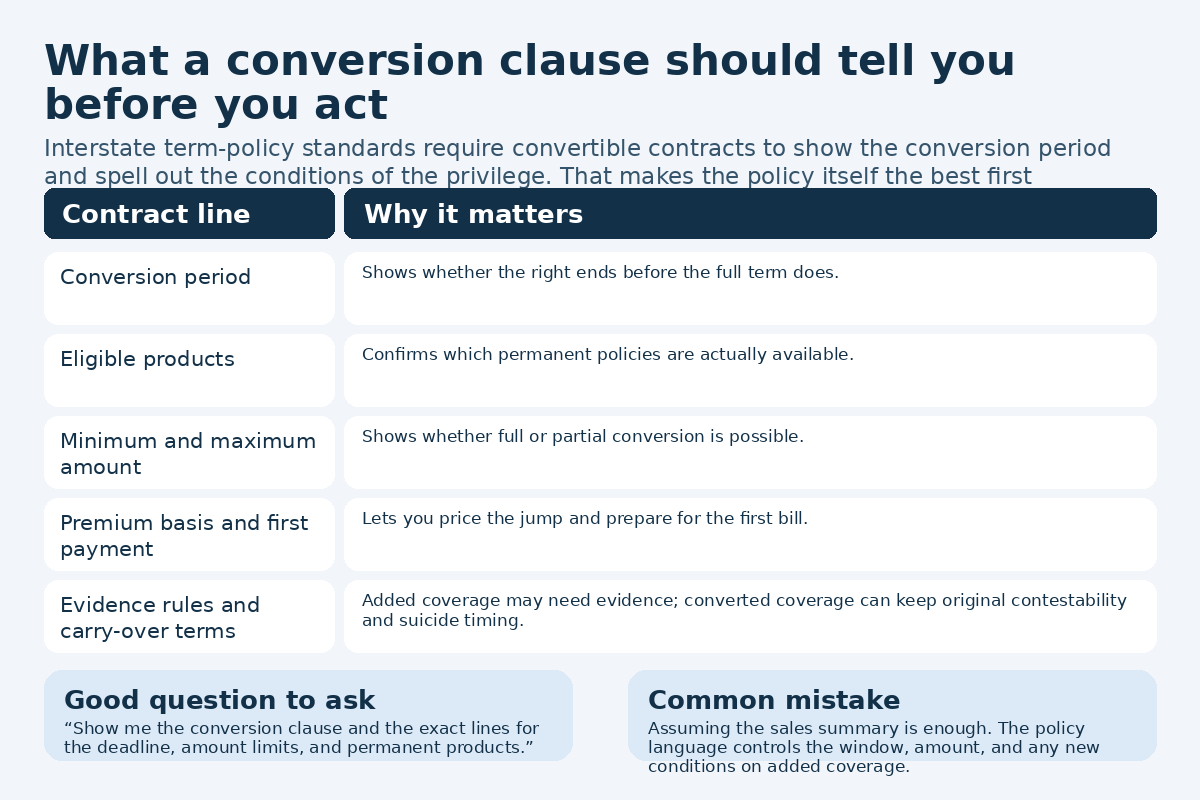 The conversion clause is where the real guardrails live. If a recommendation cannot point back to these lines, the conversation is still too vague.
One more practical point belongs here. If your policy's minimum and maximum conversion amounts allow less than the full death benefit to move, partial conversion may be available. That can be a meaningful middle ground for people who want some permanent protection without committing the entire old face amount to a much higher whole life premium.
When conversion can beat a new application
There are situations where conversion is plainly stronger than starting over.
The biggest one is simple: your health changed.
If the policy is still inside its conversion period, that can be exactly what makes the conversion right valuable. Instead of applying for a new permanent policy with today's health picture, you may be able to use the conversion privilege to preserve the insurability you had when the term policy was first issued.
That does not mean the premium will feel light. It probably will not. But it can mean the permanent-policy path still exists when a new application would be weaker, more expensive, or unavailable.
Conversion can also make sense when your need has genuinely shifted from temporary to permanent. A lot of people buy term because it is the right first tool. Top Whole Life's cheap term first framework makes that point well: the term policy can lock in a health class, buy time, and let you decide later what kind of permanent design really fits. If later has now arrived, the conversion privilege may be the bridge you planned to use all along.
It can also be helpful when speed matters. If the window is still open, the carrier has a permanent design you would actually keep, and the affordability review is already done, conversion may be cleaner than restarting the entire process through a brand-new application.
Still, this is where discipline matters most. "Available" is not the same thing as "best." The right question is not whether conversion can win in theory. It is whether it wins for this amount, at this premium, with this permanent design.
When partial conversion or a fresh quote may be smarter
One of the easiest mistakes in this area is thinking the only two choices are:
- convert the entire term policy to whole life, or
- do nothing
Real life is usually more flexible than that.
If the new whole life premium feels too heavy for the full face amount, ask whether the policy allows you to convert only part of the coverage. That can be a smart compromise when you want some permanent protection but do not need the entire old term amount to last forever.
Partial conversion can also help when your budget supports a smaller permanent base now, while the remaining need is still truly temporary. In that scenario, the goal is not winning a theoretical debate about term versus whole life. The goal is matching the permanent premium commitment to the part of your life that actually calls for permanence.
A fresh quote can also be smarter when your health is still strong and the available conversion products are not clearly the best fit. Some carriers restrict which permanent policies are open through the conversion path. If the conversion menu is narrow, or the design is not the one you would choose if you were shopping freely, it is reasonable to compare that route against a new application before you commit.
The point is not to talk yourself out of conversion. The point is to avoid letting the existence of a conversion right end the decision too early.
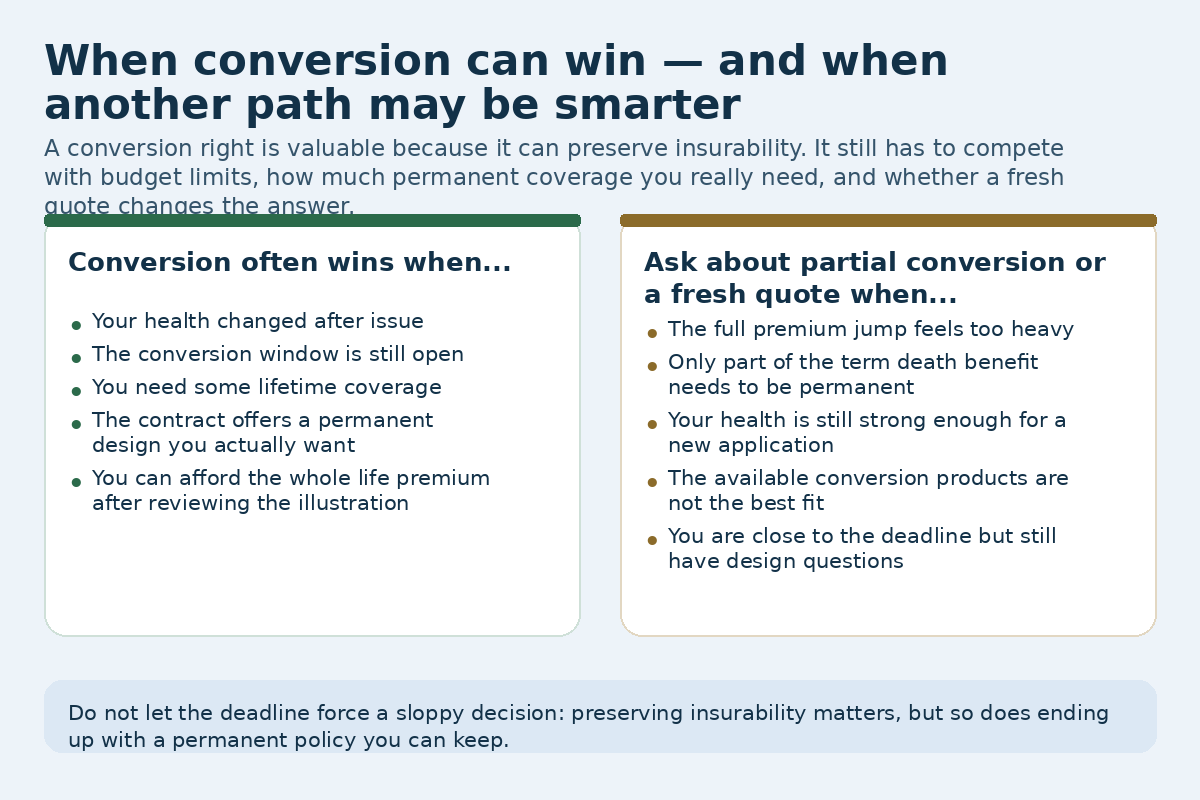 A conversion right is valuable, but the best outcome still depends on permanent-policy fit, budget, and how much coverage really needs to last for life.
There is another protection buried in the NAIC consumer guidance: if you already have a policy, do not cancel it until you have received the new one. The same page also notes that you may be able to change the current policy instead of canceling it. That matters most when readers are comparing several routes at once. If you are evaluating conversion, replacement, or a fresh permanent quote, do not create a coverage gap just because you felt rushed by the idea of a deadline.
If you reach the point where the permanent fit is still unclear, start with a fresh single whole life quote and compare that result against the conversion path rather than assuming the first available route must be the best one.
Questions to ask before you sign
If a conversion conversation is real, these are the questions worth slowing down for:
- What is the exact conversion deadline on this policy?
- Which permanent products are actually available through conversion?
- Can I convert the full amount, or does the contract allow a partial conversion?
- How will the new whole life premium be determined, and when is the first payment due?
- Do any riders, benefits, or structures disappear when I convert?
- Would any added coverage require evidence of insurability or restart provisions that do not apply to the converted amount?
- Am I converting because permanent coverage clearly fits my needs, or because I am reacting to the deadline without a full comparison?
- If I decide not to convert today, what other options still exist before the window closes?
Those questions are not nitpicking. They are the real decision.
The best term conversion to whole life outcome usually comes from separating three things that buyers often mix together:
- the value of preserving insurability
- the cost of the new permanent policy
- the amount of coverage that truly needs to stay in force for life
When those three answers line up, conversion can be excellent. When they do not, partial conversion, a different permanent design, or a fresh quote may be the cleaner answer.
This article is general education only. Review the exact conversion clause in your policy, confirm the available permanent products and premium commitments, and do not cancel existing coverage until the new arrangement is fully in place.