Whole Life Insurance Rates Comparison [2026]

Updated November 10, 2026.
Whole life insurance pricing is the monthly premium for a permanent policy. MoneyGeek's whole life rates-by-age chart, updated November 2, 2026, is the source for every dollar figure on this page. The chart says the study analyzed whole life quotes across ages, face amounts, health, and tobacco use. The main tables use the nonsmoker, good-health profile. Where a displayed figure is modeled from patterns in the collected quotes, rather than taken from a quote collected directly, the study identifies it as an estimate. These rows are examples from that chart. They are not a Top Whole Life quote, not an offer of insurance, and not a premium a carrier has to offer you.
Samples at $1 million from the same chart stay on the $1 million whole life cost page. This page does not reprint that table.
Sample monthly premiums
Monthly premium. Nonsmoker, good health. The chart lists ages 20 through 80 in five-year steps. Three face amounts are below. The chart also lists $750,000. That column is not reprinted here.
$100,000
| Age | Female | Male |
|---|---|---|
| 20 | $68 | $76 |
| 25 | $77 | $86 |
| 30 | $87 | $96 |
| 35 | $100 | $108 |
| 40 | $114 | $121 |
| 45 | $135 | $145 |
| 50 | $160 | $173 |
| 55 | $202 | $224 |
| 60 | $257 | $288 |
| 65 | $356 | $406 |
| 70 | $498 | $575 |
| 75 | $745 | $860 |
| 80 | $1,125 | $1,293 |
$250,000
| Age | Female | Male |
|---|---|---|
| 20 | $144 | $162 |
| 25 | $163 | $183 |
| 30 | $186 | $208 |
| 35 | $214 | $239 |
| 40 | $245 | $275 |
| 45 | $299 | $338 |
| 50 | $365 | $414 |
| 55 | $464 | $532 |
| 60 | $590 | $684 |
| 65 | $835 | $967 |
| 70 | $1,189 | $1,374 |
| 75 | $1,775 | $2,074 |
| 80 | $2,678 | $3,151 |
$500,000
| Age | Female | Male |
|---|---|---|
| 20 | $270 | $310 |
| 25 | $312 | $352 |
| 30 | $362 | $400 |
| 35 | $418 | $463 |
| 40 | $482 | $537 |
| 45 | $586 | $657 |
| 50 | $712 | $806 |
| 55 | $909 | $1,042 |
| 60 | $1,161 | $1,348 |
| 65 | $1,644 | $1,909 |
| 70 | $2,345 | $2,720 |
| 75 | $3,513 | $4,103 |
| 80 | $5,316 | $6,228 |
What changes the sample
Age at application is the pattern in the chart. For $500,000, the nonsmoker sample at 60 is $1,161 for a woman and $1,348 for a man. At 30 the samples are $362 and $400. MoneyGeek says the premium is fixed once the policy is issued. A higher sample at an older age is the price for a new applicant at that age. It is not, by itself, an annual increase after a level premium is already in force.
In every age row of the nonsmoker tables above, the woman's sample is lower than the man's at the same face amount.
Tobacco is a separate profile. For $500,000, the chart states both sexes at the ages below. The samples are for smokers in otherwise good health.
| Age | Female | Male |
|---|---|---|
| 40 | $682 | $764 |
| 50 | $1,083 | $1,232 |
| 60 | $1,874 | $2,154 |
The chart's male smoker table lists more ages. This page prints only the ages where the write-up also states the woman's sample.
Health class is the next split the chart prints. At age 40 and $500,000, nonsmoker:
| Health class | Female | Male |
|---|---|---|
| Good | $482 | $537 |
| Poor | $775 | $869 |
The chart also names coverage amount, and occupations or hobbies such as commercial fishing, logging, mining, roofing, skydiving, scuba diving, or rock climbing, as items that can change a premium or lead to an exclusion. It does not print a dollar add-on for those jobs or hobbies, so this page does not either.
The same chart lists a 20-year, $500,000 term premium for a 40-year-old man: $44 a month, next to $537 a month for $500,000 of whole life. Term coverage ends when the term ends. Whole life is priced as coverage meant to last for life, with cash value. How those two costs are compared is on whole life versus term cost. This page does not choose between them.
In the chart's company comparison, for a $500,000 nonsmoker in good health at age 40, the averages are $464 at USAA, $525 at Gerber Life, and $621 at Protective Life. Those are that comparison's averages. They are not a ranking by this site, and they are not the tables above.
Cash value, dividends, and other schedules
MoneyGeek describes whole life premiums as funding both the death benefit and a cash value account, and says extra cash value growth above a minimum is not guaranteed. This page does not print a cash value at a future age. Older charts on this URL did. Those dollar figures had no source that could be re-checked, so they are not repeated.
A participating policy may pay dividends. A dividend interest rate is not the policy's return, and dividends are not guaranteed. Year-by-year carrier figures are on the whole life dividend rate history page.
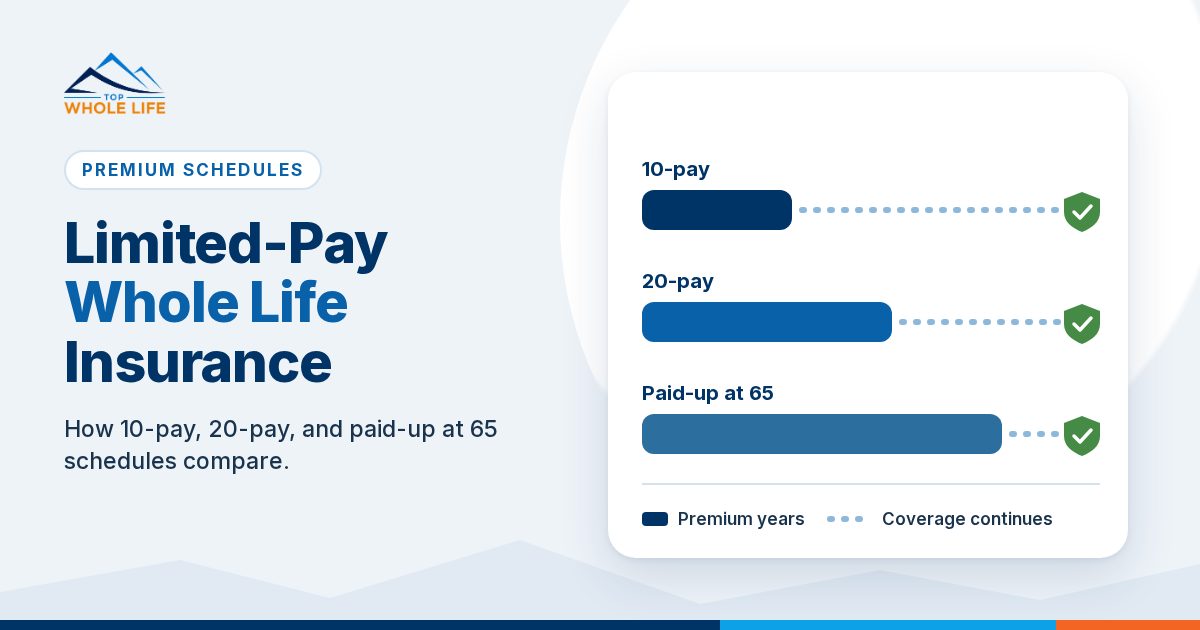
A 10-pay contract finishes the scheduled premium in ten years. That price is not the lifetime-pay sample above. Labeled examples for limited-pay schedules are on limited-pay whole life.
Guaranteed universal life is a different permanent contract. This page does not reprint a GUL premium. Product notes for policies still being sold are on the guaranteed universal life roundup.
Guaranteed-issue samples
The same chart separates guaranteed whole life from the tables above. It says these policies accept applicants without health questions or a medical exam, cap the death benefit at $25,000, and are aimed at final expenses when age or health keeps someone from qualifying for a traditional policy. The figures below are the chart's age-65 row. The chart also lists ages 45 through 80. This row is not a $100,000 or $250,000 participating whole life premium.
| Face amount | Female | Male |
|---|---|---|
| $5,000 | $32 | $41 |
| $10,000 | $60 | $78 |
| $15,000 | $88 | $115 |
| $20,000 | $116 | $153 |
| $25,000 | $145 | $191 |
Age 65. Monthly premium. The chart's guaranteed-issue averages.
Frequently asked questions
How much does whole life insurance cost per month?
In the MoneyGeek chart cited above, a nonsmoker in good health at age 40 has a sample of $114 a month for $100,000, $245 for $250,000, and $482 for $500,000 for a woman. The samples for a man at the same age are $121, $275, and $537. The age rows are in the tables above. They are examples from that chart, not a quote from Top Whole Life.
Does the premium rise every birthday?
Not on the description the chart gives for a policy already issued. It says the premium is fixed once coverage begins. The samples are higher at older ages because they are prices for a new applicant at that age.
Are these figures a Top Whole Life quote?
No. They are MoneyGeek's published samples. The form on this site asks for age, coverage, and health class. The next screen asks how to reach you. After that, the results page shows illustrative whole life premiums from carrier rate sheets. Those illustrations are a different set of figures. They are not a binding offer, and they are not the tables above.
Can I deduct the premium on my own policy?
Publication 529 says you can't deduct premiums you pay on your life insurance. The same section says you may be able to deduct, as alimony, premiums you pay on a policy assigned to a former spouse. That is the publication's rule. It is not a tax return for any reader.
Sources
- MoneyGeek, Whole Life Insurance Rates by Age Chart (2026): whole life rates by age
- IRS Publication 529 (revised December 2020), Life Insurance Premiums: Publication 529
What to do next
Use the whole life quote form to enter age, coverage, and health class. Read the results as an illustration. The samples in the tables above remain MoneyGeek's examples, not the offer.