Understanding the Cost of a $1 Million Dollar Whole Life Insurance Policy

Updated November 9, 2026.
A $1 million whole life policy is permanent life insurance. MoneyGeek's million-dollar rate study, updated November 2, 2026, lists sample monthly premiums for nonsmokers in good health. At age 40 the sample is $952 for a woman and $1,042 for a man. At age 30 the samples are $699 and $762. These figures are examples from that study. They are not a Top Whole Life quote, not an offer of insurance, and not a premium a carrier has to offer you.
Whether $1 million of coverage fits a household is a separate question from the price. That discussion is on is a million-dollar policy worth it. A $30 million face amount is a high-net-worth planning size, not a larger version of this table. See pros and cons of a $30 million policy.
Sample $1 million whole life premiums
MoneyGeek says it analyzed thousands of life insurance quotes from more than 30 insurers. Its standard profile is a nonsmoker in good health. The study says that where a displayed figure is modeled from patterns in the collected quotes, rather than taken from a quote collected directly, the study identifies it as an estimate. The rows below are the whole life figures in that study's "$1 Million Whole Life Insurance Cost" table. The table's footnote says the rates are for people in good health. The column used here is the nonsmoker column.
MoneyGeek's separate whole-life-by-age chart, updated the same day, shows the same $1 million nonsmoker figures for these ages. Both pages are MoneyGeek. They are not two carriers, and they are not averaged with any other site.
Nonsmoker, good health
Monthly premium. Face amount $1,000,000.
| Age | Female | Male |
|---|---|---|
| 20 | $520 | $588 |
| 30 | $699 | $762 |
| 40 | $952 | $1,042 |
| 50 | $1,384 | $1,556 |
| 60 | $2,362 | $2,767 |
| 70 | $4,228 | $5,044 |
Smoker, otherwise in good health
Same study, same face amount, smoker column. Monthly premium.
| Age | Female | Male |
|---|---|---|
| 20 | $726 | $827 |
| 30 | $975 | $1,058 |
| 40 | $1,348 | $1,489 |
| 50 | $2,116 | $2,393 |
| 60 | $3,358 | $3,896 |
| 70 | $5,972 | $7,014 |
The same MoneyGeek page lists a 20-year, $1 million term premium for nonsmokers in good health at age 40: $65 a month for a woman and $80 a month for a man. Term coverage ends when the term ends. Whole life is priced as coverage meant to last for life, with cash value. This page does not choose between them.
What the whole life contract is
The National Association of Insurance Commissioners describes whole life as a fixed amount of coverage that lasts for the insured's entire life, with the benefit paid after the insured dies. The NAIC says these policies are designed to build cash value over time, and that the cash value grows without being taxed. The cash value comes from the premiums paid, minus fees and insurance costs. A policyholder may borrow against the cash value.
On ordinary level-premium whole life, the NAIC says the premium stays the same throughout the insured's life, or until the cash value matches the face amount. A different contract, indeterminate-premium whole life, can change each year, but not above a stated maximum. The MoneyGeek samples are not labeled as one of those contract shapes. They are not a 10-pay or paid-up-at-65 schedule.
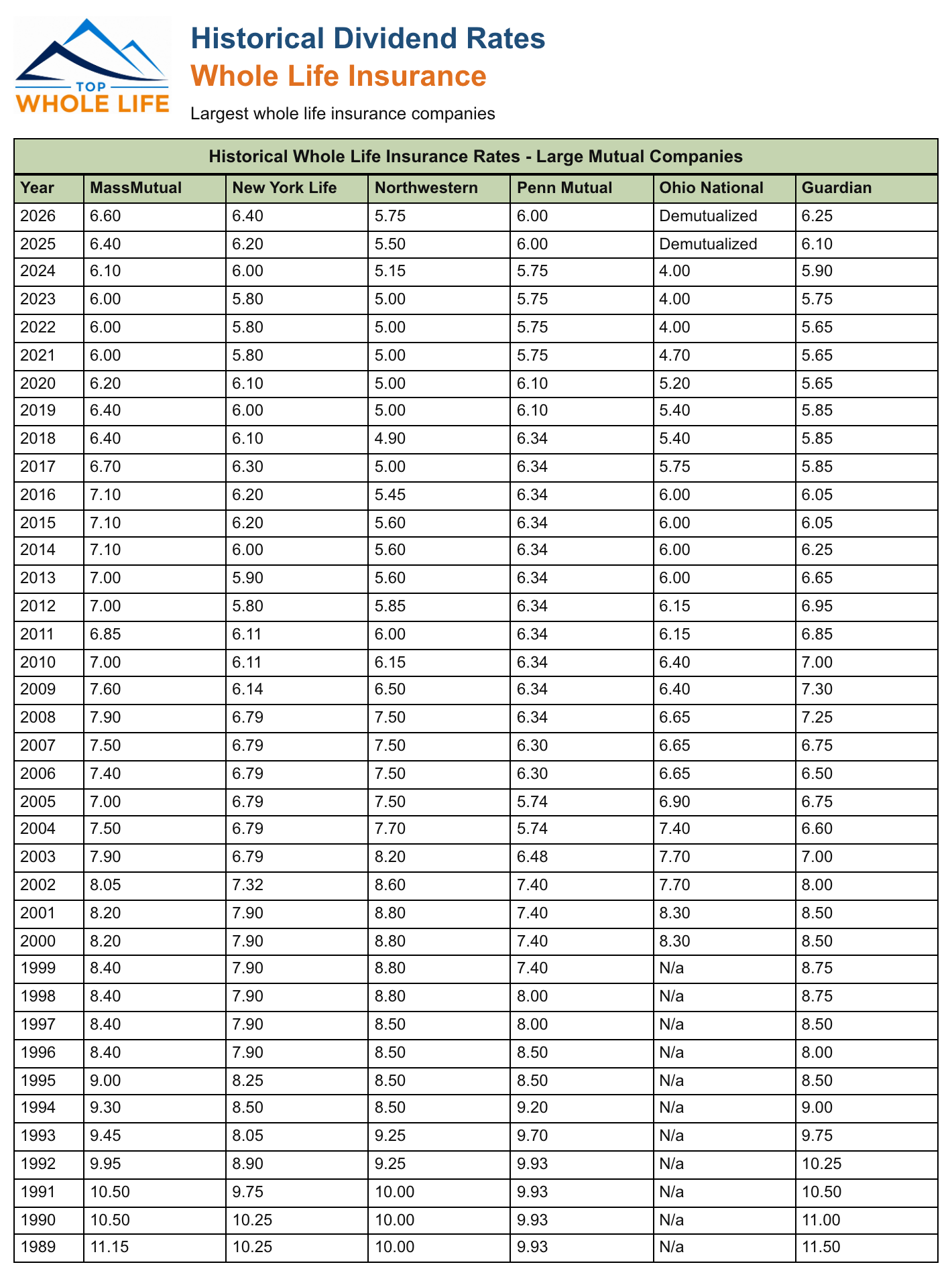
A participating policy may pay dividends based on the insurer's financial performance. The NAIC says those dividends can be used to lower premiums or to buy more coverage, and that participating policies usually cost more. This page does not quote a dividend rate. Carrier history is kept on the dividend rate history page. Dividends are something a participating policy may pay. They are not part of the sample premium above.
What changes the sample
Age at application is the pattern in the table. The nonsmoker sample at 60 is higher than the sample at 30, for both sexes. MoneyGeek's age chart says the premium is fixed once the policy is issued. That matches the NAIC description of ordinary level-premium whole life. Buying later changes which sample you are shown. It is not, by itself, an annual increase after a level-premium policy is already in force.
In every row of this study's good-health nonsmoker table, the woman's sample is lower than the man's at the same age.
Tobacco is the second table. At age 40 the smoker samples are $1,348 for a woman and $1,489 for a man, against $952 and $1,042 for nonsmokers.
The million-dollar page says its $1 million rates assume good health, and that applicants with more serious health concerns will pay more or may be disqualified. MoneyGeek's whole-life age chart says a worse health class raises the premium. The dollar example on that chart is for $500,000 of coverage, so it is not reprinted here as a $1 million price.
MoneyGeek's rider FAQ says each rider adds to the monthly premium, and that rider availability and terms vary by insurer and by state. This page does not list a rider price.
These rows are $1 million. They do not scale to a $30 million face amount.
Death proceeds and the premium you pay
The IRS life-insurance FAQ, last reviewed October 11, 2026, says that life insurance proceeds you receive as a beneficiary because the insured person died generally are not included in gross income and do not have to be reported. Interest you receive is taxable. If the policy was transferred to you for cash or other valuable consideration, the exclusion is limited to the consideration you paid, additional premiums you paid, and certain other amounts. There are exceptions. Publication 559 (2025) states the same income exclusion, including that it applies whether the beneficiary is a person, a corporation, or a partnership, and that the proceeds are not taxable unless the policy was turned over for a price.
Publication 529 says you cannot deduct premiums you pay on your life insurance. It also says you may be able to deduct, as alimony, premiums you pay on a policy assigned to a former spouse. That is the publication's rule. It is not a tax return for any reader.
Exams and guaranteed-issue caps
MoneyGeek says guaranteed-issue policies accept applicants with no medical exam and no health questions, and that coverage is capped at $25,000 to $30,000. The no-exam dollar examples on the million-dollar page sit in its term section. This page does not publish a no-exam whole life premium at $1 million.
Frequently asked questions
How much does $1 million of whole life cost per month?
In the MoneyGeek study cited above, the sample monthly premium for a nonsmoker in good health is $699 for a woman at 30 and $762 for a man at 30. At 40 the samples are $952 and $1,042. At 50 they are $1,384 and $1,556. At 60 they are $2,362 and $2,767. The full nonsmoker and smoker tables are above. They are examples from that study, not a quote from Top Whole Life.
Why is the woman's sample lower than the man's?
In this study, it is lower at every age in the nonsmoker table and in the smoker table. The study does not print the pricing formula. The tables are the comparison.
Does a whole life premium rise every birthday?
Not on the contract the NAIC calls ordinary level-premium whole life. There, the premium stays the same for life, or until cash value equals the face amount. The samples above are higher at older ages because they are prices for a new applicant at that age. Indeterminate-premium whole life is a different contract: the premium can change each year, up to a maximum. The MoneyGeek rows are not labeled as either contract.
Are these figures a Top Whole Life quote?
No. They are MoneyGeek's published samples for a $1 million whole life profile. The form on this page asks for coverage details, then for contact details. Illustrative premiums from this site's rate sheets are shown after that contact step. Those illustrations are a different set of figures. They are not a binding offer, and they are not the table above.
Is the $1 million death benefit taxable income?
Generally, no, when you receive it as a beneficiary because the insured person died. The IRS FAQ says those proceeds are not included in gross income. Interest paid on the proceeds is taxable. A transfer of the policy for cash or other value can limit the exclusion. Publication 559 states the same limits.
Can I deduct the premiums on my own policy?
Publication 529 says you cannot deduct premiums you pay on your life insurance. The same section describes a separate alimony treatment when a policy is assigned to a former spouse.
What to do next
The form on this page asks for age, coverage, and health class. The next screen asks how to reach you. After that, the results page shows illustrative whole life premiums from carrier rate sheets. The coverage menu lists amounts through $1,000,000. Nothing on that menu is a $30 million illustration. Use the whole life quote form for that path. Read the results as an illustration. The samples in the tables above remain MoneyGeek's examples, not the offer.