Whole Life Insurance Quotes Online (2026): How Online Quoting Works and Sample Rates by Age

Updated October 17, 2026
Quick answer: Whole life insurance quotes online are preliminary premiums for permanent coverage. An instant screen, an agent-run illustration, and an exam application are three different steps. Use the quote form above for a personal whole life number. The table below shows each source’s own monthly sample for $250,000, labeled by chart, as of Oct 17, 2026.
Search results for whole life insurance quotes are often term life, a small burial policy, or universal life with a whole life label. Read the product name before you compare the premium.
Instant, agent-assisted, and exam quotes
Instant quote
You enter a short set of facts: age or date of birth, sex, state, tobacco, face amount, and a health class you choose. The screen prices that assumed class. The carrier has not read medical records. The class on an issued policy can be different.
An instant result is a budget check. It is the wrong place to stop if the page cannot tell you the product. A 10-, 20-, or 30-year end date and no cash value means the result is term, not whole life.
Agent-assisted quote
An agent starts from the same facts and adds the design choices a short form often skips: lifetime pay versus a limited pay, riders, and which carriers will consider the history you actually have. You get illustrations to set side by side. An illustration is still not an issued contract.
Exam application
Many fully underwritten applications include a medical exam. As of October 17, 2026, Guardian (page updated January 29, 2026) says most life policies require one, and MoneyGeek (updated September 30, 2026) says fully underwritten whole life may require one. Both also describe policies that skip the exam.
Carriers do not use “simplified issue” and “guaranteed issue” the same way. Read that company’s application to see whether health questions are still required. This page does not treat the two labels as interchangeable.
Sample whole life rates by age
These are example quotes for a nonsmoker buying $250,000 of whole life, not your premium. The three charts do not use the same health class, so each source’s own monthly figure is shown. Checked as of Oct 17, 2026.
- MoneyGeek, whole life rates by age, updated September 30, 2026: nonsmoker, average health
- Ethos, whole life rates by age, updated July 15, 2026: traditional whole life. The chart does not name a health class
- Policygenius, average whole life rates, illustration as of October 1, 2024: MassMutual, Preferred Plus, paid up at age 100. Guardian (updated January 29, 2026) reprints that table and cites Policygenius, so Guardian is not a separate column
| Age | Sex | MoneyGeek (9/30/26) | Ethos (7/15/26) | Policygenius (10/1/24) |
|---|---|---|---|---|
| 30 | Female | $208 | $200 | $206 |
| 30 | Male | $222 | $222 | $238 |
| 40 | Female | $274 | $302 | $296 |
| 40 | Male | $294 | $334 | $355 |
| 50 | Female | $336 | $513 | $462 |
| 50 | Male | $443 | $573 | $543 |
| 60 | Female | $665 | $869 | $772 |
| 60 | Male | $732 | $1,026 | $903 |
MoneyGeek and Ethos both show $222 a month for a male, age 30, $250,000, nonsmoker, as of Oct 17, 2026. MoneyGeek calls that cell average health. Ethos does not name a health class on that cell. Policygenius’s Preferred Plus MassMutual illustration for the same age, sex, and face amount is $238 a month, as of October 1, 2024.
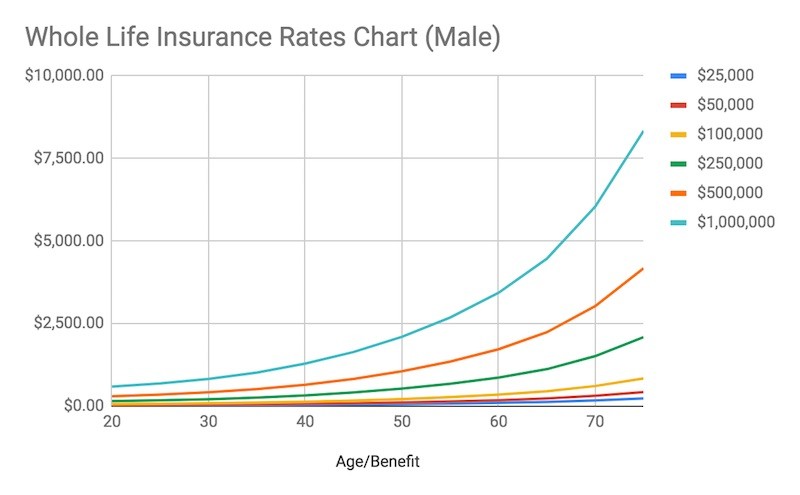
The site’s older internal charts stay on the whole life cost FAQ. They are not copied onto this page. A how-to for reading a chart layout is on how to use a whole life rate chart.
Women are generally priced lower than men at the same age. As of October 17, 2026, that direction is stated by Ethos (updated July 15, 2026) and by Guardian (updated January 29, 2026). This page does not print a percentage gap. The sources do not state the same one.
On traditional whole life, the premium is set when the policy is issued and stays level if you pay as agreed. Ethos (July 15, 2026) and MoneyGeek (September 30, 2026) both say that. A later birthday makes a new application cost more. It does not, by itself, raise the premium on a policy already in force.
What you need for an accurate quote
A quote prices the class it assumes. Gather these before you compare screens:
- Date of birth
- Sex
- State where the application will be signed
- Tobacco and nicotine, including cigarettes, cigars, vape, chew, and cessation products. Carriers do not define nonsmoker the same way
- Height and weight
- Face amount (the death benefit)
- Product: whole life, unless you mean to buy term or universal life
- Pay period: lifetime pay, or a limited pay such as 10-pay or 20-pay
- Conditions and prescriptions you would put on an application
- Riders you want inside the premium, such as waiver of premium, guaranteed insurability, or an accelerated death benefit
- Coverage you already own and plan to keep
Leave tobacco or a condition off the form and the number will not survive underwriting.
How to compare quotes
Compare quotes only after the product is the same. The checklist below is the compare-quotes list from the older best-deal guide, moved here so one page covers both getting a whole life quote and reading it.
- Same death benefit
- Same product (whole life) and the same pay period
- Premium for that face amount, not a cheaper term premium on the same screen
- Cash value in the same policy years. Years 10, 20, and 30 are enough to see the shape
- Riders, and whether each rider’s cost is inside the premium or added on
- Financial strength from more than one rating agency, such as A.M. Best, Moody’s, and S&P. Read the letter on the life company that would issue the contract
- Exclusions, the contestability period, the suicide clause, and what a policy loan costs
- The health class on the quote versus the class the application can actually support
Two illustrations with different face amounts are not a comparison. A whole life quote next to a 20-year term quote is not a comparison either.
A longer walk-through of the same ideas is on compare whole life insurance quotes. Carrier context for cash value is on top whole life companies for cash value and the dividend rate history.
How does an instant whole life quote differ from an agent-assisted quote?
An instant quote prices the health class and face amount you entered. An agent-assisted quote adds pay period, riders, and which carriers fit the history, then produces illustrations you can set side by side. Neither result is an issued policy.
When does a whole life quote include an exam?
Many fully underwritten applications include a medical exam. As of October 17, 2026, Guardian (page updated January 29, 2026) says most life policies require one, and MoneyGeek (updated September 30, 2026) says fully underwritten whole life may require one. Both also describe policies that skip the exam. Whether a no-exam application still asks health questions depends on that carrier’s form.
What do I need for an accurate whole life quote?
Date of birth, sex, state, tobacco use, height and weight, face amount, whole life as the product, the pay period, conditions and prescriptions, the riders you want priced, and any coverage you will keep. A missing tobacco answer or a missing condition is the usual reason an online number changes later.
How do I compare whole life insurance quotes?
Hold the death benefit, the product, and the pay period still. Then compare the premium, cash value in the same years, riders, financial-strength letters, and the policy fine print. Set aside a result that is term life.
Why do quote sites show term life for a whole life search?
Term is what many comparison sites are built to sell. Read the product name on the result. A fixed end date and no cash value means the premium is not a whole life quote.
Are sample rates by age the same as my premium?
No. The table is a set of example quotes for a nonsmoker buying $250,000 of whole life, checked as of Oct 17, 2026. MoneyGeek (average health), Ethos (traditional whole life, health class not named), and Policygenius (MassMutual Preferred Plus, paid up at 100) do not price the same class, so the dollars differ. Your state and the class you qualify for will move the price. Use the quote form above for a personal number.
What should match before two quotes are comparable?
The death benefit, the product type, and how long you pay. After that, compare cash value, riders, and financial-strength ratings. A lower premium on a different product is not a better whole life quote.
Questions about an illustration go through contact us.