Gerber Whole Life Insurance Review (2026)
Gerber Life is easy to recognize and hard to use well. The baby-food brand sells the idea of a small policy that “grows up” with your child. The contract underneath that ad is real whole life — just not the kind of participating, dividend-paying whole life most families mean when they ask us for a quote.
2026 verdict: Gerber is financially strong (A+ Superior). The products are small, simplified, and expensive per dollar of coverage. The Grow-Up Plan can lock in a modest face amount on a child. It is a weak college-savings vehicle. Adult guaranteed-issue coverage can make sense after health problems. If you want cash value, paid-up additions, and a policy you can actually design, look at a mutual carrier instead.
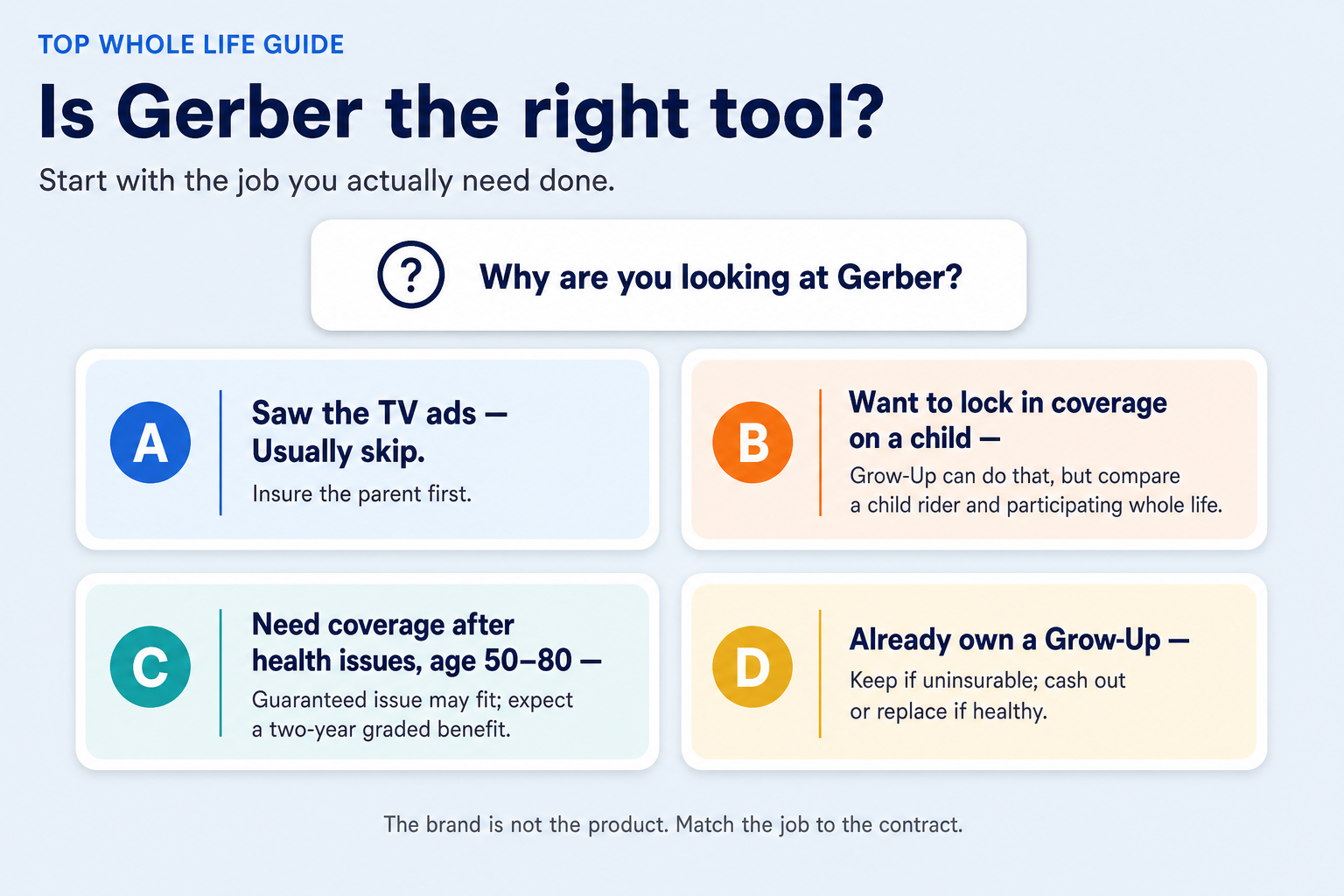
Who Gerber is for — and who should skip it
 Match the job to the contract. The Gerber name is not a reason to buy the policy.
Gerber can be a fit if:
- You want a small, permanent face amount on a child or grandchild and you accept that cash value will be modest.
- You are age 50–80, cannot pass underwriting, and you understand guaranteed-issue whole life has a two-year graded death benefit for non-accidental death.
- You already own a Grow-Up Plan and the insured would struggle to get coverage elsewhere.
Skip Gerber — or use it only as a last resort — if:
- You are shopping because of the TV ads and you think this is how you “save for college.”
- You want $250,000, $500,000, or $1 million of participating whole life with dividends and paid-up additions.
- You are a healthy parent. Insure you first. A child’s funeral is tragic. A parent’s lost income is what usually breaks a household.
If the job is cash value and policy design, start with our top whole life companies for cash value and a free whole life quote. If the job is “should I put insurance on a kid at all,” read whole life insurance for kids.
Company snapshot: Nestlé name, Western & Southern balance sheet
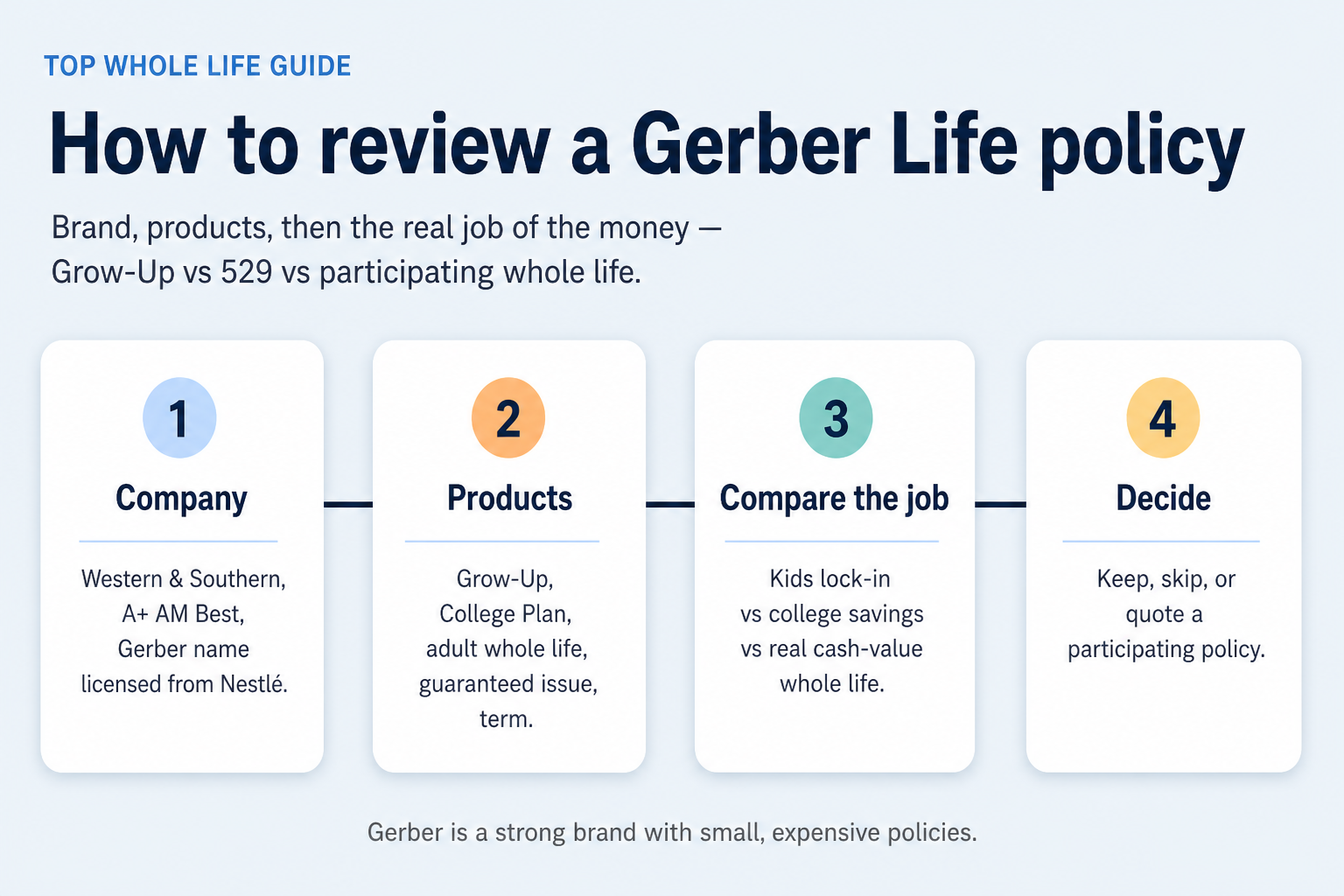
Gerber Life Insurance Company has sold juvenile and family policies since 1967. The baby-food company sold the insurer to Western & Southern Financial Group in 2018. Gerber still uses the Gerber name and logo under a license from Nestlé / Gerber Products. Western & Southern later added Fabric by Gerber Life as a digital agency channel. Term policies on the Gerber site are issued by Western-Southern Life Assurance Company, not always by Gerber Life Insurance Company itself.
That ownership change matters more than the mascot. You are not buying a cereal brand. You are buying a Western & Southern subsidiary.
Financial strength: AM Best rates Gerber Life A+ (Superior). Western & Southern announced the upgrade from A to A+ in 2024. AM Best affirmed A+ with a Positive outlook on April 23, 2026 for Western & Southern and its life subsidiaries, including Gerber. Older reviews that call Gerber’s finances “middle of the road” or “not ideal” are out of date.
Gerber.com also discloses that Gerber Life and Western-Southern Life Assurance Company are both A+ (Superior) by AM Best.
Gerber Life products at a glance
Product rules change by state and by issue age. Confirm the illustration and the application. These bands are what Gerber publishes on its site in 2026.
| Product | Who it is for | Issue ages | Face amount | Exam? | Cash value | Issued by |
|---|---|---|---|---|---|---|
| Grow-Up Plan | Child / grandchild whole life | 14 days–17 | $5,000–$50,000 (doubles at 18) | Simplified | Yes, modest | Gerber Life |
| Young adult whole life | Teens | 15–17 | Similar doubling feature | Simplified | Yes | Gerber Life |
| College Plan | Endowment sold as college savings | Adults (plan-specific) | About $10,000–$150,000 | Simplified | Endowment, not a 529 | Gerber Life |
| Adult whole life | Permanent coverage, no-exam band | 18–80 | $50,000–$1,000,000 ($500,000 max at 56+) | Often none in-band | Yes, non-participating style | Gerber Life |
| Guaranteed Life | Final expense if you cannot underwrite | 50–80 (75 in NY) | $5,000–$25,000 ($15,000 in SD) | No (guaranteed issue) | Yes, small | Gerber Life |
| Term life | Income replacement for a set term | 21–70 | $100,000–$5,000,000 | Exam on larger / older cases | No | Western-Southern Life Assurance |
| Accident protection | AD&D only | 18–69 | $50,000–$500,000 | No | No death benefit for illness | Gerber Life |
The old version of this page said adult Gerber whole life and term topped out at $300,000. That is no longer what Gerber publishes. Term can go to $5 million. Adult whole life can go to $1 million under age 56. The useful point is unchanged: Gerber is still a simplified, direct-to-consumer shop, not a dividend-paying mutual.
Grow-Up Plan: what the ads skip
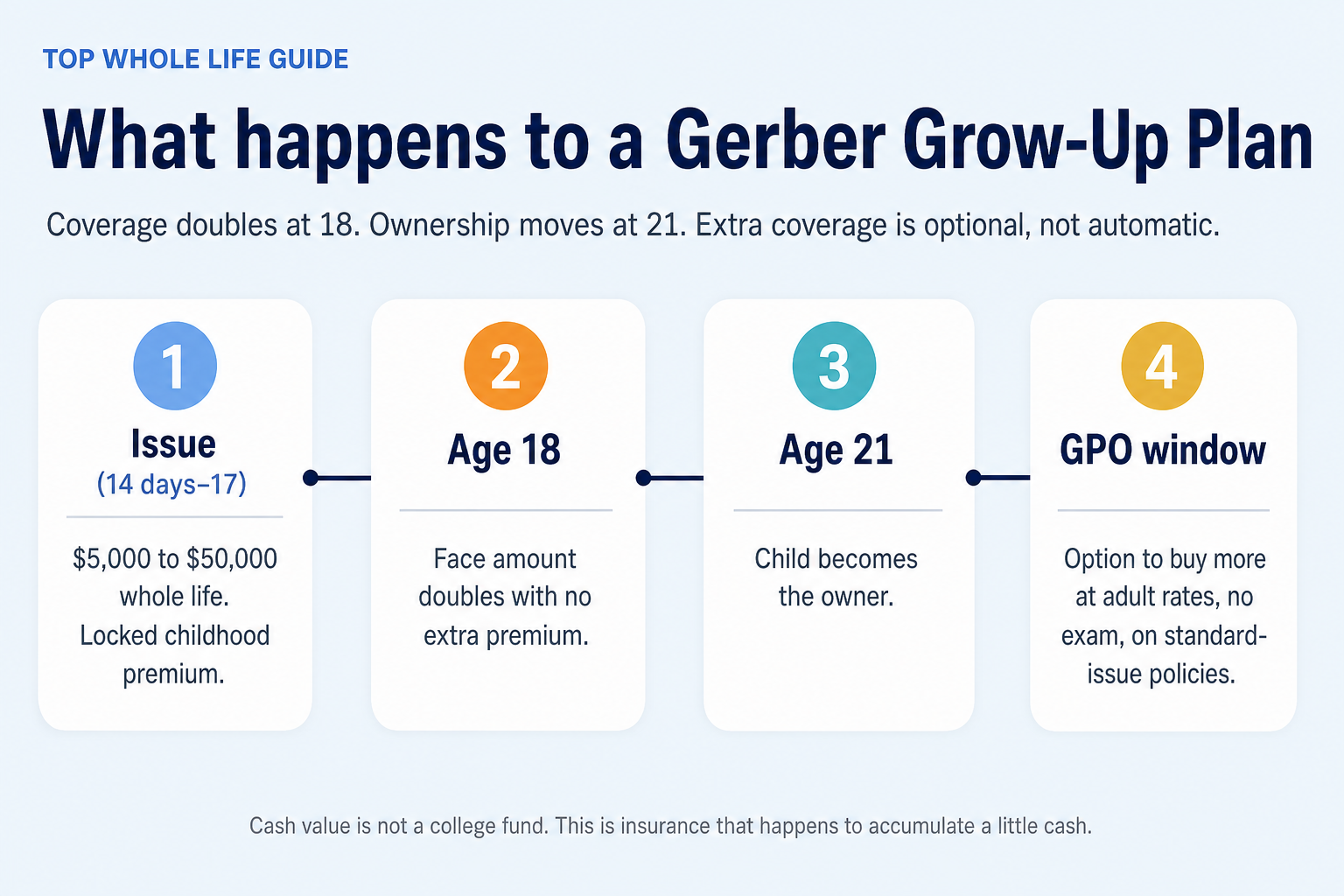 The doubling at 18 is real. It is not a savings match. The premium does not change when the face amount doubles.
The Grow-Up Plan is whole life on a child. Parents, grandparents, and legal guardians can apply. Coverage is $5,000 to $50,000. During age 18 the face amount doubles with no extra premium. At age 21 ownership typically moves to the child.
That doubling is the TV hook. It is also the easiest thing to misunderstand:
- You did not “earn” another $50,000 of savings. The insurer increased the death benefit.
- Cash value does not double. Cash value is the policy’s savings component, and on a small juvenile contract it stays small for a long time.
- If the child is healthy at 21, they can usually buy cheaper coverage per thousand elsewhere — or they may not need life insurance at all.
Guaranteed Purchase Option (GPO): On standard-issue Grow-Up policies, Gerber includes a guaranteed-purchase rider. The child can buy additional coverage later at standard adult rates without a new medical exam, in windows tied to ages and life events (Gerber describes openings around age 21, marriage, childbirth, and later ages). Limits apply — Gerber’s own explainer caps extra coverage around 10 times the original amount, often with a $100,000 ceiling. Substandard issues may not get the rider. The rider is an option, not a requirement, and the new policies are priced at adult rates.
Gerber’s consumer materials still describe a 90-day window after those option dates. If you own a policy, read the rider page in the contract. Do not rely on a blog.
What Grow-Up is actually good at: locking a modest permanent face amount while the child is healthy, and giving a child who later develops a health problem a way to buy more coverage without new underwriting.
What it is bad at: funding college, matching a 529, or substituting for a properly designed participating whole life policy.
College Plan vs a 529
Gerber still markets a College Plan — an endowment. It pays a lump sum on a target date or at death, whichever comes first. Face amounts are typically $10,000 to $150,000. The insured is usually the parent; the “college” date is a marketing overlay on an endowment schedule.
Three problems show up in almost every honest review of this product:
- It is insurance, not a 529. 529 earnings used for qualified education expenses are tax-advantaged. Endowment gain is generally taxable.
- Returns are not competitive with a cheap index fund inside a 529 over a 10–18 year horizon.
- If the parent dies, a 529 plus a term policy on the parent usually does more for the child than a small endowment.
If the goal is college, fund a 529. If the goal is “the household does not collapse if I die,” buy term or participating whole life on the parent. Do not ask one Gerber product to do both jobs.
Adult whole life and guaranteed issue
Adult whole life (Gerber Life): roughly $50,000 to $1 million, ages 18–80, with a $500,000 cap at age 56+. Many cases skip a paramed exam inside those bands. This is still simplified permanent insurance. It is not MassMutual, New York Life, or Penn Mutual participating whole life. You should not expect a competitive dividend, paid-up additions design, or the same early cash value as a broker-built mutual policy.
Guaranteed Life (ages 50–80, 75 in New York): $5,000–$25,000 ($15,000 max in South Dakota). Not available in Montana. No health questions. Gerber will not issue it when a POA or guardianship exists on the adult applicant.
Read the graded-benefit language. Gerber states that if the insured dies in the first two years from a cause other than a defined accident, the payout is 110% of premiums paid, not the face amount. Full face amount for other causes starts after that waiting period (or any shorter period required by law). That is normal for guaranteed-issue final expense. It is not “instant $25,000 no matter what.”
Term on the Gerber site: 10 / 15 / 20 / 25 / 30 years, $100,000–$5,000,000, ages 21–70, issued by Western-Southern Life Assurance Company. Larger amounts and older ages can still require an exam. Healthy applicants should still shop the term market. Gerber is convenient, not usually the cheapest.
Sample costs: Grow-Up vs insuring the parent
Gerber publishes this sample on the Grow-Up page (March 2026): $3.70 a month for $5,000 on a child under age 1 in Delaware with automatic bank draft.
NerdWallet’s 2025 Connecticut male samples (direct from the insurer) are in the same neighborhood: about $3.73 / month for $5,000 and $35.53 / month for $50,000 on an infant.
| What you buy | Sample monthly | What you actually get |
|---|---|---|
| Gerber Grow-Up, infant, $5,000 | ~$3.70 (DE, ACH, Mar 2026) | Tiny death benefit; tiny cash value |
| Gerber Grow-Up, infant, $50,000 | ~$35–$36 (CT male sample) | $50,000 now, $100,000 at 18 if it stays in force |
| Participating $250,000 whole life on a healthy 35-year-old parent | typically a few hundred dollars | Real income replacement + cash value you can design — see our whole life rate comparison |
The $35 Grow-Up premium is not “cheap insurance.” It is cheap looking because the face amount is small. Per thousand of coverage, juvenile simplified whole life is expensive. The same $35 a month in a 529, or as extra premium on the parent’s participating policy, usually does more economic work.
Rates vary by age, gender, state, tobacco, and draft vs coupon billing. Gerber often discounts ACH. None of these figures is a quote.
Get a participating whole life quote if you want numbers on MassMutual, New York Life, Penn Mutual, or similar — not a Gerber illustration.
Pros and cons
Pros
- Instantly recognized brand; parent company is Western & Southern with A+ (Superior) AM Best.
- Grow-Up locks a childhood rate and doubles the face amount at 18 with no extra premium.
- GPO on standard-issue juvenile policies can matter if the child later cannot pass underwriting.
- Guaranteed issue for ages 50–80 when fully underwritten whole life is not available.
- Online quote and issue for many products; ACH discount.
Cons
- Small face amounts on the products people actually buy from the ads ($5k–$50k Grow-Up; $5k–$25k GI).
- High cost per thousand versus underwritten participating whole life or competitive term.
- Grow-Up cash value is a poor college or “investment” substitute.
- Guaranteed issue has a two-year graded benefit for non-accidental death.
- Rider menu is thin compared with a mutual whole life policy (PUA, waiver, term blend, etc.).
- Not all products in all states (GI not in Montana; other state cuts exist).
- Trustpilot scores are weak. NAIC complaint ratios, per independent reviews such as NerdWallet, have been close to expected for a company of this size — noisy consumer-review sites are not the same as regulator complaints.
What Reddit gets right (and what it gets wrong)
Search results for this topic are full of Reddit and Facebook threads. Two themes repeat, and both are mostly right:
- Children do not need their own life insurance the way a working parent does. A child rider on the parent’s term, or nothing plus a 529, is the usual advice — and it is usually correct.
- Adults who inherit a Grow-Up Plan often cash it out. If you are healthy, have no dependents, and the cash value is a few thousand dollars, surrendering and using the money is often cleaner than paying the premium forever.
What those threads get wrong is treating Gerber as a scam. It is a simplified product with a famous trademark. The disappointment is almost always expectation: people thought they bought a college fund or a competitive adult whole life policy.
Lawsuits and “does Gerber pay claims?” questions also rank. Gerber is a licensed insurer on a large balance sheet. Claim disputes happen at every carrier. Graded-benefit GI policies will pay a reduced amount in the first two years for non-accidental death — that is the contract, not a gotcha unique to Gerber. Read the policy.
Already own a Grow-Up Plan?
Use this order:
- Get the in-force illustration and cash-surrender value. Do not guess from the original sales folder.
- If the insured cannot get coverage elsewhere (health, occupation, military, or a condition that started after issue), keep it and calendar the GPO windows. That rider is the whole point.
- If the insured is a healthy adult with no dependents, ask what the surrender value is. Paying a juvenile whole life premium into your 30s with a $50k–$100k face amount is often a bad use of cash.
- If the insured now has kids or a mortgage, price term on that adult and, if cash value matters, a participating whole life quote. Do not assume Gerber adult whole life is the upgrade path.
Call (209) 867-5433 if you want a second set of eyes on an in-force Gerber policy versus a replacement. Bring the latest statement.
Better alternatives we actually quote
| Job | Better tool than Gerber |
|---|---|
| Parent dies, family needs income | Term or participating whole life on the parent |
| College | 529 plan |
| Cash value / PUA / policy loans | MassMutual, New York Life, Penn Mutual, Guardian, Northwestern |
| Small permanent amount on a child | Child rider, or a properly designed kids whole life — see whole life for kids |
| Uninsurable adult, burial / final expense | Shop GI across carriers; Gerber is one option, not the only one |
Ohio National is no longer a default recommendation on this site. Use current mutual carriers.
Does Gerber life insurance actually pay out?
Yes — it is a licensed life insurer. Grow-Up and adult whole life pay the face amount (minus loans) when the insured dies and the policy is in force. Guaranteed-issue policies pay a reduced, premium-refund-style benefit for non-accidental death in the first two years, then full face amount after that. Accidental-death-only policies do not pay for illness. Always read the contract you own.
Is Gerber Life term or whole life?
Both. Grow-Up, adult whole life, the College Plan endowment, and Guaranteed Life are permanent (or endowment) products issued by Gerber Life Insurance Company. Term on the Gerber website is a separate product issued by Western-Southern Life Assurance Company.
What happens to a Gerber Grow-Up Plan at 18?
The death benefit doubles during age 18 with no extra premium, if the policy is in force. Ownership typically transfers to the child at 21. Cash value does not double. GPO windows for extra coverage, if the rider is on the policy, are separate and time-limited.
Can you cash out a Gerber Life policy?
If it is whole life or an endowment with cash value, you can usually surrender for the cash surrender value, or take a policy loan. Surrender may have tax consequences if value exceeds basis. Term and AD&D generally have no cash value. Get the in-force numbers before you act.
How much is Gerber whole life for adults?
Adult whole life starts at $50,000 of face amount. Premiums depend on age, gender, state, and tobacco. Gerber is convenient and often no-exam in-band; it is rarely the cheapest or the best cash-value design. Compare a participating quote if you are healthy enough to underwrite.
Get a quote that matches the job
If Gerber still looks like the right narrow tool after this page — juvenile lock-in or guaranteed issue — buy it with your eyes open.
If you wanted whole life that builds usable cash value, skip the mascot and compare participating whole life quotes. Or call (209) 867-5433. No obligation.
Rates, issue ages, and state availability change. This page is education, not an offer of insurance. Your illustration and contract control.