Hillary Clinton's Life Insurance: What Her 2016 Disclosure Listed
Hillary Clinton's May 2016 financial disclosure listed five life insurance policies, and every one was permanent coverage that builds cash value: two whole life policies from Northwestern Mutual, one universal life policy from National Life Insurance Company, and two universal life policies from AIG. Their reported cash values added up to somewhere between $1.28 million and $2.6 million. Three of the five, the largest, were held in irrevocable life insurance trusts.
That is the short answer to what type of life insurance Hillary Clinton has, with one important qualifier: it describes what she reported in 2016. A disclosure is a snapshot of one reporting period, and it lists only the kinds of coverage the form asks for. Term life, for example, is never reported.
This page used to guess at her coverage and then compare the guess to the filing. That version is gone. What follows is the list from the disclosure, what each line means, and what a household can learn from how the policies were set up. It is general education, not tax, estate, or insurance advice about any named person. Confirm current filings with the official source and any policy question with a licensed professional.
The five policies on her 2016 disclosure
Clinton filed the disclosure in May 2016 as a presidential candidate. It covered 2015 and the first months of 2016, and The Washington Post reported its release. Life insurance appears on it as assets, each with a value range and an income range:
| # | Insurer | Policy type | Owner or holder | Cash value range | Income range |
|---|---|---|---|---|---|
| 1 | Northwestern Mutual | Whole life | Spouse | $15,001 – $50,000 | Dividends $5,001 – $15,000 |
| 2 | Northwestern Mutual | Whole life | Hillary Clinton | $15,001 – $50,000 | Dividends $5,001 – $15,000 |
| 3 | National Life Insurance Company | Universal life | William J. Clinton 2010 Irrevocable Life Insurance Trust | $250,001 – $500,000 | Interest $15,001 – $50,000 |
| 4 | AIG | Universal life | Hillary Rodham Clinton Irrevocable Life Insurance Trust | $500,001 – $1,000,000 | Interest $15,001 – $50,000 |
| 5 | AIG | Universal life | William Jefferson Clinton Irrevocable Life Insurance Trust | $500,001 – $1,000,000 | Interest $15,001 – $50,000 |
The ranges in the table add up exactly to the totals Money reported from the same filing: five policies with a combined cash value between $1.28 million and $2.6 million, the three larger ones each held in its own irrevocable life insurance trust (two for Bill Clinton, one for Hillary Clinton), and two smaller policies, one in each of their names, each valued between $15,000 and $50,000.
Two things stand out. There is no term policy on the list, and that is expected, because the form does not ask for term. And the two kinds of permanent coverage are used for different jobs: the small whole life policies are owned by the couple directly, while the large universal life policies sit inside trusts.
What a value range tells you, and what it does not
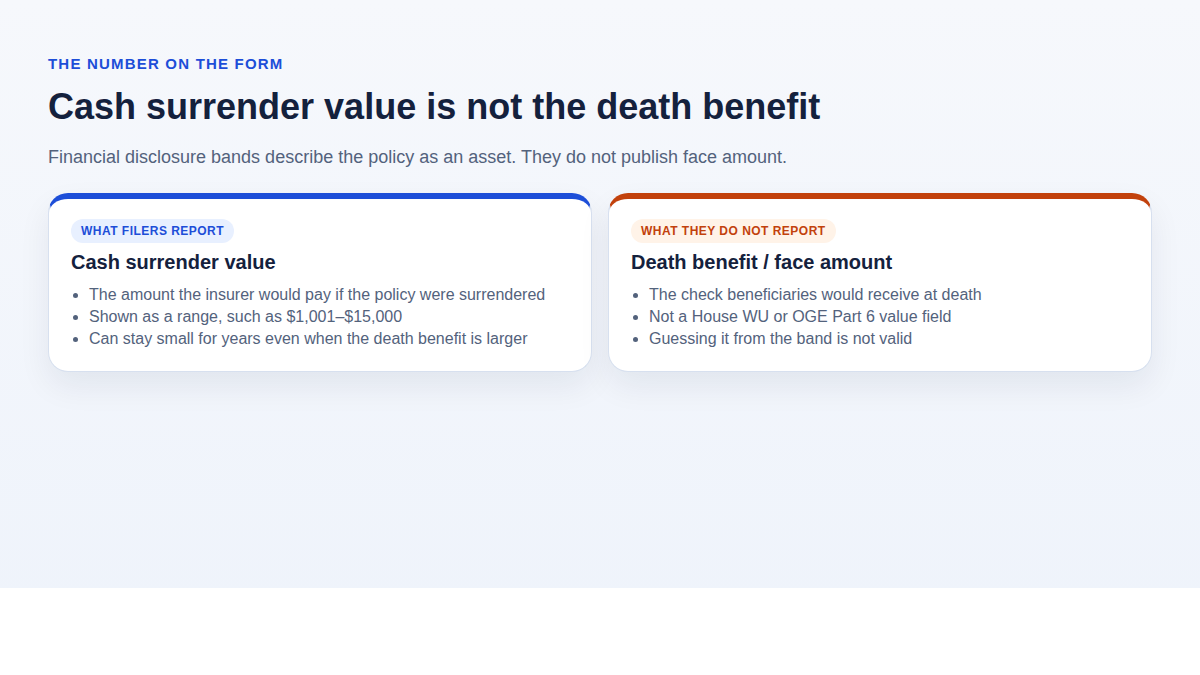 The number on a disclosure is an asset band for the policy's cash value. It is not the check a beneficiary would receive.
The most common misreading of a filing like this is to treat the dollar ranges as the amount of insurance. They are not.
For financial disclosure, the U.S. Office of Government Ethics says the value of a whole, universal, or variable life policy is its cash surrender value, not its face value (OGE FAQs). Cash surrender value is roughly what the owner would get by cancelling the policy today. The death benefit, the amount paid when the insured person dies, is usually much larger, and the form does not ask for it.
So the table tells you:
- Which insurers and which product types. Northwestern Mutual whole life, National Life universal life, AIG universal life.
- Roughly how much cash value each policy had built. In the government's standard reporting bands, not exact figures.
- How the policies were owned. Two directly, three through irrevocable trusts.
- What the policies earned during the period. Dividends on the whole life policies, interest credited on the universal life policies, again in bands.
It does not tell you the death benefit, the premium, when each policy was bought, or whether there was other coverage the form does not cover. Anyone who quotes a face amount for these policies from this filing is guessing.
Why term life would never appear on the form
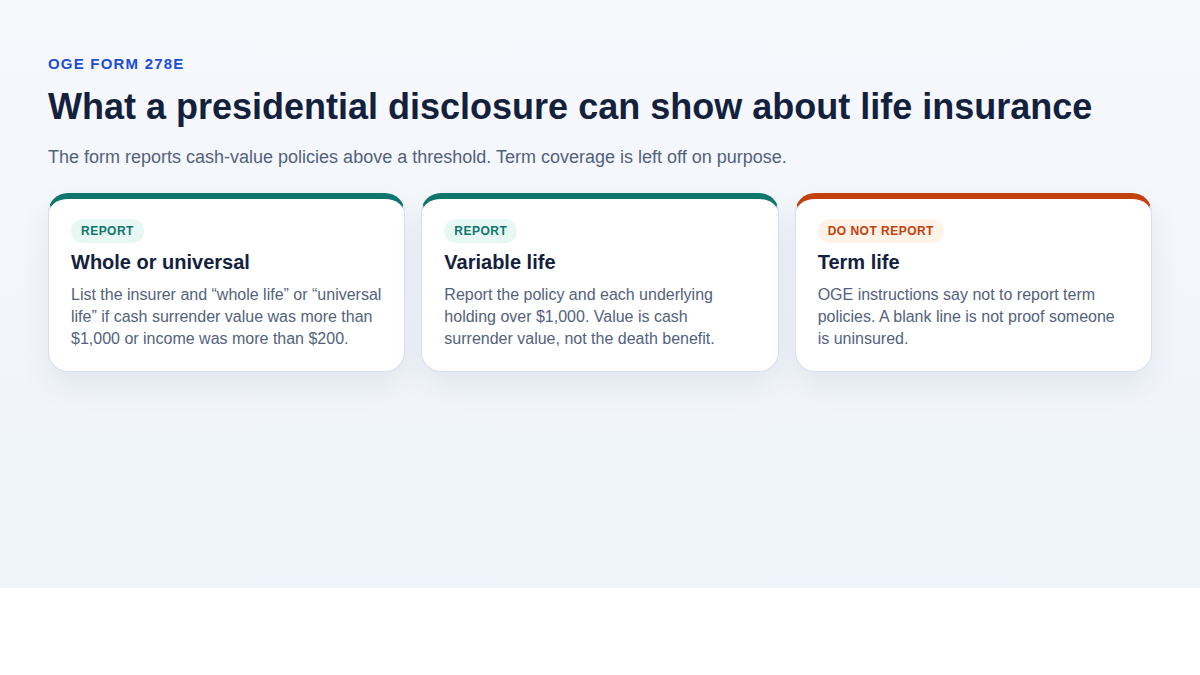
The OGE Public Financial Disclosure Guide is direct about it: do not report a term life insurance policy that belongs to the filer, a spouse, or a dependent child. The same guide says to report a whole life or universal life policy when its value was more than $1,000 at the end of the reporting period or it produced more than $200 of income, and to describe it by insurer name and "whole life" or "universal life."
The logic is that term coverage is pure protection for a set number of years. It has no cash value, so there is no asset to list. Whole and universal life are part insurance and part asset, which is why they show up next to bank accounts and funds.
That is also why a filing cannot prove anyone is uninsured, and why it cannot show the full picture of anyone's coverage. A filer can hold any amount of term life, or group coverage through an employer, and the disclosure stays silent about it. The only thing the 2016 list proves is the permanent coverage that crossed the reporting threshold.
Why three of the policies sit in irrevocable trusts
The detail on this filing most worth understanding is not the insurers. It is that the three largest policies are each owned by an irrevocable life insurance trust, often shortened to ILIT.
An ILIT is a trust created to own life insurance. Once a policy is inside it, the person who set it up no longer owns the policy, and "irrevocable" means they cannot simply take it back. As Money put it in its review of the Clintons' estate planning, placing the policies in the trusts takes the death benefits out of their estate, so that money does not count toward their estate tax exemption.
For a family with a large estate, that can matter more than which carrier wrote the policy. The tradeoff is control: once the trust owns the policy, the person who set it up can no longer change it or cash it in the way an owner could.
This is the part of the 2016 list that translates to ordinary planning. You do not need a presidential campaign to face the question of who should own a large permanent policy. The answer depends on the size of the estate, state law, and family goals, which is why it belongs with an estate planning attorney, not a blog post. For a broader look at how permanent coverage fits into estate plans, see whole life insurance in estate planning.
Whole life and universal life side by side
The filing happens to show both main kinds of permanent coverage in one household, which makes it a useful comparison.
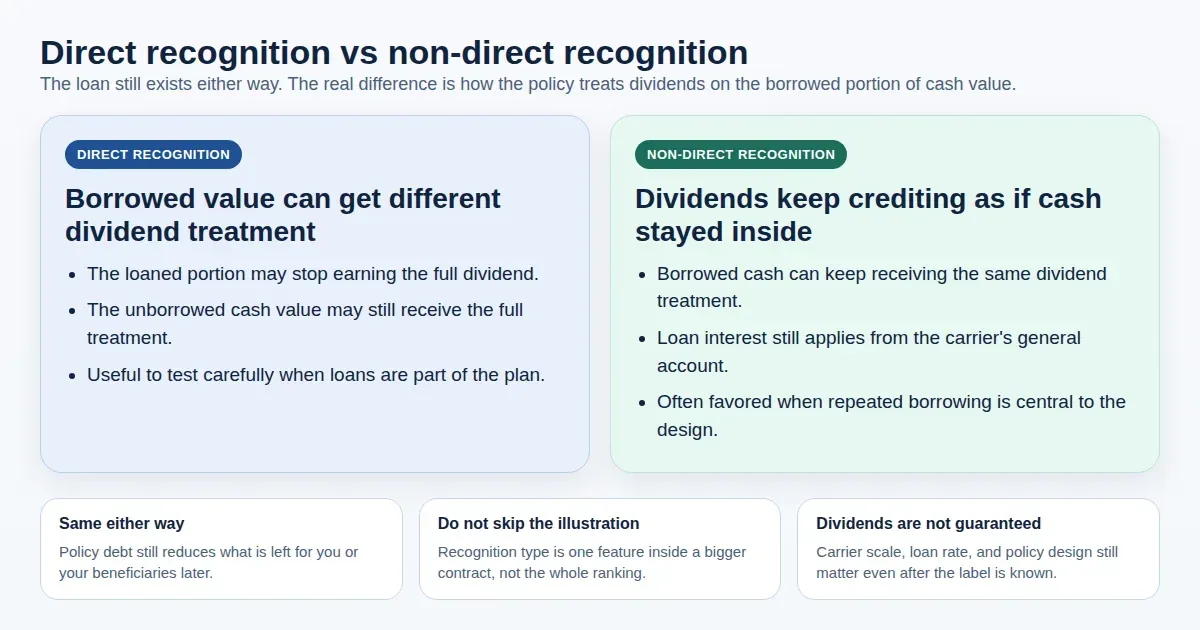
- Whole life (the two Northwestern Mutual policies) is built around a fixed premium and guaranteed cash value growth, and some whole life policies pay dividends. The two Northwestern Mutual lines on the filing show dividend income.
- Universal life (the National Life and AIG policies) lets the owner adjust premiums and the death benefit within limits. Cash value grows with credited interest, which is why those lines show interest rather than dividends.
On this filing, the flexible universal life policies are the large ones held in trusts, and the whole life policies are the smaller ones held directly. That is a pattern, not a rule; plenty of families hold whole life in an ILIT. If you are weighing the two product types for yourself, start with what whole life insurance is and then compare it with universal life in five key differences between whole life and universal life.
Reading any politician's disclosure the same way
The same rules apply to every filer who uses this form, so the same questions work on any official's or candidate's report:
- Find the life insurance lines. They are listed as assets with the insurer's name and "whole life," "universal life," or "variable life."
- Read the value as cash surrender value. Not the death benefit.
- Check who owns each policy. The filer, a spouse, or a trust. A trust name usually signals estate planning.
- Treat a missing line carefully. No life insurance on the form can mean term coverage, coverage below the threshold, or no coverage at all. The form cannot tell you which.
For a walkthrough of the form itself, see how financial disclosures report life insurance. For other named officials, see what filings show about politicians' life insurance, and for the most-asked comparison, what Donald Trump's disclosure shows.
What this means if you are shopping for coverage
The 2016 filing is a picture of one wealthy household's planning, not a recommendation. What carries over to an ordinary family is the set of questions behind it:
- What is the coverage for? Income replacement for a set number of years is a term question. Lifelong coverage, estate liquidity, or a cash value asset is a permanent-coverage question.
- Who should own the policy? Owning it yourself is simple and keeps control. A trust can keep the benefit out of a taxable estate but gives up control. For deaths in 2026, the IRS lists a basic exclusion amount of $15,000,000, so federal estate tax is not the deciding factor for most households. Whether a trust still makes sense is a question for an estate planning attorney, not a template.
- Whole life or universal life? Whole life trades flexibility for guarantees. Universal life trades some guarantees for flexibility. Neither is better for everyone.
If you want to see what permanent coverage would cost for your age and health, an independent agent can quote several carriers side by side. That is a conversation about your situation, not about anyone's filing.
This article summarizes a public financial disclosure filed in 2016 and later public reporting on it. Holdings may have changed since. It is general education, not tax, legal, estate, or insurance advice. Confirm details with the official filing and with licensed professionals before acting.