
Final Expense Whole Life Insurance (2026): 12 Questions Answered

Updated October 17, 2026
Final expense whole life insurance is a small whole life policy. A life insurer pays a cash death benefit to the person you name. That person can use the money for a funeral, unpaid bills, or other costs. It is not a contract with one funeral home.
As of October 17, 2026, a figure two sources share is labeled once. Where they disagree, each source’s own number is shown with the document and date. Nothing here is an average of sources that do not match.
Face amounts and who sells it
Life insurance companies sell final expense whole life. Two published plans, checked October 17, 2026, show the spread. They do not share one face-amount range, so this page does not invent a single “typical” amount.
Gerber Life Guaranteed Life is whole life meant for final expenses. Gerber Life’s 2024 Guaranteed Life brochure (form GL-AM 0424, © 2024) lists issue ages 50 to 80 (50 to 75 in New York), face amounts $5,000 to $25,000, no health questions, and acceptance that does not depend on health. It is not issued in Montana, and the maximum face amount is $15,000 in South Dakota. Premiums do not increase while the policy stays in force. Checked October 17, 2026. An older 2015 overview is not used for these figures.
United of Omaha Life Insurance Company, a Mutual of Omaha company, sells Living Promise whole life for final expenses. Its client highlight sheet lists:
- Level benefit: issue ages 45 to 85, face amounts $2,000 to $50,000 ($5,000 to $50,000 in Washington)
- Graded benefit: issue ages 45 to 80, face amounts $2,000 to $20,000 ($5,000 to $20,000 in Washington)
The same sheet says United of Omaha is licensed in all states except New York. Both carriers say the contract can differ by state. Confirm the form you are offered. An agent portfolio is not used for these figures.
Simplified issue and guaranteed issue
Simplified issue asks health questions and does not require an exam. The South Carolina Department of Insurance says ads for “no physical exam” usually still include a few health questions. Living Promise’s highlight sheet says there is no medical exam and that coverage is based on answers to a few health questions.
Guaranteed issue asks no health questions. South Carolina’s department says the insurer balances that risk with higher premiums or a smaller face amount, and that the policy may return only the premiums if death occurs in the first couple of years. The Virginia Bureau of Insurance life insurance guide says these plans ask no medical questions, and that limits often apply if death occurs in the first two or three years.
Graded death benefit in the first two years
On the two graded products above, the early-year rule is more specific, and both contracts describe the same structure. As of October 17, 2026:
- If the death in the first two policy years is not an accident, the beneficiary receives premiums plus 10 percent, not the full face amount.
- An accidental death pays the full face amount.
- After two years, the full face amount is paid.
Gerber Life’s 2024 brochure calculates that 10 percent on earned premium. Living Promise’s sheet says all premiums paid plus 10 percent. Read the contract you are issued. Virginia’s guide still describes the guaranteed-issue window more broadly as two or three years, so this two-year pattern is these two products, not every policy on the market.
Suicide limits are not the same sentence in both contracts. Gerber Life’s 2024 brochure pays the premiums plus 10 percent interest if death is by suicide within two years, or any shorter period state law requires. Living Promise’s highlight sheet returns the premiums, minus any loan, for suicide within two years (one year in North Dakota). Read the policy.
People comparing a larger permanent policy, or a senior-branded plan, can read life insurance for seniors and the AARP life insurance review. This page does not restate those prices.
Monthly premiums by age
These are example quotes, not the premium an applicant will be offered. Each figure names the age, sex, health class, and face amount, plus the document and date. Checked October 17, 2026. Where two sources print different numbers, each number is shown on its own. They are not averaged.
Gerber Life’s 2015 product overview is not used. It is older than the brochure below, and its monthly grid does not match that brochure. The Gerber quotes in this section are only from the 2024 brochure.
Gerber Life Guaranteed Life, form GL-AM (0424)
Source: Gerber Life Guaranteed Life brochure, form GL-AM (0424), © 2024. Monthly rates include the automated clearing house (ACH) bank-draft discount. Health class: guaranteed issue, no health questions, acceptance regardless of health. The brochure prints ages 50, 60, 70, and 80 only. It does not print an age-65 rate. The maximum face amount is $15,000 in South Dakota, so the $20,000 and $25,000 columns do not apply there. In New York the maximum issue age is 75, so the age-80 row does not apply. The policy is not issued in Montana.
| Age | Sex | $5,000 | $7,000 | $10,000 | $15,000 | $20,000 | $25,000 |
|---|---|---|---|---|---|---|---|
| 50 | Male | $22.50 | $31.14 | $44.09 | $65.68 | $87.27 | $108.86 |
| 50 | Female | $17.69 | $24.40 | $34.47 | $51.24 | $68.02 | $84.79 |
| 60 | Male | $32.40 | $45.00 | $63.89 | $95.38 | $126.87 | $158.36 |
| 60 | Female | $25.99 | $36.02 | $51.06 | $76.13 | $101.20 | $126.27 |
| 70 | Male | $50.05 | $69.70 | $99.18 | $148.32 | $197.45 | $246.59 |
| 70 | Female | $38.23 | $53.15 | $75.53 | $112.84 | $150.15 | $187.46 |
| 80 | Male | $124.12 | $173.40 | $247.32 | $370.52 | $493.72 | $616.92 |
| 80 | Female | $88.64 | $123.73 | $176.37 | $264.09 | $351.82 | $439.55 |
Other published $10,000 quotes
The roundups below do not match Gerber’s brochure or each other. Each column is that source’s own figure for a $10,000 policy. Living Promise monthly rates that appear only on a carrier illustration, rate card, or agent portfolio are not printed.
MoneyGeek market average. Nonsmoker, average health. This is an average of many quotes, not one carrier’s contract. MoneyGeek, updated September 22, 2026. Its baseline is a 50-year-old nonsmoker in average health unless a section says otherwise.
| Age | MoneyGeek female | MoneyGeek male |
|---|---|---|
| 50 | $30 | $38 |
| 55 | $36 | $46 |
| 60 | $42 | $53 |
| 65 | $50 | $66 |
| 70 | $64 | $84 |
| 75 | $87 | $113 |
| 80 | $125 | $164 |
Colonial Penn guaranteed acceptance. Female only in this source. No health questions. Built from $9.95 units. Asurgo, updated June 2, 2026, using the colonialpenn.com quote tool captured March 2026. This source does not print a male Colonial Penn premium, so none is shown. At age 80, 15 units is the maximum and buys about $9,120, not $10,000. The $149.25 figure is that 15-unit maximum, not a $10,000 policy.
| Age | Colonial Penn female |
|---|---|
| 50 | $49.75 (5 units) |
| 55 | not in this source |
| 60 | $69.65 (7 units) |
| 65 | $79.60 (8 units) |
| 70 | $99.50 (10 units) |
| 75 | $139.30 (14 units) |
| 80 | $149.25 (about $9,120, not $10,000) |
For a $10,000 policy at age 65, checked October 17, 2026, a woman pays $50–$79.60 across MoneyGeek’s nonsmoker average (updated September 22, 2026, $50) and Colonial Penn guaranteed acceptance (Asurgo, updated June 2, 2026, $79.60). MoneyGeek’s figure for a man at the same age and face amount is $66. Gerber’s 2024 brochure does not publish age 65.
MoneyGeek’s company row for a 50-year-old and $10,000 rounds Gerber Life to $34 for a woman and $44 for a man (nonsmoker, average health). The 2024 brochure’s ACH rates at that age and face amount are $34.47 and $44.09. Those two pairs are labeled separately. They are not averaged.
What you pay still depends on your age, the face amount, tobacco use, health answers, state, and whether the benefit is level or graded. Compare a current quote on whole life insurance quotes online.
How final expense differs from burial and pre-need plans
Burial insurance is a name insurers use for this same small whole life product. TruStage’s April 30, 2026 explainer calls final expense insurance burial insurance and funeral insurance. It says the coverage is built like whole life: you pay a set premium for life, and the beneficiary receives a cash lump sum that can pay for a funeral or for other bills. Gerber Life’s 2024 brochure describes its guaranteed plan the same way, as whole life for final expenses.
A pre-need plan (also called a prepaid funeral) is a different contract. TruStage and Lincoln Heritage Funeral Advantage (page updated May 19, 2026) agree on the split:
- Final expense is bought from a life insurance company. The benefit is paid to your beneficiary, who decides how to spend it, including at any funeral home.
- A pre-need plan is arranged with a specific funeral home for services you pick in advance. The benefit is paid to that funeral home, not to your family to spend as they choose.
The FTC Funeral Rule applies to pre-need arrangements and to arrangements made after a death. The funeral provider has to give a General Price List. If the prepaid plan did not lock the prices, survivors can be asked to pay the difference, and they must receive price lists if they change the plan or owe more. The FTC’s Paying Final Respects guide also says some states require the funeral home to place prepayments in a trust or to buy a life insurance policy with the death benefit assigned to the funeral home.
Funeral Advantage prints funeral-cost and face-amount figures that do not match the sources in the next section or the two carrier ranges above. Those figures are not used here.

Funeral costs used on this page
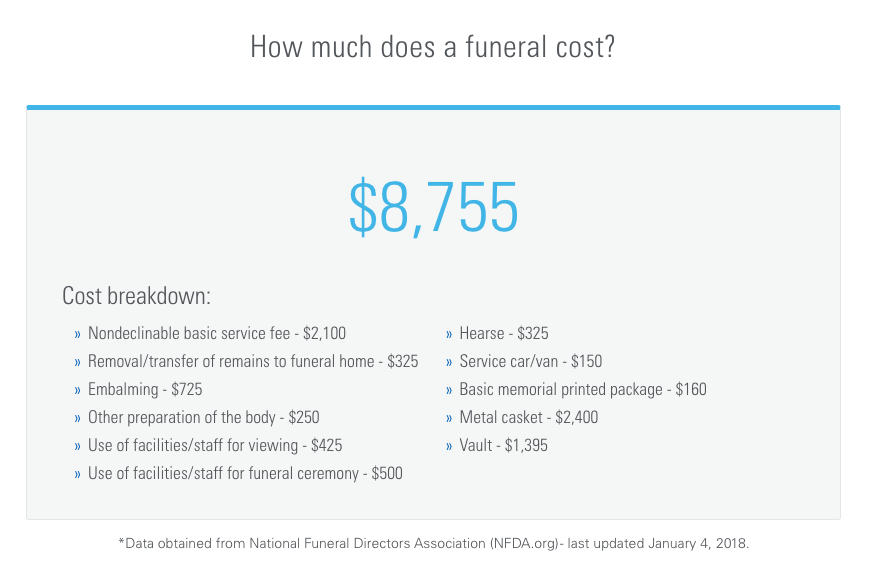
As of October 17, 2026, the latest national medians the National Funeral Directors Association still publishes are from its 2023 General Price List study. NFDA’s statistics page (data last updated September 29, 2025) and the 2023 study release both state:
- $8,300 median for a funeral with viewing and burial
- $6,280 median for a funeral with cremation
MarketWatch’s 2026 funeral-cost guide reports those same two medians. The study leaves out the cemetery plot, the grave marker, and cash-advance items such as flowers or an obituary. NFDA’s study and MarketWatch both list a vault median of $1,695, and both keep that vault outside the $8,300 figure.
NFDA’s 2025 reports update cremation and burial rates, not these price medians. There is no newer NFDA national price list as of October 17, 2026.
Social Security’s one-time lump-sum death payment is $255. SSA’s lump-sum page and 20 CFR § 404.390 both set that amount, for an eligible widow or widower who lived in the same household or, if no such spouse survives, for certain children. It does not pay for an $8,300 funeral.
Life insurance death benefits paid because the insured died are generally left out of the beneficiary’s gross income under 26 U.S.C. § 101(a)(1), except where the statute says otherwise, including a transfer for value. Living Promise’s highlight sheet cites the same section and the same exception. That is not tax advice for your return.
12 questions about final expense whole life insurance
- What is final expense whole life insurance?
- What final expenses should I plan for?
- How much final expense coverage do I need?
- What will a final expense policy cost?
- When should I buy final expense life insurance?
- Will my final expense premiums change?
- How long does a final expense policy last?
- Do I qualify for a final expense policy?
- How do I apply for a final expense policy?
- How is final expense different from larger whole life?
- Can I buy final expense life insurance online?
- Where do I compare final expense quotes?
1) What is final expense whole life insurance?
Final expense whole life insurance is a small whole life policy that pays a cash death benefit to the beneficiary you name. Insurers also call it burial insurance or funeral insurance. TruStage’s April 30, 2026 explainer and Gerber Life’s 2024 Guaranteed Life brochure both describe it that way: permanent coverage sized for funeral costs and other bills, not a contract that locks you to one funeral home.
2) What final expenses should I plan for?
Plan for the costs that show up soon after a death, plus any small debts you do not want left behind:
- A funeral or memorial, including viewing
- Burial or cremation, and a cemetery plot or marker if you want one
- Medical bills that are still unpaid
- Credit cards or other small debts
As of October 17, 2026, NFDA’s latest published national medians are $8,300 for a funeral with viewing and burial and $6,280 for a funeral with cremation. Those figures leave out the plot, the marker, flowers, and an obituary. A vault is a separate $1,695 median. Social Security’s lump-sum death payment is $255, and only for an eligible spouse who lived in the same household or, if none, certain children. It does not cover the funeral.
Income replacement, education, or a large inheritance needs more coverage than these small face amounts. See life insurance for seniors if that is the goal.
3) How much final expense coverage do I need?
Start with the funeral you actually want, then add debts and a cushion. The $8,300 burial median is a floor for the funeral-home portion only. It is not a recommended face amount.
Published plans do not share one maximum. Gerber Life’s guaranteed plan lists $5,000 to $25,000. Living Promise’s highlight sheet lists $2,000 to $50,000 on the level plan and $2,000 to $20,000 on the graded plan, with a $5,000 minimum in Washington. Pick a face amount from the policy you qualify for, not from an average of those ranges.
4) What will a final expense policy cost?
There is no single monthly price. The monthly premiums by age section prints example quotes with the age, sex, health class, and face amount on each figure.
Gerber Life’s 2024 brochure (form GL-AM 0424) is the Gerber source used here. Its grid is guaranteed issue, includes the ACH bank-draft discount, and covers ages 50, 60, 70, and 80. It does not print age 65. A 2015 Gerber overview is not used.
For a $10,000 policy at age 65, checked October 17, 2026, a woman pays $50–$79.60 across MoneyGeek’s nonsmoker average (updated September 22, 2026) and Colonial Penn guaranteed acceptance (Asurgo, updated June 2, 2026). MoneyGeek’s figure for a man is $66. Those sources are labeled separately in the table. Compare a current quote on whole life insurance quotes online.
5) When should I buy final expense life insurance?
Buy when you know you want the coverage. Virginia’s life insurance guide says a whole life premium is based on your age when you buy, and that buying younger generally means a lower premium.
The two plans cited here do not share one issue-age window. Gerber Life’s 2024 brochure lists ages 50 to 80 (50 to 75 in New York). Living Promise’s highlight sheet lists 45 to 85 on the level plan and 45 to 80 on the graded plan, and says United of Omaha is not licensed in New York. Availability outside those ages depends on the carrier and the state.
6) Will my final expense premiums change?
On ordinary whole life, Virginia’s guide says the premium is set from the age at purchase and that amount generally does not go up. Living Promise’s highlight sheet says premiums never increase, and the policy cannot be canceled as long as premiums are paid. TruStage describes final expense the same way: a set premium for life.
Virginia’s guide also describes modified-premium and graded-premium whole life, where the premium steps up on a schedule. Those are different designs. Read the policy before you assume the draft you were shown stays flat.
7) How long does a final expense policy last?
It is permanent coverage. Virginia’s guide says permanent insurance stays in force for the insured’s lifetime as long as premiums are paid when due. Living Promise’s highlight sheet says the policy is kept to age 100 (120 in Florida) if premiums are paid, and that the face amount is then paid less any outstanding loan and loan interest. Missed premiums can lapse the policy. The contract controls.
8) Do I qualify for a final expense policy?
You usually see two paths on these small whole life plans.
- Simplified issue: a few health questions and typically no exam. Living Promise is sold this way. Its graded plan does not pay the full face amount for a natural death in the first two years.
- Guaranteed issue: no health questions. Gerber Life’s Guaranteed Life plan is sold this way, with the two-year graded limit described above. State insurance guides warn that the premium is higher or the face amount is smaller, and that an early death may return premiums instead of the full benefit.
A decline on one application is not a decline everywhere. The health questions, if any, still have to be answered accurately.
9) How do I apply for a final expense policy?
Compare a current quote first on whole life insurance quotes online. The application then goes to the insurer that issues the policy.
On the simplified-issue and guaranteed-issue plans described above, there is no medical exam. Simplified issue still asks health questions. Guaranteed issue does not. If a different product requires an exam, the insurer will schedule it. This page does not set up a phone appointment.
10) How is final expense different from larger whole life?
Final expense is whole life. The difference is size and purpose, not a separate product category.
- Final expense whole life uses the small face amounts above and is aimed at funeral costs and other last bills.
- Larger whole life can insure a much higher face amount and is often shopped for cash value as well as a death benefit that stays in force.
The final-expense plans cited here do build cash value. Gerber Life’s 2024 brochure (form GL-AM 0424, footnote 7) says the cash value is guaranteed if premiums are paid on time, and that a policy loan reduces the cash value and the death benefit. That brochure states a policy loan interest rate of 8%. Living Promise’s highlight sheet says the policy builds cash value you may borrow against. A loan reduces what the beneficiary receives if it is still outstanding at death.
11) Can I buy final expense life insurance online?
You can compare plans and complete an application online. You can also research senior-branded options, including the AARP life insurance review, and then decide on the quote page.
Buying online does not change the contract. The graded period, the face amount, and the premium are whatever that policy form says.
12) Where do I compare final expense quotes?
Use whole life insurance quotes online to compare a current quote for your age and face amount. The premium tables above are example quotes with the age, sex, health class, face amount, document, and date on each figure. They are not the price you will be offered. This page does not promise a call.
Bottom line
Final expense whole life insurance is small whole life from a life insurer. The beneficiary gets cash and chooses how to use it. A pre-need plan is a funeral-home contract. Guaranteed-issue versions often limit the death benefit in the early years. Living Promise’s graded plan does too, for a natural death in the first two years. As of October 17, 2026, published face amounts on the two plans checked here run from $2,000 up to $25,000 or $50,000 depending on the plan, with a $5,000 Living Promise minimum in Washington. For a $10,000 policy at age 65, a woman pays $50–$79.60 across the MoneyGeek and Colonial Penn sources labeled above. Gerber’s own example quotes are the 2024 brochure grid, not a blended rate.