Retirement Planning With Whole Life Cash Value (2026)

Updated November 9, 2026.
Permanent whole life can hold cash value that a policyholder may borrow against. This page is about that retirement-liquidity use. It does not price a policy. Sample monthly premiums for $1 million of whole life are on the cost guide. None of those premiums are repeated here.
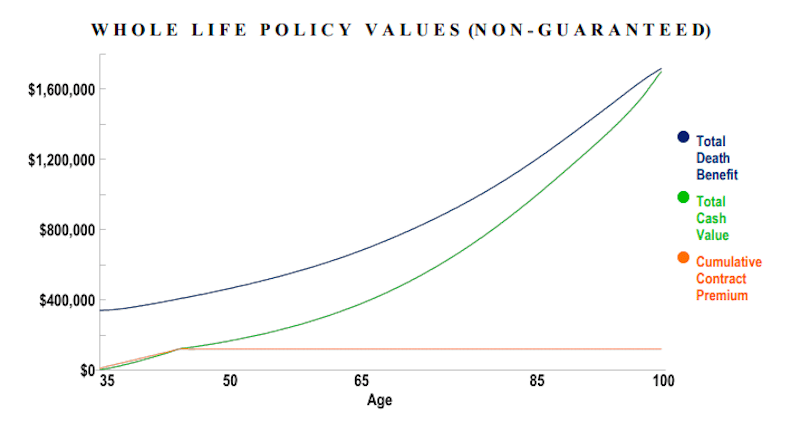
Whole life is first a death benefit. The National Association of Insurance Commissioners says the cash value builds from premiums minus fees and insurance costs, grows without being taxed, and may be borrowed against. Designs that push cash value earlier, including ideas sold as infinite banking, still depend on premiums being paid. Cash value is not a retirement paycheck, and this page does not promise one.
Using cash value in retirement
Participating whole life builds cash value on a schedule in the contract. The NAIC says a participating policy may pay dividends based on the insurer's results. Dividends are not quoted on this page.
Common uses people ask about:
- Policy loans. The NAIC says a policyholder may borrow against cash value. Any interest, and what an unpaid loan does to the death benefit, is in that contract. This page does not quote a loan rate.
- Surrender for cash. The IRS senior-taxpayer FAQ, last reviewed September 23, 2026, says that if you surrender a life insurance policy for cash, you must include in income any proceeds that are more than the cost of the policy. In general, that cost is the premiums you paid, minus refunded premiums, rebates, dividends, or loans you did not repay and did not already include in income. The insurer reports the gross proceeds and the taxable part on Form 1099-R.
- A stream of loans or surrenders in later years. Some illustrations show that pattern and a remaining death benefit. An illustration is not the guaranteed column. Read the guaranteed values separately from any dividend or interest assumption.
None of these replaces Social Security, a pension, or other retirement accounts. They are features inside a permanent policy, available only while the contract stays in force.
Infinite banking, described without a price
Infinite banking is a way of designing whole life so cash value is available to borrow. Descriptions of the idea include holding cash for a later expense, bridging a gap before other accounts are used, and recapitalizing after a business sale. Those are descriptions of the idea. They are not a finding that the design will outperform other savings.
The tradeoffs are the ones the contract creates: the premium has to be paid, a loan follows the contract's terms, and dividends may or may not be paid. Opportunity cost versus other uses of the same dollars is the buyer's comparison. This page does not run that comparison, and it does not publish a $1 million premium for the design.
Death benefit versus living use
If the goal is a legacy, borrowing reduces what is left to talk about in the death benefit. The contract, not this page, states the reduction. If the goal is access to cash value while the insured is alive, the design has to build that value early enough to use, and the premium still has to be affordable in the years before retirement.
A face amount aimed at estate liquidity at a much larger size is a different problem. See $100 million life insurance for high-net-worth families. That page is not a premium table for $1 million.
Carrier and design
Loan provisions and cash value schedules differ by company. A starting list of mutual carriers is the top 7 whole life companies for cash value. Compare the guaranteed column of an illustration with the non-guaranteed column. This page does not declare a winner and does not quote a dividend rate.
What to do next
Get a whole life quote when you want an illustration. The quote form's coverage menu lists amounts through $1,000,000. Say whether the priority is cash-value access, a death benefit, or both. Bring policies you already own. The illustration is not a retirement-income guarantee, and it is not the sample premium table on the cost guide.
Frequently asked questions
Does this page show what a $1 million whole life policy costs?
No. The sample monthly premiums live on the cost guide. This page does not repeat them. Retirement use of cash value and the price of a $1 million policy are different questions.
Is cash value the same as retirement income?
No. The NAIC describes cash value as an amount inside a whole life policy that grows without being taxed and that the policyholder may borrow against. A surrender above the cost of the policy is income under the IRS FAQ cited above. Neither rule is a paycheck.
Are policy loans a quoted interest rate on this page?
No. The NAIC says you may borrow against cash value. The rate and the effect on the death benefit are in the contract you are shown. This page does not print a rate.