Whole Life Insurance Cash Value Calculator: How to Use It (and What It Can't Show)

Looking for a whole life insurance cash value calculator? Start with the quote tool and sample premium tables on this page, then use the checklist below to read what those numbers mean—and what they do not mean—before you compare policies or fund a design for long-term cash value access.
This 2026 refresh is educational, not personalized insurance, tax, or investment advice. Dividends on participating whole life are not guaranteed. Past dividend scales are not a predictor of future results. For product recommendations tailored to you, work with a licensed agent and, when tax treatment matters, your tax advisor.
Related: Essential guide to whole life cash value · Dividend rate history · Top 7 companies for cash value
What a cash value calculator shows (and what it can't)
A cash value calculator—and the whole life quote form above—is useful for a first pass: ballpark premiums by age, gender, coverage amount, and health class, plus a sanity check against the sample monthly tables on this page.
It is not a substitute for:
- Your annual policy statement, carrier portal, or a phone ask for net cash surrender value and any loan balance (the numbers of record on an in-force policy)
- A carrier-certified illustration prepared for your age, underwriting class, state, riders, and premium schedule after underwriting
- A guarantee that illustrated non-guaranteed values will be paid
Think of free tools as showing the shape of a design (premium outlay vs access over time). Carrier pricing, dividend history, and contract rules set the real coordinates. For plain-language definitions of how cash value builds, use the essential cash-value guide linked above as the companion to this calculator page.
If you only need a quick premium comparison, our whole life insurance cost calculator is the sibling page built around quoting cost first. This URL owns cash-value analysis literacy—how to use calculator and illustration outputs without treating them as promises.
Inputs checklist before you trust any estimate
Whether you use the form above or a projection-style calculator elsewhere, get these inputs right. One wrong assumption can make a pretty chart useless.
- Age, gender, and tobacco / health class — Whole life premiums are underwriting-sensitive. Preferred non-tobacco sample tables are not “your” rate if you are standard, tobacco, or rated.
- Death benefit (face amount) — The coverage you want the policy to pay at death (before loans or withdrawals reduce it).
- Premium amount and schedule — Monthly vs annual; level pay-to-100 vs limited-pay; how many years you can actually fund.
- Riders — Term riders, waiver, long-term care, or other add-ons change both premium and early cash value.
- Participating vs non-participating — Participating policies may pay dividends; non-participating designs do not rely on dividends the same way.
- Guaranteed rate vs illustrated / current scale — Always run (or request) both columns when an illustration is available.
Coverage sizing tip: Some buyers use a common rule of thumb around 10–15× annual income when picking a face amount. Treat that as a starting conversation range, not a recommendation for your household.
Premium split and paid-up additions (why two “same premium” designs diverge)
Part of each premium typically supports the base whole life coverage. On many participating designs, another part can buy paid-up additions (PUAs)—small chunks of fully paid coverage that usually carry cash value earlier than base premium alone.
That premium split is one of the main reasons two people at the same age and annual outlay can see very different early cash values. A base-heavy design prioritizes death benefit efficiency; a PUA-heavy design (within tax and product limits) usually aims for earlier accessible cash value. Neither is “correct” in the abstract—the design has to match the job you want the policy to do.
Early policy years often look slow on purpose: issuance and insurance costs are front-loaded. That pattern alone is not proof a policy is “bad,” but it is why surrendering in the first few years is often expensive relative to premiums paid.
Guaranteed vs non-guaranteed columns
When you request a full illustration, look for at least:
| Column | What it means | How to use it |
|---|---|---|
| Guaranteed cash value | Contractual floor if the company credits only what it must under the contract assumptions shown | Your downside case for planning conversations |
| Non-guaranteed / current | Projection assuming a dividend or crediting scale similar to “today’s” illustrated scale | A scenario, not a promise—scales change |
| Cumulative premiums | What you have paid in to date | Compare against cash value and surrender value |
| Death benefit | What would pay if death occurred that year (before loan offsets, depending on design) | Recheck after loans, withdrawals, or PUAs |
Cash value and cash surrender value are not always the same early on. Surrender charges, outstanding loans, and unpaid loan interest can make the amount you would walk away with lower than the account value on the statement. When a decision is real (borrow, withdraw, or surrender), ask for the net cash surrender value.
For historical context on how mutual carriers have published scales over time—not as a forecast—see the dividend rate history page linked above, then compare company positioning on the top-7 cash-value list in the related bar.
Loans vs withdrawals vs surrender
Lifetime access usually comes in three flavors. Details are contract-specific.
Policy loan. You borrow against cash value. Coverage can stay in force while a loan is outstanding, but interest accrues, and any unpaid loan balance typically reduces the death benefit. There is usually no consumer credit check the way a bank loan works—this is a contractual feature, not free money.
Withdrawal / partial surrender. You permanently remove value. The death benefit often drops. Tax treatment depends on basis, gain, and whether the contract is a modified endowment contract (MEC).
Full surrender. You end the policy and take the surrender value. You lose the death benefit and future cash-value growth. Early-year surrender charges may apply.
Tax note (educational only): Internal Revenue Code concepts in §7702 (life insurance definitional tests) and §7702A (modified endowment contracts) affect how aggressively a policy can be funded and how lifetime distributions may be taxed. Crossing MEC limits can change the playbook people wanted for loans and withdrawals. Do not treat this page as tax advice—confirm structure with a licensed professional and your tax advisor.
Using this page for “infinite banking calculator” questions
People searching for an infinite banking calculator are usually trying to pressure-test a high-cash-value whole life design: how much to fund, how early value appears, and how loans might interact with ongoing premiums. You do not need a separate calculator URL for that.
Use this page as the calculator owner:
- Run the whole life quote / premium tool above for a realistic outlay at your age and face amount.
- Ask for illustrations that show guaranteed and non-guaranteed values, plus loan scenarios if you expect to borrow.
- Stress-test premium split / PUA intent with your agent—IB-style designs are sensitive to how premium is allocated and to MEC limits.
- Read the concept companion infinite banking using whole life insurance cash value for strategy context—not as a return promise.
Infinite banking is a funding and behavior framework built on properly structured whole life, not a separate product class with guaranteed banking returns. If a pitch depends entirely on the non-guaranteed column, treat that as a red flag for diligence—not as proof the concept “doesn’t work.”
How to use the calculator and tables on this page
- Scan the sample tables for $250,000 and $1,000,000 illustrative monthly premiums by age and gender (preferred non-tobacco framing on the live tables). These are illustrative sanity checks, not offers of insurance.
- Enter your details in the quote form—age, gender, desired coverage, and health class. Accuracy matters more than optimism.
- Compare your quote to the sample range. A result far outside the table may reflect health class, tobacco, state, riders, or carrier mix—ask before assuming the tool is “wrong.”
- Request a full cash value illustration showing guaranteed and non-guaranteed values over time for the carriers you are seriously considering.
- Review access rules (loans, withdrawals, surrender) on the specimen contract and illustration footnotes.
- Talk with a licensed advisor about fit, affordability, and alternatives (including whether term plus separate savings is a better match for a pure death-benefit need).
Actual premiums vary by health class, tobacco use, state, and carrier. Use the form for personalized numbers rather than copying table cells into a budget spreadsheet as gospel.
Frequently asked questions
Is a whole life cash value calculator the same as my policy’s cash value?
No. Your statement, portal, or carrier service line reports in-force values. A calculator estimates or quotes based on assumptions. Use calculators to compare designs and premiums; use the carrier for today’s surrender value and loan balance.
Can I use this page instead of an infinite banking calculator?
Yes for a first pass. This URL absorbs that research intent: quote premiums here, then demand dual-column illustrations and a clear premium-split explanation. Pair with the infinite banking cash-value companion article linked above—do not expect a second calculator slug on this site for the same job.
Why do guaranteed and “current” cash values differ so much?
The guaranteed column is the contractual floor under the illustration’s guaranteed assumptions. The current / non-guaranteed column assumes a dividend or crediting scale that can change. The gap is normal; relying only on the optimistic column is not.
Do policy loans hurt cash value growth?
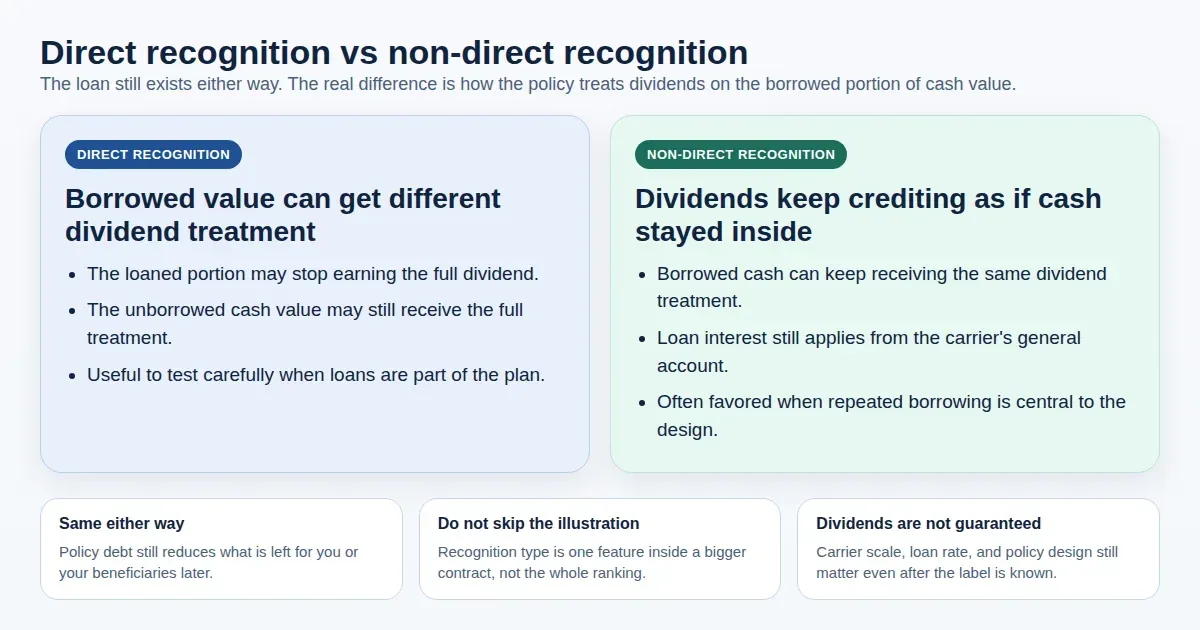
Mechanics vary by direct vs non-direct recognition and contract language. Practically: loans accrue interest, unpaid balances reduce death benefit, and some designs credit differently on borrowed vs unborrowed value. Model loans on an illustration rather than assuming “the money keeps growing the same either way.”
When should I stop using free calculators and talk to someone?
As soon as you are choosing a face amount, a funding schedule near MEC limits, a loan plan, or a replace/surrender decision. Free tools help you ask better questions; they do not underwrite you or bind coverage.
Ready for numbers that reflect your age and coverage target? Run a personalized whole life quote, compare the sample tables above, then request carrier illustrations before you fund or replace anything.
Educational content only. Not an offer of insurance. Product features, dividends, and tax treatment depend on the issuing company, your contract, and applicable law.